Harvest
Invoices
Sign up

Create Invoice for Saudi Arabia

Harvest provides robust invoicing tools that can assist in generating invoices efficiently, though specific regional compliance like Saudi Arabia's ZATCA requirements may need additional solutions.

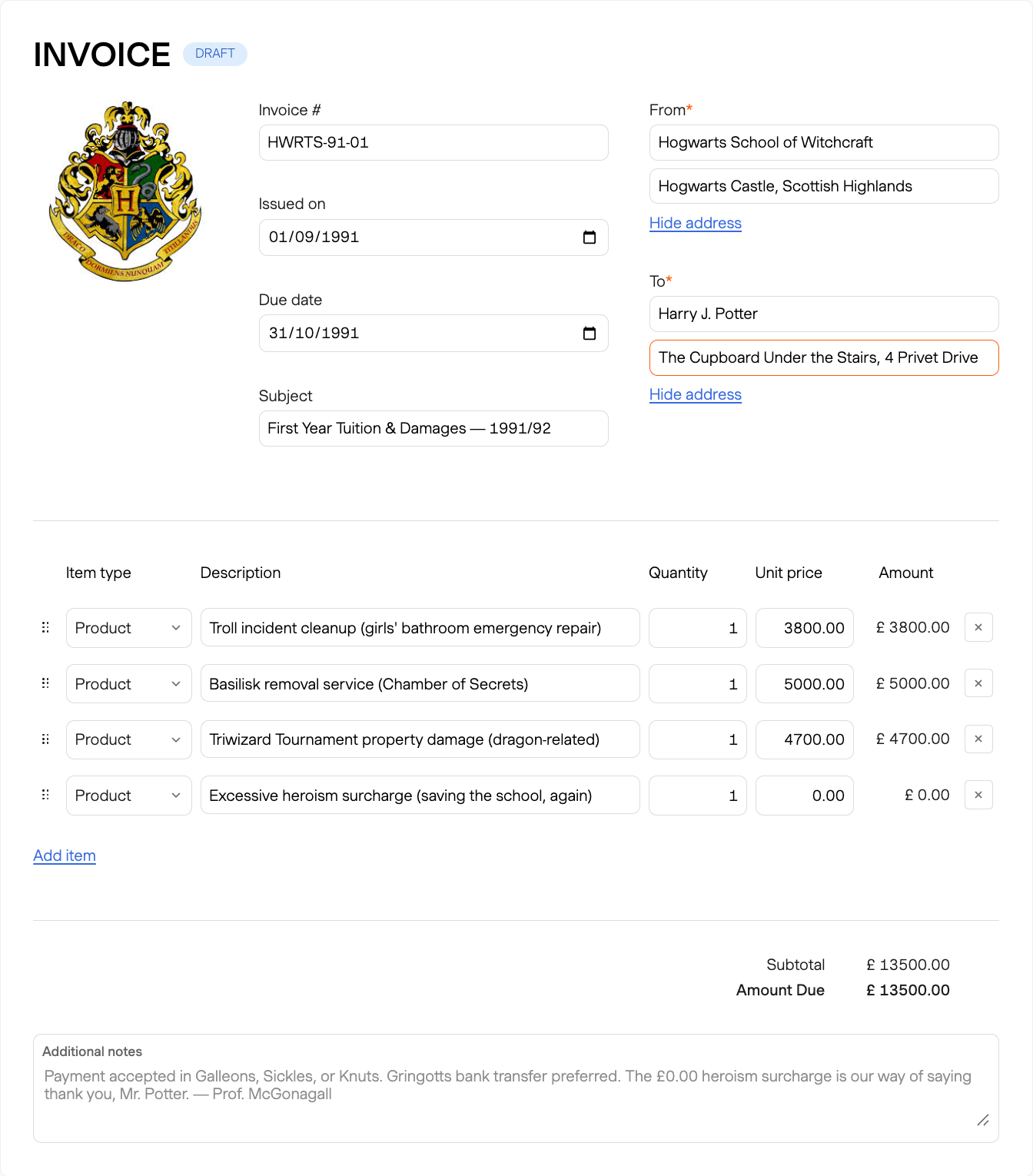
INVOICE DRAFT

Add your logo here
Item type
Description
Quantity
Unit price
Tax
Amount
Subtotal
$0.00
Discount
$0.00
Amount Due
$0.00
Get paid via:
Credit card / Debit card
ACH
Wire transfer

Customise invoice

Appearance

Add a logo
Show invoice title

Invoice settings

Tax Add up to 2 tax rates
%
Discount Apply a discount percentage
%

Key Features of a ZATCA-Compliant Invoice Generator

A ZATCA-compliant invoice generator must possess specific features to ensure adherence to Saudi Arabia's e-invoicing regulations. Essential capabilities include generating invoices in a structured XML format or a structured PDF (PDF/A-3 with embedded XML). A crucial element for compliance is the automatic generation of a QR code, which is mandatory for all simplified tax invoices in Phase 1 and for both simplified and standard tax invoices in Phase 2. This QR code must contain specific data such as the seller's name, VAT registration number, invoice timestamp, total VAT amount, and total invoice amount. Furthermore, the system should support Arabic language as the primary language for invoices, with the option to include other languages. For Phase 2, the generator must also support unique identifiers (UUIDs), cryptographic stamps, and secure digital signatures to ensure data integrity and authenticity.
How to Create a ZATCA-Compliant Invoice

Creating a ZATCA-compliant invoice involves a structured process to ensure all regulatory data elements are included and correctly formatted.

  • Select Compliant Software: Utilize an e-invoicing solution that is explicitly ZATCA-certified and meets technical and security guidelines.
  • Configure for Phase 1 Requirements: Ensure your system can generate invoices with mandatory fields such as the seller's name, VAT registration number, invoice date and time, item descriptions, unit price, VAT rate, VAT amount, and total invoice amount. For simplified tax invoices, a QR code must be included.
  • Complete Phase 2 Technical Integration: If your business falls under Phase 2, integrate your invoicing system with ZATCA's Fatoora platform via APIs. This phase requires generating a Universally Unique Identifier (UUID), creating and adding a digital signature, including a cryptographic stamp, and ensuring sequential numbering for each e-invoice.
  • Go Live and Maintain Compliance: Once approved, transmit all B2B invoices in real-time for clearance and report B2C invoices within 24 hours of issuance.

Common Pitfalls in ZATCA Invoice Generation

Businesses often encounter several common pitfalls when generating ZATCA-compliant invoices, leading to non-compliance and potential penalties. A significant mistake is using non-compliant or unregistered software that lacks the specific technical features required for ZATCA Phase 2, such as generating invoices in a secure XML format, creating cryptographic stamps, or integrating with the ZATCA platform. Another common error is mixing up invoice types, issuing a simplified tax invoice (B2C) to a business customer (B2B), which requires a standard tax invoice. Missing or incorrect mandatory data fields can also invalidate an invoice; even slight rounding errors in VAT amounts can lead to rejection. Furthermore, overlooking archiving rules is a pitfall, as ZATCA requires secure storage of the signed XML electronic file for up to six years, not just PDF copies. Penalties for non-compliance can range from SAR 1,000 to SAR 50,000 per violation.

Preview Your Saudi Invoice Template

See how your invoice appears with Arabic language support and QR code generation for ZATCA compliance in Saudi Arabia.

Create Invoice for Saudi Arabia FAQs

  • ZATCA e-invoicing requirements in Saudi Arabia include generating invoices in a structured XML format or a structured PDF with embedded XML. It is mandatory to include a QR code containing specific data like the seller's name, VAT registration number, invoice timestamp, total VAT amount, and total invoice amount. Additionally, invoices should support the Arabic language and integrate features such as unique identifiers, cryptographic stamps, and secure digital signatures for Phase 2 compliance.

  • While online invoice generators can facilitate many aspects of invoice creation, fully automating ZATCA compliance is challenging. Compliance requires specific technical and security features that may not be available in all online tools. Businesses should verify that their chosen tool meets all ZATCA requirements, especially for Phase 2 integration.

  • Yes, Harvest offers reporting features that allow users to analyze invoicing performance, track revenue trends, and assess time spent on projects. These insights can help businesses make informed decisions and improve overall efficiency.
  • QR codes for Saudi invoices can be generated using compliant invoicing software that automatically includes required data such as the seller's name, VAT registration number, invoice timestamp, total VAT amount, and total invoice amount. These QR codes are vital for simplified tax invoices and should be generated as per ZATCA guidelines.

  • Free tools for creating ZATCA-compliant invoices exist, but they may lack comprehensive features needed for full compliance, especially for Phase 2. Businesses should ensure that any free tool they consider meets ZATCA's technical and security standards and integrates with the necessary platforms.