Harvest
Invoices
Sign up

Download Invoice for Japan

Harvest offers flexible tax settings to accommodate various international tax requirements, including Japan's consumption tax. Customize your invoices effortlessly to meet Japanese standards.

INVOICE DRAFT

Add your logo here
Item type
Description
Quantity
Unit price
Tax
Amount
Subtotal
$0.00
Discount
$0.00
Amount Due
$0.00
Get paid via:
Credit card / Debit card
ACH
Wire transfer

Customise invoice

Appearance

Add a logo
Show invoice title

Invoice settings

Tax Add up to 2 tax rates
%
Discount Apply a discount percentage
%

Key Features of a Compliant Japanese Invoice Template

To ensure compliance with Japanese invoicing standards, especially under the Qualified Invoice System (QIS) effective October 1, 2023, your template must include specific details for businesses to claim input tax credits. A compliant invoice should clearly state:

  • The name and 13-character registration number of the qualified invoice issuer.
  • The transaction date.
  • Detailed transaction descriptions, explicitly noting any items subject to the reduced 8% consumption tax rate (e.g., food and beverages, excluding alcohol and dining out) versus the standard 10% rate.
  • The total amount of consideration for each tax rate (either tax-exclusive or tax-inclusive).
  • The consumption tax amount for each applicable tax rate, rounded once per tax rate per invoice.
  • The name of the invoice recipient.

While not legally mandatory, a company seal (hanko), particularly a square kakuin, is customarily used on sales invoices to convey a professional impression, though its legal necessity is diminishing.
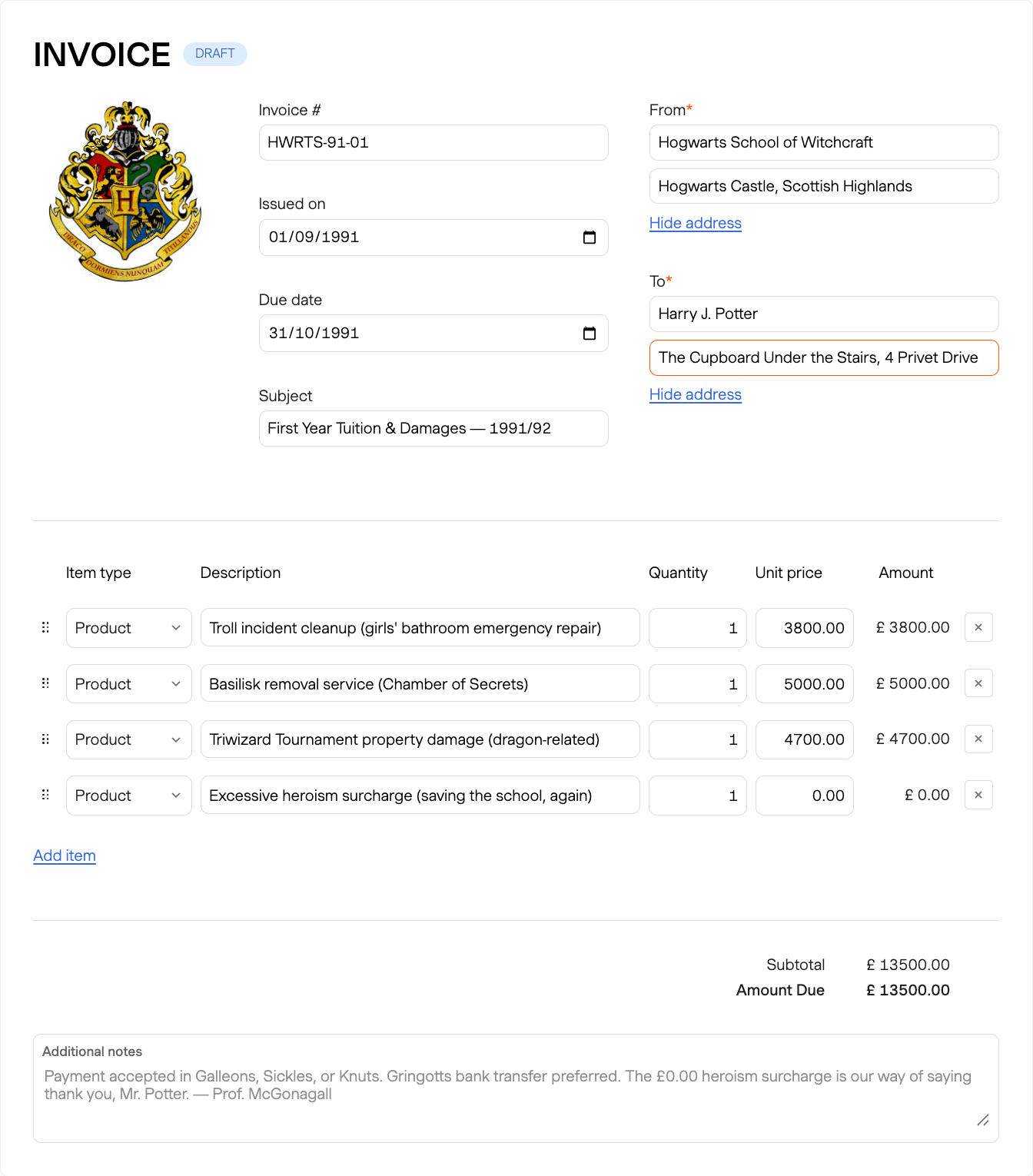
Customizing Your Invoice Template for Japanese Business Needs

Tailoring your invoice template for the Japanese market involves more than just compliance; it enhances professionalism and clarity. You can easily customize templates to include your business logo, typically placed in the top left corner, to brand your documents seamlessly. Beyond branding, consider these practical adjustments:

  • Line Items for B2B Transactions: For business-to-business (B2B) sales, ensure line items are highly detailed, specifying product names, unit prices, quantities, and subtotals, clearly differentiating between the 8% and 10% consumption tax rates.
  • International Shipments: When shipping internationally from Japan, the commercial invoice should be in English and include the receiver's contact information. Provide clear and accurate goods descriptions, avoiding vague terms like "samples" or "parts," and state the country of origin, especially if eligible for reduced tariffs under trade agreements. The JCT portion must be shown in JPY, even if the transaction currency is foreign.
  • Payment Details: Include comprehensive bank transfer information, such as bank name, code, branch name, account number, and account name (with phonetic reading if necessary), to prevent payment delays.

Common Pitfalls When Using Japanese Invoice Templates

Navigating Japanese invoicing requires attention to detail to avoid common errors that can impact tax credits and business relationships. A significant pitfall is mistakes in consumption tax calculation. Under the Qualified Invoice System, tax amounts must be rounded once per tax rate per invoice, not on a line-by-line basis, to ensure accuracy. Incorrect rounding can lead to discrepancies in input tax credits.

Another common error is omitting required details. Failing to include the issuer's 13-character Qualified Invoice Issuer (QII) registration number, transaction date, or clear breakdown of consumption tax by rate (8% or 10%) will render the invoice non-compliant for input tax credit claims.

Finally, incorrect formatting can cause issues. While there are no strict legal formatting requirements, clarity and ease of understanding are paramount. Ensure all necessary information is present and legible. Also, avoid using decimal points for yen amounts, as fractions less than one yen are typically rounded. For international invoices, ensure the JCT amount is converted and stated in JPY.

See Your Japanese Invoice Template in Action

Preview how your invoice will look with JPY currency, consumption tax rates, and detailed transaction descriptions for Japanese clients.

Download Invoice for Japan FAQs

  • Harvest allows you to include consumption tax on invoices by setting up applicable taxes in the invoice configuration settings. This feature ensures that your invoices meet the requirements for including consumption tax in Japan.

  • A Japanese invoice must include the issuer's name and registration number, transaction date, itemized transaction descriptions, and the breakdown of taxes at different rates. Additionally, while a company seal is often used, it is not legally required.

  • Yes, Harvest provides customer support through several channels, including email, a help center with articles and tutorials, and live chat during business hours. They aim to assist users promptly with any questions or issues.
  • Most invoice templates do not automatically convert currencies. Users typically need to manually adjust the amounts or use a separate tool for currency conversion. This ensures accuracy and compliance with local tax regulations.

  • With Harvest, you can customize your invoice template by adding your business logo and details, adjusting line items for B2B transactions, and including comprehensive payment details to suit your business needs in Japan.