Harvest
Invoices
Sign up

Invoice App with Notion Integration

Harvest excels in providing customizable invoicing solutions that cater to freelancers and small businesses, even without Notion integration.

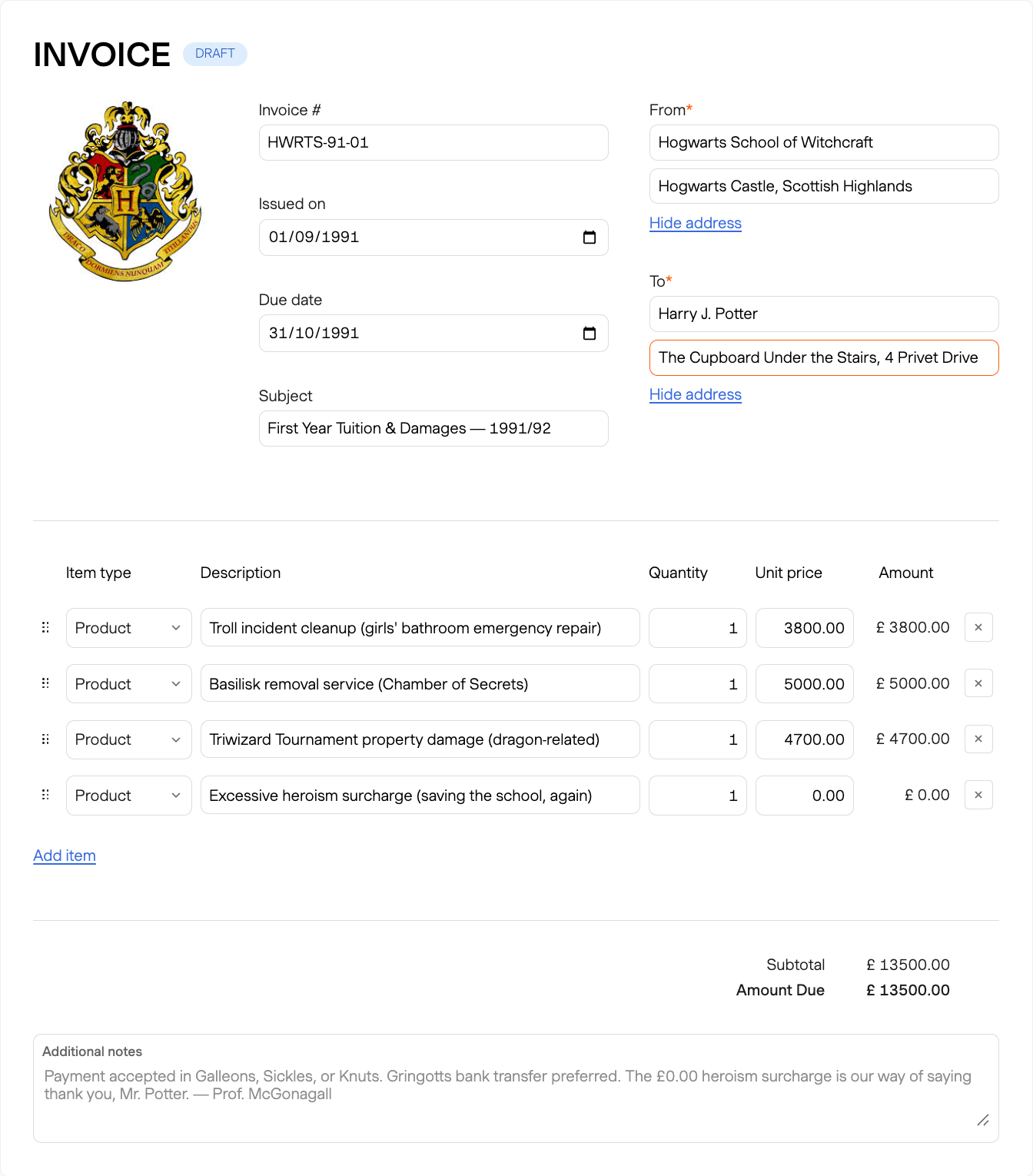
INVOICE DRAFT

Add your logo here
Item type
Description
Quantity
Unit price
Tax
Amount
Subtotal
$0.00
Discount
$0.00
Amount Due
$0.00
Get paid via:
Credit card / Debit card
ACH
Wire transfer

Customise invoice

Appearance

Add a logo
Show invoice title

Invoice settings

Tax Add up to 2 tax rates
%
Discount Apply a discount percentage
%

Key Features of Invoicing Apps with Notion Integration

Invoicing applications that integrate with Notion significantly enhance financial workflows by automating repetitive tasks and centralizing data. A core feature is automated invoice generation, which can pull client details, project hours, or service descriptions directly from your Notion databases, reducing manual entry errors by up to 80%. These tools also offer customizable PDF invoices, allowing you to brand documents with your logo, specific payment terms, and legal disclaimers, ensuring professional presentation and compliance. Crucially, real-time data syncing keeps your Notion workspace updated with invoice statuses—whether sent, viewed, or paid—providing an immediate overview of your financial health. Furthermore, the ability for direct email sending of invoices streamlines delivery, often including tracking to confirm receipt and opening.
How to Choose the Right Invoicing App for Notion

Selecting the optimal invoicing app for your Notion setup requires careful consideration of several practical factors to avoid common pitfalls. Begin by evaluating selection criteria such as the depth of integration—does it support two-way sync or just one-way data transfer? Prioritize apps with robust data security protocols, including encryption and compliance with relevant financial regulations. Consider the app's scalability; can it handle increasing invoice volumes or more complex billing models like recurring subscriptions or retainage—the 5-10% of each payment held until final inspection—as your business grows? Common pitfalls include overlooking the app's reporting capabilities, which are vital for financial analysis, or choosing a solution with a steep learning curve that negates the benefits of automation. Ultimately, ease of use, from initial setup to daily operation, should be a primary concern.

Streamlining Your Workflow: Integration Process Explained

Integrating an invoicing app with Notion is typically a straightforward process designed for user-friendly setup, though understanding the steps and potential challenges is key. The initial integration steps usually involve:

  1. Authorizing the connection between the invoicing app and your Notion workspace, often requiring API key generation or OAuth authentication.
  2. Mapping specific Notion database fields (e.g., client name, project cost, due date) to corresponding fields within the invoicing app's invoice template.
  3. Configuring automation triggers, such as generating an invoice when a Notion database item's status changes to "Ready for Invoice."
While most setups are guided by wizards, common challenges can include ensuring data consistency across platforms or troubleshooting permission issues. A successful integration should feel seamless, allowing you to manage client projects and billing from a single, unified Notion environment, significantly reducing administrative overhead.

Explore Your Invoicing App with Notion Integration

See how invoicing apps merge with Notion to streamline billing with automated features and real-time data updates.

Invoice App with Notion Integration FAQs

  • Harvest allows customization of PDF invoices with company information, logos, and default settings to reflect your brand identity.

  • Integrating an invoice app with Notion offers streamlined workflows by automating data entry and updates, reducing manual errors. It enhances organization by allowing seamless data flow between Notion's databases and the invoicing system, facilitating efficient financial management.

  • Go to your account settings and set rates per person, per project, or per task. When you create an invoice from tracked time, Harvest uses these rates to calculate line item totals.
  • Invoicing apps integrated with Notion may face limitations in terms of real-time data syncing speed, potential setup complexity, and the scope of features compared to standalone invoicing systems. They might also have constraints on handling complex billing scenarios or extensive customization needs.

  • Harvest excels in providing customizable invoicing solutions that cater to freelancers and small businesses, even without Notion integration.