Harvest
Invoices
Sign up

Invoice Generator for HR Managers

Harvest helps HR managers by tracking billable hours and automating recurring invoices, simplifying the process of managing contractor and freelancer invoicing.

INVOICE DRAFT

Add your logo here
Item type
Description
Quantity
Unit price
Tax
Amount
Subtotal
$0.00
Discount
$0.00
Amount Due
$0.00
Get paid via:
Credit card / Debit card
ACH
Wire transfer

Customise invoice

Appearance

Add a logo
Show invoice title

Invoice settings

Tax Add up to 2 tax rates
%
Discount Apply a discount percentage
%

Key Features of an Invoice Generator for HR Managers

When selecting an invoice generator, HR managers should prioritize features that ensure legal compliance and streamline employee-specific billing. A robust solution will offer dynamic compliance checks, automatically updating with federal and state labor laws to prevent costly errors in wage calculations and deductions. Look for extensive customization capabilities, allowing you to detail various pay structures, bonuses, and expense reimbursements unique to each employee or contractor. Crucially, seamless integration with existing HRIS or payroll systems is paramount; this reduces manual data entry by up to 70%, minimizing discrepancies and improving data accuracy across platforms. Ensure it supports diverse invoice formats, from simple hourly billing to complex project-based compensation.
Best Practices for Customizing HR Invoices

Effective customization of HR invoices ensures clarity and accuracy for both employees and financial departments. To tailor invoices accurately, always include a detailed breakdown of tax withholdings, clearly separating federal, state, and local taxes. Itemize all benefits deductions, such as health insurance premiums, 401(k) contributions, and any pre-tax or post-tax deductions, ensuring transparency. For roles with varying responsibilities, clearly delineate different pay rates for specific tasks or projects, perhaps using a line-item approach for "standard hours," "overtime," and "project work." Consider adding a dedicated section for expense reimbursements, attaching receipts or approval codes where necessary to maintain audit trails.

Avoiding Common Pitfalls in HR Invoice Generation

To mitigate risks in HR invoice generation, focus on proactive measures that ensure accuracy and legal adherence. A primary pitfall is non-compliance with evolving labor laws; regularly verify that your generator's templates and calculation rules align with current minimum wage, overtime, and deduction regulations. Another common issue is errors in payroll tracking, often stemming from manual data entry or inconsistent record-keeping; implement automated data syncs to reduce this risk by over 90%. For recurring invoices, establish clear approval workflows and automated scheduling to prevent missed payments or duplicate billing. Always conduct a final review before distribution, cross-referencing against timesheets and HR records to catch any discrepancies.

Experience the HR Invoice Generator

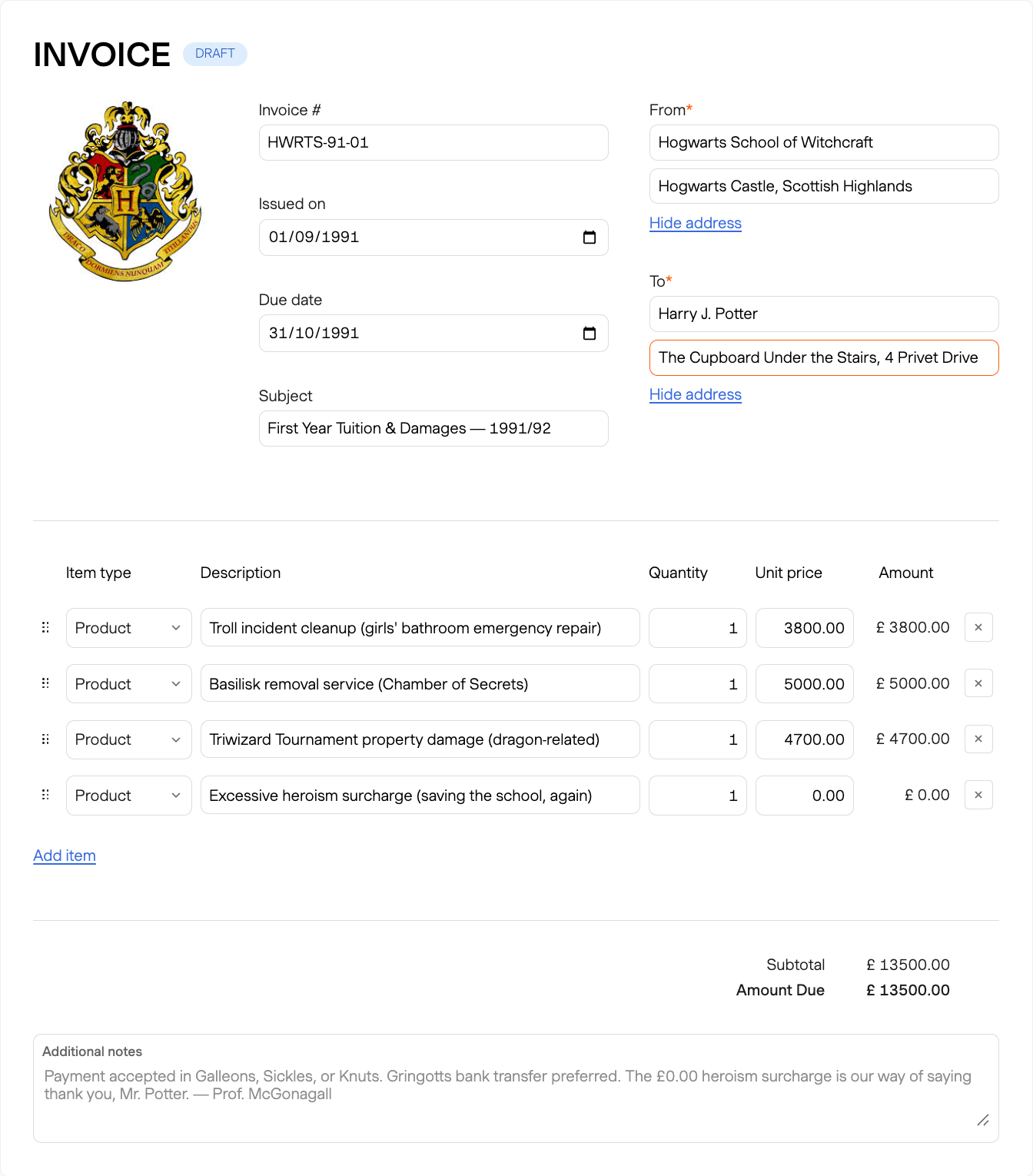
See how tailored invoices display payroll integrations, tax withholdings, and employee-specific details for HR managers.

Invoice Generator for HR Managers FAQs

  • Harvest can track billable hours for both contractors and freelancers, providing reports to help match hours with invoices.

  • Harvest can automate recurring invoices for ongoing services or retainers, allowing for flexible scheduling and automatic sending.

  • Harvest regularly updates its software to improve existing features and introduce new ones. While there’s no fixed schedule, users can expect updates that enhance usability and incorporate user feedback.
  • Compliance requirements for HR invoice generation include aligning with federal, state, and local labor laws. This entails accurate wage calculations, proper tax withholdings, and adherence to minimum wage and overtime rules. Additionally, clear documentation of deductions and benefits is essential to ensure transparency and legal compliance.

  • Invoice generators can assist with compliance by incorporating current labor law regulations into templates and calculations. However, full automation is challenging due to the complexity and frequent changes in laws; manual oversight is often necessary to ensure complete compliance.