Harvest
Invoices
Sign up

Invoice Generator for South Korea

Harvest offers flexible invoice customization, including tax settings, making it a versatile tool for international invoicing needs.

INVOICE DRAFT

Add your logo here
Item type
Description
Quantity
Unit price
Tax
Amount
Subtotal
$0.00
Discount
$0.00
Amount Due
$0.00
Get paid via:
Credit card / Debit card
ACH
Wire transfer

Customise invoice

Appearance

Add a logo
Show invoice title

Invoice settings

Tax Add up to 2 tax rates
%
Discount Apply a discount percentage
%

Essential Features for South Korean Invoice Compliance

To ensure your invoices comply with South Korean regulations, your generator must support specific features. South Korea applies a standard 10% Value Added Tax (VAT) rate to most goods and services. A compliant invoice generator should accurately calculate this VAT based on the supply value. Crucially, both the supplier and recipient's Business Registration Number (사업자등록번호) are mandatory fields. For most businesses, electronic tax invoices (e-Tax Invoices) are compulsory, with thresholds like KRW 100 million in annual turnover for individual businesses as of July 2023. These e-Tax Invoices must be generated in an XML format and digitally signed using a Public Key Infrastructure (PKI) certificate. Transmission to the National Tax Service (NTS) is typically required within one day of issuance.
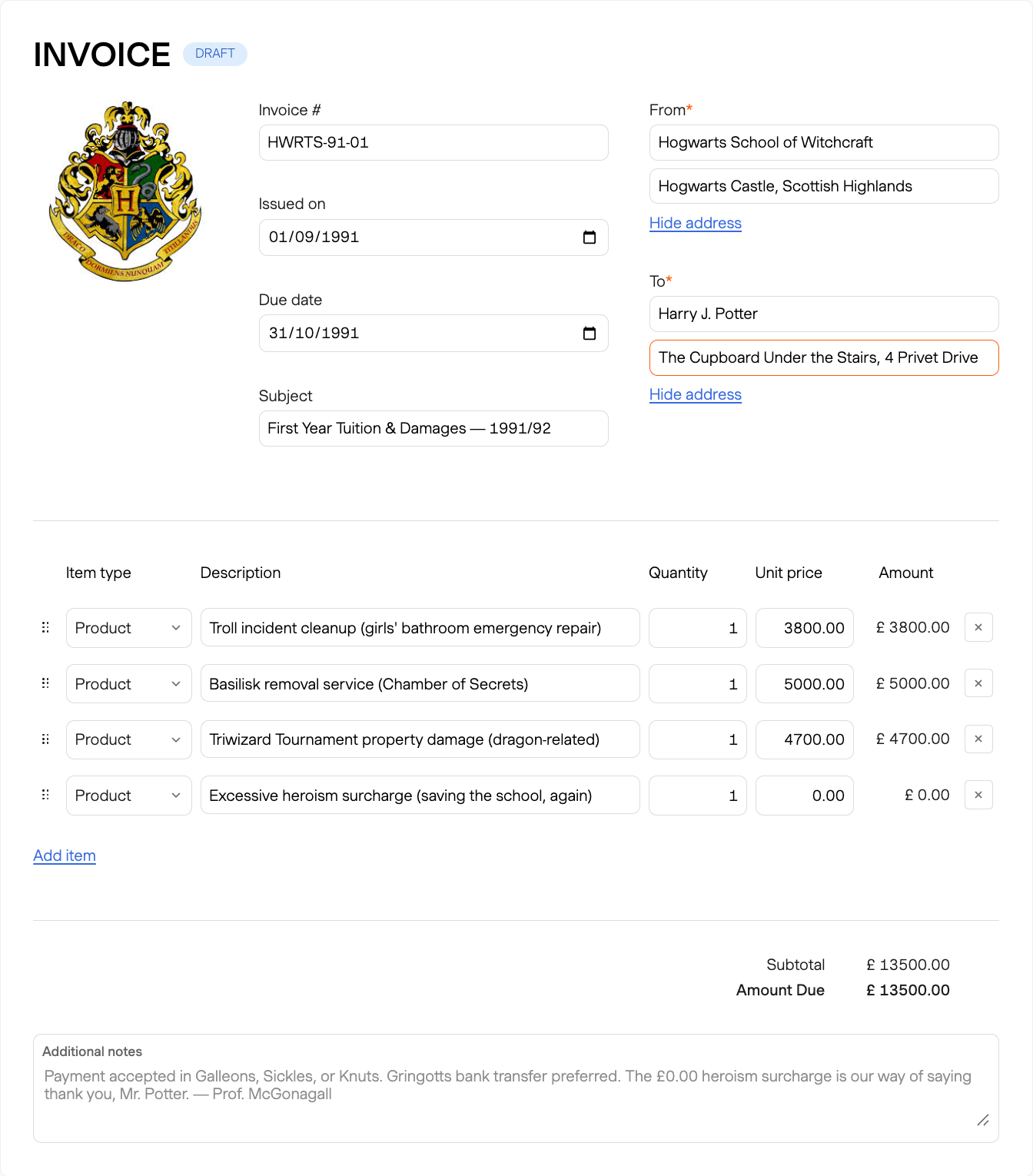
Step-by-Step Guide to Generating a Compliant Invoice

Generating a compliant invoice in South Korea involves accurately populating specific fields and adhering to formatting. First, ensure you include the mandatory information: the supplier's business registration number and name, the buyer's business registration number (or ID/resident registration number if not a business), the supply amount (before VAT), the VAT amount, and the date of issuance. It's vital to clearly separate the supply value from the VAT amount. An efficient invoice generator will automate VAT calculations and ensure the correct XML format for e-Tax Invoices. After populating all necessary data, the invoice must be digitally signed and then transmitted to the NTS, ideally within 24 hours of issuance.

Avoiding Common Pitfalls in Invoice Generation

Navigating South Korean invoice regulations requires careful attention to avoid common errors and penalties. A frequent mistake is incorrect VAT calculation, such as applying the 10% VAT rate to the total amount including VAT, rather than the supply value. Errors in mandatory fields, like an incorrect buyer's business registration number or a missing issuance date, can invalidate the invoice for VAT input tax deduction purposes for the buyer. Furthermore, late transmission of e-Tax Invoices to the NTS can incur penalties, with surcharges for non-transmission or delayed transmission by the 10th of the next month. Tax documents, including e-Tax Invoices, must be retained for a minimum of five years. For corrections, South Korean tax law requires a "Negative Offset" logic, issuing a negative invoice to cancel the original, and a new one if needed, with specific rules for the effective date depending on the type of error.

Visualize Your South Korean Invoice Format

Preview how your invoice will look with mandatory business registration numbers, VAT breakdown, and compliance with South Korean regulations.

Invoice Generator for South Korea FAQs

  • Harvest allows you to apply a 10% VAT to each line item on your invoices, ensuring proper tax breakdowns.

  • Harvest enables you to create well-formatted PDF invoices by allowing customization of company information and logos.

  • Harvest supports multi-user time tracking by allowing team members to log their hours individually against shared projects. This feature enables accurate billing and performance analysis across the team.
  • A South Korean invoice must include the supplier's business registration number and name, the buyer's business registration number (or ID/resident registration number if not a business), the supply amount (before VAT), the VAT amount, and the date of issuance.

  • Invoice generators generally require regular updates to maintain compliance with tax regulations. Real-time updates depend on the software provider's ability to incorporate changes swiftly, which may not always be instantaneous.