Harvest
Invoices
Sign up

Purchase Order Template for Denmark

Harvest provides essential tools for integrating VAT information and supports e-invoicing formats compatible with Danish regulations.

INVOICE DRAFT

Add your logo here
Item type
Description
Quantity
Unit price
Tax
Amount
Subtotal
$0.00
Discount
$0.00
Amount Due
$0.00
Get paid via:
Credit card / Debit card
ACH
Wire transfer

Customise invoice

Appearance

Add a logo
Show invoice title

Invoice settings

Tax Add up to 2 tax rates
%
Discount Apply a discount percentage
%

Download Your Danish-Compliant Purchase Order Template

Finding a suitable purchase order (PO) template for Denmark is a crucial first step, and many generic templates can be adapted. You'll typically find templates available in widely used formats such as PDF, Microsoft Word, and Excel, offering flexibility for your business operations. When selecting a template, prioritize those that allow for easy customization to reflect your company's branding, including adding your logo and specific contractual terms. While ready-to-use options exist, always ensure the chosen template can be tailored to meet specific Danish compliance requirements before integration into your procurement process.
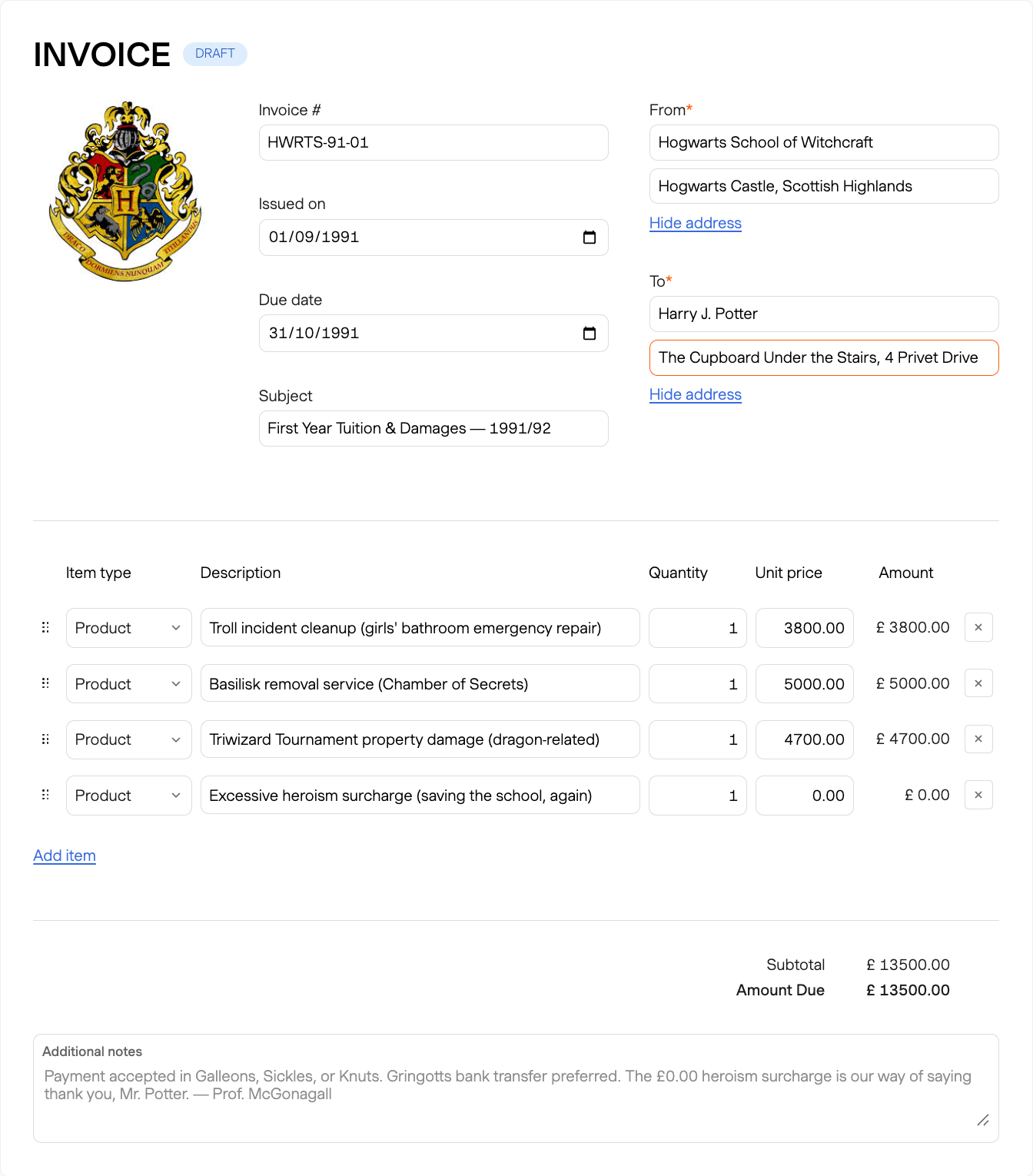
Key Elements for Danish Purchase Order Compliance

To ensure your purchase orders comply with Danish regulations, several mandatory elements must be included. Crucially, every PO should feature the Danish VAT registration number (CVR number) for both the buyer and seller, which is an eight-digit number prefixed with "DK". Other essential details include the full company names and addresses of both parties, a unique invoice date and number, and a clear order number. Furthermore, detailed descriptions of goods or services, quantities, unit prices, and total amounts (both inclusive and exclusive of VAT) are required. Specifying delivery dates and the place of delivery is also vital for legal clarity. For legal documentation, it's a best practice to retain records for a minimum of five years.

Ensuring Compliance with Danish VAT and E-Invoicing Regulations

Navigating Danish VAT and e-invoicing regulations is essential for compliant purchase orders. The standard Danish VAT rate is 25%, and your purchase orders must clearly state the applicable VAT amounts. For cross-border transactions, be aware of the reverse charge mechanism, where the buyer may be responsible for calculating and paying VAT. Regarding electronic purchase orders, e-invoicing has been mandatory for business-to-government (B2G) transactions in Denmark since 2005. For business-to-business (B2B) transactions, while sending e-invoices isn't universally mandatory yet, the acceptance of electronic invoices became mandatory for most companies using certified accounting software by January 1, 2026, under the Danish Bookkeeping Act of 2022. Best practices involve utilizing platforms like NemHandel or the Peppol network, supporting formats such as Peppol BIS 3.0 or the local OIOUBL 2.1.

Preview Your Danish Purchase Order Template

See how your purchase order will display with Danish VAT, legal terms, and e-invoicing formats — ready for compliance.

Purchase Order Template for Denmark FAQs

  • Harvest allows you to include your company's VAT number on invoices, which is essential for Danish purchase orders. This ensures compliance with the requirement to showcase the VAT registration number (CVR number) on all purchase orders.

  • In Denmark, purchase orders must include the VAT registration number, company names and addresses, a unique order number, and detailed descriptions of goods or services. These elements ensure legal compliance and clarity.

  • Yes, Harvest offers a support system that includes a help center with articles, tutorials, and FAQs, as well as customer support via email and chat to assist you with any issues you may encounter.
  • Harvest supports UBL e-invoices, which are compatible with Danish e-invoicing regulations. This makes it possible to use purchase order templates for electronic invoicing under these guidelines.

  • Purchase order templates may not automatically update with changing regulations, requiring manual updates to maintain compliance. Additionally, templates might not integrate seamlessly with all accounting software systems.