
Harvest
계약서
가입하기

Contract Template in Hindi

Harvest provides a robust solution for time tracking and invoicing, helping businesses manage contracts with ease, particularly in Hindi-speaking regions.

템플릿에서 시작하기

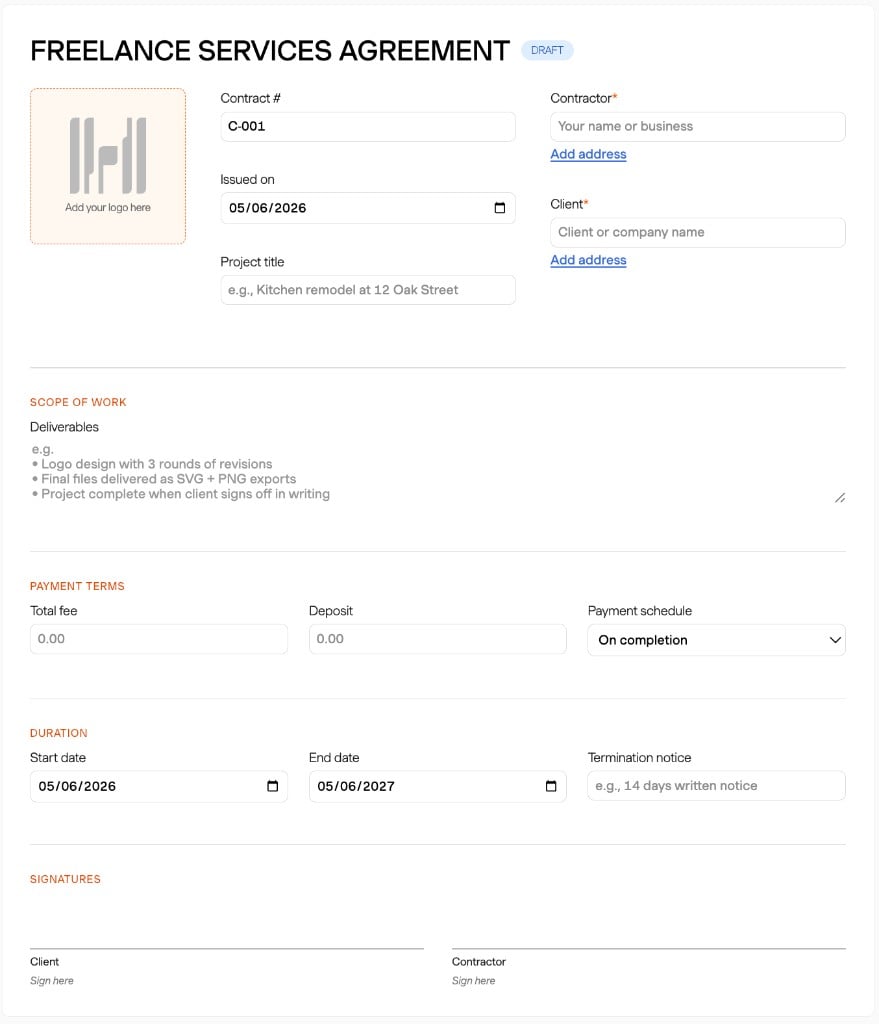
계약서 초안

여기에 로고를 추가하세요

작업 범위

지불 조건

기간

서명

클라이언트

여기에 서명

계약자

여기에 서명

결제 방법:
신용카드 / 직불카드
ACH
전신 송금

계약서 사용자 정의

모양

로고 추가
계약서 제목 표시

계약 설정

지불 조건 포함 총 수수료, 보증금 및 일정
해지 조항 포함 계약 종료를 위한 통지
서명란 포함 양 당사자가 하단에 서명

Understanding the Need for Contract Templates in Hindi

In India, the demand for contract templates in Hindi is growing, driven by the language's adoption in district courts and governmental communications. As of November 2021, Hindi was the official language in courts handling approximately 20 million out of 40 million pending cases. This highlights the importance of Hindi in legal documentation and its increasing use in various agreements, such as rental and contractor agreements.

Despite the prevalence of English in higher courts, there is a gradual shift towards Hindi in legal and administrative domains. This shift is supported by governmental efforts to promote Hindi as a primary language for governance and legal proceedings. As a result, many businesses and individuals are seeking Hindi contract templates to ensure compliance with local legal standards while catering to a wider audience.

Moreover, the evolution of legal practices, including the rise of digital platforms and e-contracts, necessitates the availability of accurate and reliable Hindi contract templates. These templates must adhere to the foundational principles outlined in the Indian Contract Act, 1872, while accommodating modern contracting needs.

Legal Requirements for Hindi Contracts

Creating a legally binding contract in Hindi involves understanding and incorporating essential elements as per Indian law. The Indian Contract Act, 1872, governs contract validity, requiring elements such as a clear offer and acceptance, lawful consideration, and competent parties. These elements ensure that the contract is enforceable in court.

While electronic contracts are gaining ground, they must comply with Section 10A of the Information Technology Act, 2000, which validates digital signatures and electronic records. Importantly, these contracts must still be translated accurately to maintain legal integrity, as a mistranslation could lead to severe consequences, including invalidation.

Given the multilingual nature of India, ensuring precise legal translation in Hindi is crucial. Legal professionals often use legal dictionaries and AI-powered translation platforms to maintain over 95% accuracy. This is vital for contracts intended for Hindi-speaking regions, where linguistic nuances can significantly impact legal outcomes.

Customizing Hindi Contract Templates for Specific Needs

Using and customizing Hindi contract templates requires careful attention to detail to meet specific legal and business needs. These templates serve as practical starting points for various agreements, including freelance work, rental arrangements, and construction contracts.

When customizing templates, it is essential to include common clauses that address payment terms, intellectual property rights, and dispute resolution mechanisms. This ensures clarity and prevents potential legal issues, such as misclassification of workers or unclear payment terms, which can arise in contractor agreements.

Furthermore, leveraging technology can streamline this process. AI-powered legal drafting tools can automate the extraction of relevant facts and generate drafts that comply with Indian legal standards, thus reducing preparation time by over 90%. Such tools are invaluable for individuals and businesses looking to efficiently create compliant contracts in Hindi.

Where to Find and Download Hindi Contract Templates

Finding reliable Hindi contract templates involves accessing platforms that offer legally vetted formats. Many legal websites and software platforms provide such templates, allowing users to download them in Hindi and customize them to fit specific needs.

These templates are often structured to include essential components like the Preamble, Recitals, and Operative Clauses, ensuring a comprehensive and enforceable agreement. Users should ensure that these templates are updated to reflect the latest legal standards and include necessary clauses like those for Tax Deducted at Source (TDS) and Goods and Services Tax (GST).

For those seeking to draft Hindi contracts, consulting legal experts or using AI-powered drafting tools can provide valuable guidance and ensure the templates meet all legal requirements. This approach not only facilitates compliance but also enhances the efficiency of the drafting process.

Efficient Contract Management with Harvest

Harvest streamlines time tracking and invoicing for Hindi contracts, ensuring compliance and efficiency in legal workflows.

Screenshot of Harvest's time tracking and invoicing features for Hindi contracts

Contract Template in Hindi FAQs

  • A Hindi contract must include a clear offer, acceptance, lawful consideration, competent parties, and free consent to be legally binding under the Indian Contract Act, 1872.

  • Yes, electronic contracts are valid in India under the Information Technology Act, 2000, provided they meet specific authentication and digital signature standards.

  • While Harvest focuses on time tracking and invoicing, it can help manage the financial aspects of contracts, supporting efficient workflows in Hindi-speaking regions.

  • Accurate translation requires using legal dictionaries, consulting experts, and leveraging AI-powered platforms to maintain over 95% accuracy, crucial for legal integrity.

  • Common clauses include payment terms, intellectual property rights, dispute resolution methods, and compliance with tax regulations like TDS and GST.

  • Many legal websites and software platforms offer downloadable Hindi contract templates, which can be customized for specific needs and ensure compliance with legal standards.

  • AI-powered legal drafting tools can automate fact extraction and draft generation, reducing preparation time and ensuring compliance with current legal standards.