
Harvest
Contracten
Registreer nu

Independent Contractor Agreement Template in Japanese

Navigating the complexities of independent contractor agreements in Japan can be challenging. Harvest offers tools to streamline workflows, ensuring efficient time tracking and invoicing.

Begin met een sjabloon

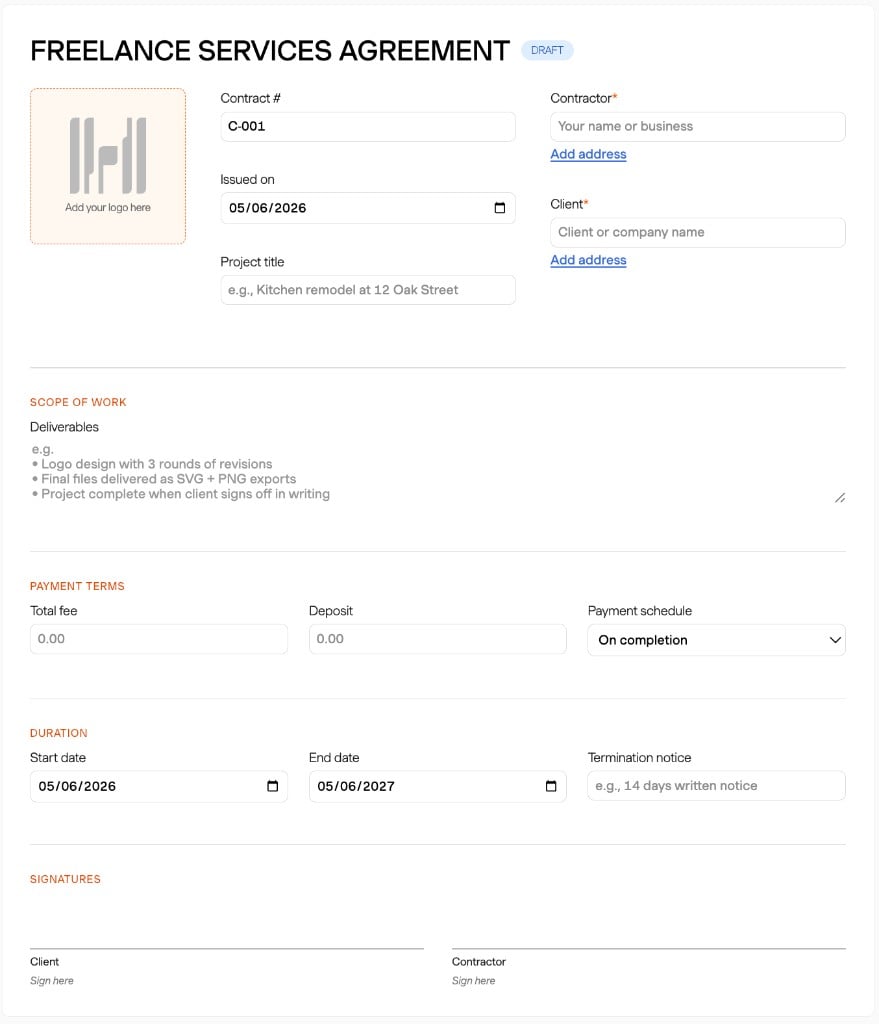
OVEREENKOMST CONCEPT

Voeg hier je logo toe

Omvang van het werk

Betalingsvoorwaarden

Duur

Handtekeningen

Klant

Hier ondertekenen

Aannemer

Hier ondertekenen

Betaal via:
Creditcard / Debitkaart
ACH
Bankoverschrijving

Contract aanpassen

Uiterlijk

Voeg een logo toe
Toon contracttitel

Contractinstellingen

Betalingsvoorwaarden opnemen Totaalbedrag, aanbetaling en schema
Opzegclausule opnemen Vereiste kennisgeving om het contract te beëindigen
Handtekeningblokken opnemen Beide partijen ondertekenen onderaan

Understanding Independent Contractor Agreements in Japan

Independent contractor agreements in Japan are governed by specific legal frameworks designed to protect both parties involved. These contracts, known as "Gyo-mu Itaku" agreements, facilitate a business-to-business relationship, primarily involving sole proprietors. These agreements are essential in Japan's growing gig economy, which is projected to reach 110 billion yen by 2024, emphasizing the need for clear and compliant contracts. The Freelance Act, effective from November 1, 2024, mandates written or electronic contracts that specify key terms like work description, payment details, and deadlines. This regulation aims to address past issues with verbal agreements, which often led to delayed payments and reduced wages.

It's crucial for businesses and contractors to understand the distinction between "Ukeoi" (Contract for Work) and "Jun-inin" (Quasi-delegation) agreements. The former ties compensation to specific deliverables, while the latter compensates for services provided over a period. Misclassification of contractors as employees can result in severe penalties, making it vital to structure agreements correctly. Legal experts note that Japanese contracts are typically concise, focusing on fundamental terms, and allow for later negotiations if necessary.

Key Elements of a Compliant Agreement

A compliant independent contractor agreement in Japan should include several critical elements to align with the Freelance Act. These include a detailed description of the project deliverables rather than hours, the inclusion of an Anti-Social Forces Clause to prevent associations with organized crime, and a clear specification of intellectual property rights transfer upon payment. Additionally, agreements should state whether Japan Consumption Tax (JCT) is included or excluded from the fee.

Contracts extending beyond one month cannot reduce agreed-upon compensation or demand work redone without valid reasons. For long-term contracts, a 30-day notice is required before termination or non-renewal. Companies should ensure that contractors have the autonomy to accept or reject projects and determine their own work methods and schedules. This autonomy helps avoid the legal risks of misclassification as an employee.

Challenges in Drafting and Managing Agreements

Drafting and managing independent contractor agreements in Japan can be challenging due to stringent legal requirements and the risk of misclassification. Misclassification can lead to backdated social security payments and other financial penalties. Companies must ensure that contracts comply with the Freelance Act, which mandates specific contract terms and payment timelines.

To mitigate these challenges, businesses can conduct internal reviews of existing contracts for compliance and update anti-harassment policies to include freelancers. Misclassification can occur if the contractor lacks sufficient autonomy or if the employer exercises too much control. Therefore, agreements should clearly outline the contractor's independence in managing their work to protect both parties legally.

How Harvest Supports Contractor Workflows

While Harvest does not provide legal templates or advice for independent contractor agreements in Japan, it offers robust tools to streamline contractor workflows. Harvest's time tracking and invoicing features help contractors manage their projects efficiently, ensuring accurate billing and payment records. This is particularly useful for contractors who need to provide detailed invoices as part of their agreement terms.

Harvest's expense management capabilities further assist contractors in organizing and tracking expenses related to their projects. This functionality supports compliance with the Freelance Act's requirement for clear payment terms, ensuring that contractors can provide clients with transparent financial documentation. By utilizing Harvest, contractors can focus on their deliverables while maintaining accurate and organized financial records.

Streamline Contractor Workflows with Harvest

Explore how Harvest supports contractors with efficient time tracking and invoicing tools, tailored to independent contractor agreements in Japan.

Harvest dashboard showcasing contractor workflow management

Independent Contractor Agreement Template in Japanese FAQs

  • In Japan, the Freelance Act mandates that independent contractor agreements must be in writing or electronic form, detailing the work description, payment terms, and deadlines. This ensures protection and clarity for both parties involved in the agreement.

  • To ensure compliance, include essential terms like project deliverables, payment details, and an Anti-Social Forces Clause. It's also crucial to specify whether Japan Consumption Tax is included in the fee and provide contractors with autonomy in their work process.

  • The Freelance Act, effective November 2024, aims to protect freelancers by requiring clear, written contracts that outline essential terms such as work scope and payment timelines. This act addresses issues from previous reliance on verbal agreements.

  • Het verkeerd classificeren van aannemers als werknemers kan leiden tot financiële sancties, waaronder achterstallige sociale zekerheidsbijdragen en claims voor onbetaalde lonen. Het is cruciaal om ervoor te zorgen dat overeenkomsten de autonomie en onafhankelijkheid van de aannemer weerspiegelen.

  • Harvest ondersteunt aannemers door tools te bieden voor efficiënte tijdregistratie, facturering en het beheren van uitgaven. Deze functies helpen om nauwkeurige facturering en naleving van contractuele betalingsvoorwaarden te waarborgen, waardoor het financiële documentatieproces van de aannemer wordt gestroomlijnd.

  • Belangrijke clausules zijn onder andere een gedetailleerde projectomschrijving, een Anti-Social Forces Clausule, overdracht van intellectuele eigendomsrechten en betalingsvoorwaarden. Deze elementen helpen om te voldoen aan de wettelijke normen en beschermen beide betrokken partijen.

  • Autonomie is cruciaal in overeenkomsten voor aannemers om verkeerd classificeren te voorkomen. Aannemers moeten de vrijheid hebben om projecten te accepteren of te weigeren en hun werkmethoden te bepalen, wat zorgt voor een duidelijke scheiding van werknemersrelaties.