
Harvest
Time Tracking
Sign up free

Utilization Rate Calculator for Self Employed

For self-employed individuals, achieving a balanced utilization rate is crucial for financial success. Harvest helps you track and manage your billable hours effectively.

Try Harvest Free

How much revenue is your team leaving on the table?

Most agencies run at 55-60% utilization. Even a small improvement means significant revenue. See what closing the gap looks like for your team.

Number of people who track billable time
$
Blended rate across roles (junior, senior, lead)
55%
Percentage of total hours that are billable. Industry average is 55-60%.
75%
A realistic target for service businesses is 70-80%.
Monthly revenue gap $0
Revenue at current utilization $0/mo
Revenue at target utilization $0/mo
Extra billable hours needed per person/day 0h
Annual revenue opportunity $0

Start tracking team utilization

Walk through the entire flow below. Start a timer, check your reports, and create a real invoice — all in three clicks.

Go ahead — start tracking!

One click and you're timing. Try it right here: start a timer, add an entry, edit the details. This is exactly how it feels in Harvest.

  • One-click timer from browser, desktop & mobile
  • Works inside Jira, Asana, Trello, GitHub & 50+ tools
  • Duration or start/end — your call
  • Day, week & calendar views to stay on top of it all
  • Friendly reminders so no hour gets left behind
Acme Corp
Website Redesign
Homepage layout revisions
1:24:09
Content Strategy
Blog calendar planning
1:30:00
SEO Audit
Technical audit report
0:45:00
Brand Guidelines
Color system documentation
2:15:00
Logo Concepts
Initial sketches round 1
1:00:00

Understanding Utilization Rate for the Self-Employed

A utilization rate measures the efficiency of how self-employed individuals allocate their working hours towards billable tasks. This rate is critical, as it determines the proportion of time spent on activities that directly generate income. The basic formula for calculating utilization rate is (Billable hours ÷ Total available hours) × 100. For instance, if you work 40 hours a week but only 24 of those are billable, your utilization rate is 60%. This metric is particularly crucial for freelancers who need to optimize their working hours to maximize profitability and sustain their business.

Understanding this rate is essential because a lower utilization rate may necessitate a higher billing rate to meet income goals. For example, at a 60% utilization, your required rate might be 67% higher than if you were fully utilized, as you need to cover non-billable hours. Moreover, tracking utilization can improve cash flow, with companies seeing a 15-25% increase in profitability when actively managing these rates. Harvest provides tools to help track these hours, offering insights into both billable and non-billable time, thus enabling better financial decision-making.
Calculating Your Utilization Rate

To calculate your utilization rate as a self-employed professional, you need to follow a few key steps. Start by defining your timeframe, whether it's weekly, monthly, or quarterly. Then, determine your total available hours, which are your contractual hours minus any non-working time like PTO or holidays. For instance, a 40-hour workweek with 8 hours of PTO leaves you with 32 available hours.

  1. Define the Timeframe: Choose a consistent period for calculation.
  2. Determine Total Available Hours: Subtract non-working hours from your schedule.
  3. Sum Billable Hours: Accurately record all client-billable time.
  4. Apply the Formula: Calculate (Billable hours ÷ Total available hours) × 100.

Once calculated, this rate informs your pricing strategy. Harvest can simplify this process with its powerful time tracking features, helping you differentiate between billable and non-billable hours and providing detailed reports on your time allocation.

Strategies to Improve Utilization Rates

Improving your utilization rate can significantly boost your revenue and efficiency as a self-employed individual. A key strategy is accurate time tracking. Implement tools like Harvest that offer one-click timers and detailed reports, enabling you to categorize and analyze time spent on various tasks. Establishing clear utilization targets is crucial—aiming for benchmarks such as 55-70% for established freelancers can help guide your efforts.

Additionally, regularly monitor your utilization rates to identify trends and adjust workloads or pricing accordingly. Reducing non-billable hours by minimizing administrative tasks or automating them where possible can also enhance your utilization. Harvest supports this by providing insights into time spent on non-billable activities, allowing you to optimize your schedule effectively.

Finally, strategic pricing based on utilization data ensures your billing rates adequately cover costs and desired profit margins, even if you're not at 100% utilization. This proactive approach helps in maintaining financial health and sustainability in self-employment.

Financial Implications of Utilization Rates

Utilization rates have a direct impact on the financial health of self-employed professionals. A rate below 60% often indicates potential revenue loss, as it implies a greater proportion of non-billable work. For example, a 60% utilization rate requires you to increase your hourly rate by 67% to maintain the same income level as a full utilization scenario.

Freelancers and consultants can leverage tools like Harvest to track and analyze these rates, providing a comprehensive view of how billable and non-billable hours affect income. With Harvest, you can set realistic utilization targets, such as 70-85% for professional services, which align with industry standards and personal capacity.

By understanding and optimizing utilization, self-employed individuals can make informed decisions about pricing, workload, and client engagements, ultimately leading to improved profitability and business growth.

Utilization Rate Excellence with Harvest

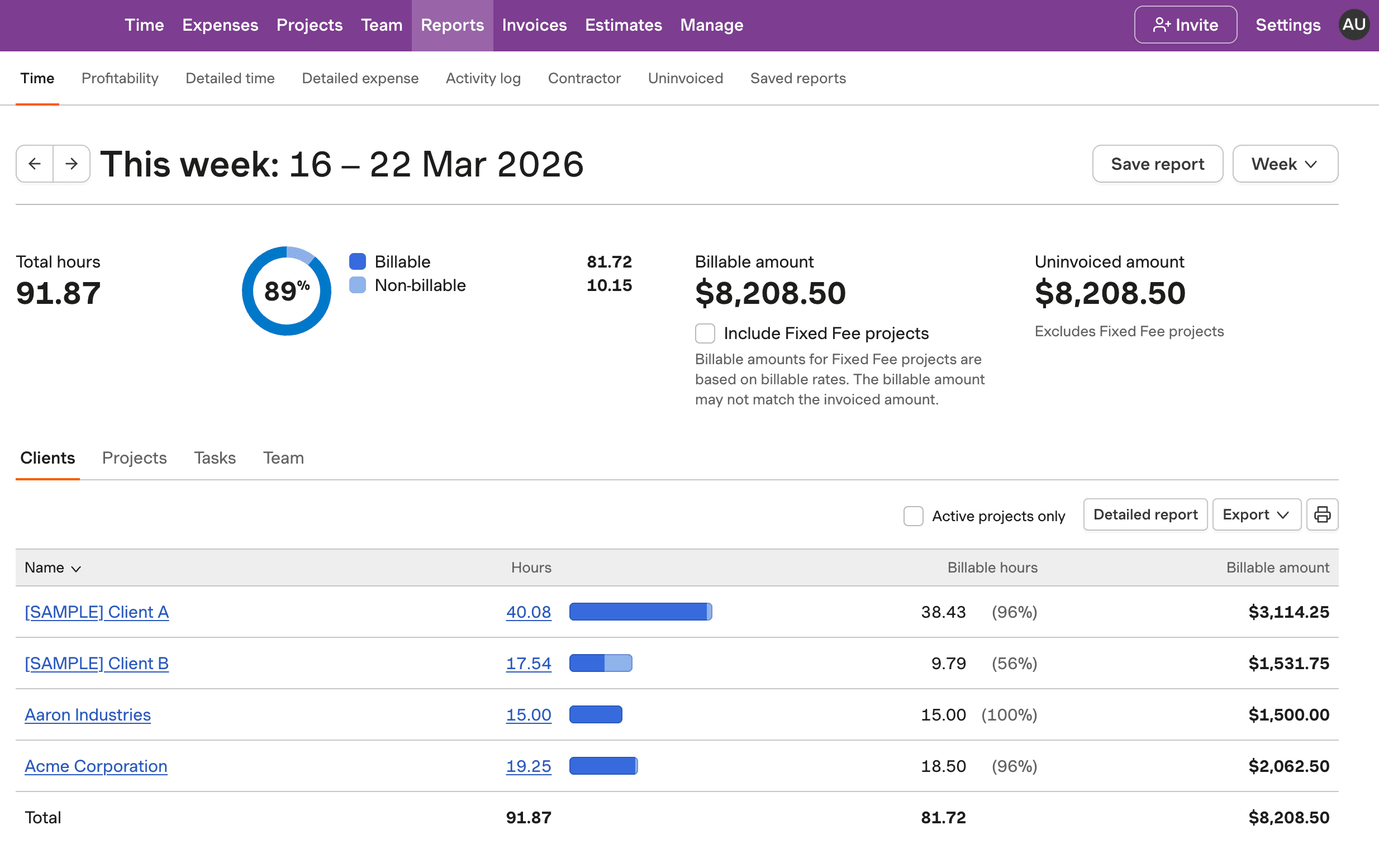
Discover how Harvest helps self-employed individuals track utilization rates, managing billable and non-billable hours effectively.

Harvest dashboard showing utilization rate for self-employed tracking.

Utilization Rate Calculator for Self Employed FAQs

  • Utilization rate measures the percentage of working hours spent on billable tasks. It's crucial for self-employed individuals as it directly impacts income, pricing strategies, and profitability.

  • Calculate your utilization rate by dividing your billable hours by total available hours, then multiply by 100. For example, 24 billable hours out of 40 total hours results in a 60% utilization rate.

  • For freelancers, a good utilization rate typically ranges from 55% to 70% for those established in their field. New freelancers might aim for 40-55% as they build their client base.

  • Improve your utilization rate by accurately tracking time, minimizing non-billable hours, and setting clear targets. Tools like Harvest can assist by providing detailed insights into time allocation.

  • Non-billable hours can reduce overall income by decreasing the time available for billable work. Harvest helps track these hours, allowing analysis of their impact on profitability.

  • Harvest offers features like one-click timers and comprehensive reports to track both billable and non-billable hours, helping self-employed individuals manage their time effectively.

  • Tracking utilization rates helps self-employed individuals optimize their working hours, improve cash flow, and make informed pricing and workload decisions.