
Harvest
Time Tracking
Sign up free

Utilization Rate Calculator for Startups

Harvest empowers startups to boost productivity by accurately tracking utilization rates, balancing billable and non-billable work effectively.

Try Harvest Free

How much revenue is your team leaving on the table?

Most agencies run at 55-60% utilization. Even a small improvement means significant revenue. See what closing the gap looks like for your team.

Number of people who track billable time
$
Blended rate across roles (junior, senior, lead)
55%
Percentage of total hours that are billable. Industry average is 55-60%.
75%
A realistic target for service businesses is 70-80%.
Monthly revenue gap $0
Revenue at current utilization $0/mo
Revenue at target utilization $0/mo
Extra billable hours needed per person/day 0h
Annual revenue opportunity $0

Start tracking team utilization

Walk through the entire flow below. Start a timer, check your reports, and create a real invoice — all in three clicks.

Go ahead — start tracking!

One click and you're timing. Try it right here: start a timer, add an entry, edit the details. This is exactly how it feels in Harvest.

  • One-click timer from browser, desktop & mobile
  • Works inside Jira, Asana, Trello, GitHub & 50+ tools
  • Duration or start/end — your call
  • Day, week & calendar views to stay on top of it all
  • Friendly reminders so no hour gets left behind
Acme Corp
Website Redesign
Homepage layout revisions
1:24:09
Content Strategy
Blog calendar planning
1:30:00
SEO Audit
Technical audit report
0:45:00
Brand Guidelines
Color system documentation
2:15:00
Logo Concepts
Initial sketches round 1
1:00:00

Understanding Utilization Rates for Startups

Utilization rate is a crucial metric for startups, reflecting the percentage of an employee's time spent on productive, billable work. It's calculated using the formula: Utilization Rate = (Billable Hours ÷ Available Hours) × 100%. For startups, maintaining a good utilization rate, typically between 70% to 80%, is vital to balancing productivity and employee well-being. Pushing too close to 100% can lead to burnout and quality issues, impacting overall performance.

Startups that actively monitor their utilization rates can significantly improve their chances of success. For instance, those tracking performance against industry benchmarks are 72% more likely to secure follow-on funding. Regular tracking helps in identifying trends and making necessary adjustments, ensuring that teams operate efficiently and remain competitive in the market.
Calculating Your Startup's Utilization Rate

Calculating utilization rates requires understanding both billable and available hours. Begin by defining total available hours, usually 2,080 annually for full-time employees, but adjusted to 1,840-1,880 after accounting for paid time off and holidays. Next, track all billable hours, which include time spent on client projects, direct work, and related tasks.

Utilization rates should be calculated regularly, such as weekly or monthly, to provide an accurate picture of team efficiency. By applying the formula, startups can assess individual and team productivity, identifying areas for improvement. For example, increasing average billable utilization by just 1% can significantly boost revenue, highlighting the financial importance of this metric.

Improving Utilization Rates in Startups

Improving utilization rates involves strategic planning and efficient use of resources. Startups should focus on tracking both billable and non-billable hours to gain a comprehensive view of team productivity. Tools like Harvest facilitate this by allowing startups to easily log and analyze time spent on various tasks, highlighting areas where efficiency can be improved.

Startups can implement strategies such as better project planning, reducing administrative overhead, and leveraging automation to optimize team performance. By doing so, they can not only enhance utilization rates but also prevent employee burnout and boost overall productivity. Regular analysis of utilization data enables startups to align team efforts with business goals, ensuring sustained growth and profitability.

Role-Specific Utilization Benchmarks

Utilization rates can vary significantly based on roles within a startup. For instance, junior consultants typically aim for a 75-85% utilization rate, while senior consultants target 70-80%. Solution architects may have a lower target of 60-70%, reflecting their involvement in both billable and strategic tasks. Understanding these benchmarks helps startups set realistic targets and measure performance effectively.

By comparing against industry averages, such as the 65-70% typical for professional services or the 75-85% for architecture and engineering, startups can gauge their standing and identify areas for improvement. Meeting these benchmarks not only enhances operational efficiency but also impacts profitability, as even a small increase in utilization can lead to substantial revenue gains.

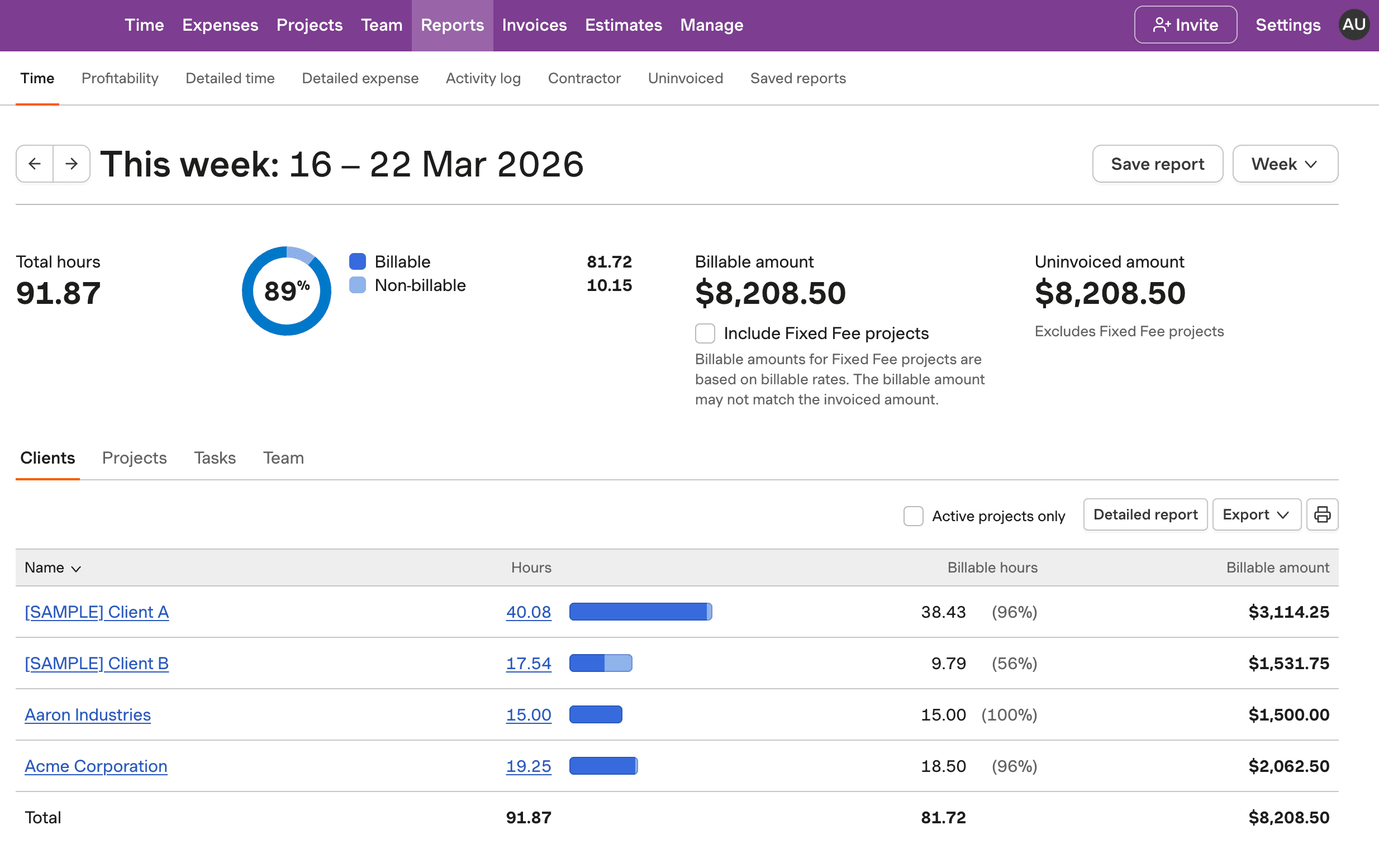
Utilization Rate Tracking with Harvest

See how Harvest tracks utilization rates for startups, balancing billable and non-billable hours efficiently.

Screenshot of Harvest's utilization rate tracking for startups.

Utilization Rate Calculator for Startups FAQs

  • Utilization rate measures the percentage of working hours spent on billable tasks. For startups, maintaining a good utilization rate is crucial for profitability and efficient resource allocation. It's essential for balancing productivity and preventing burnout.

  • To calculate utilization rate, divide total billable hours by available hours, then multiply by 100%. Regularly tracking both billable and non-billable hours helps in getting accurate insights into team productivity and efficiency.

  • A good utilization rate for startups typically ranges from 70% to 80%. This rate ensures a balance between productive work and necessary non-billable activities, such as training and administration.

  • Improving utilization involves tracking time accurately, optimizing project planning, and reducing inefficiencies. Harvest helps by providing tools to monitor both billable and non-billable hours, enabling better resource management.

  • Different roles have varying utilization targets. For example, junior consultants might aim for 75-85%, while solution architects could target 60-70%. Setting realistic benchmarks helps in evaluating and improving team performance.

  • Harvest allows startups to track non-billable hours effectively, providing a comprehensive view of team utilization. This is crucial for understanding how time is allocated and identifying opportunities for improvement.

  • Frequent tracking, such as weekly or monthly, helps identify trends and make timely adjustments. This proactive approach ensures that teams remain efficient and aligned with business goals, ultimately enhancing profitability.