Harvest
Invoices
Sign up

All-in-One Invoice Template

Harvest provides flexible invoicing solutions that cater to freelancers and service-based businesses, with integrations for streamlined financial management.

INVOICE DRAFT

Add your logo here
Item type
Description
Quantity
Unit price
Tax
Amount
Subtotal
$0.00
Discount
$0.00
Amount Due
$0.00
Get paid via:
Credit card / Debit card
ACH
Wire transfer

Customise invoice

Appearance

Add a logo
Show invoice title

Invoice settings

Tax Add up to 2 tax rates
%
Discount Apply a discount percentage
%

Key Features of an All-in-One Invoice Template

An effective all-in-one invoice template offers robust features that ensure versatility and adaptability for diverse business needs. Look for templates that provide extensive customization options, allowing you to incorporate your company's logo, brand colors, and specific font styles to maintain a professional and consistent brand image. Many templates offer the flexibility to add or remove fields, adjust layouts, and even include custom header and footer images.

Crucially, the template should support integration capabilities with accounting software, enabling seamless data transfer and reducing manual entry. This streamlines financial operations and helps maintain organized records. Finally, consider templates that offer industry-specific formats or are flexible enough to be adapted. For example, a construction business might need fields for retainage, while a consulting firm might prioritize detailed service descriptions. Templates available in common file formats like Word, Excel, or PDF provide broad accessibility and ease of use.
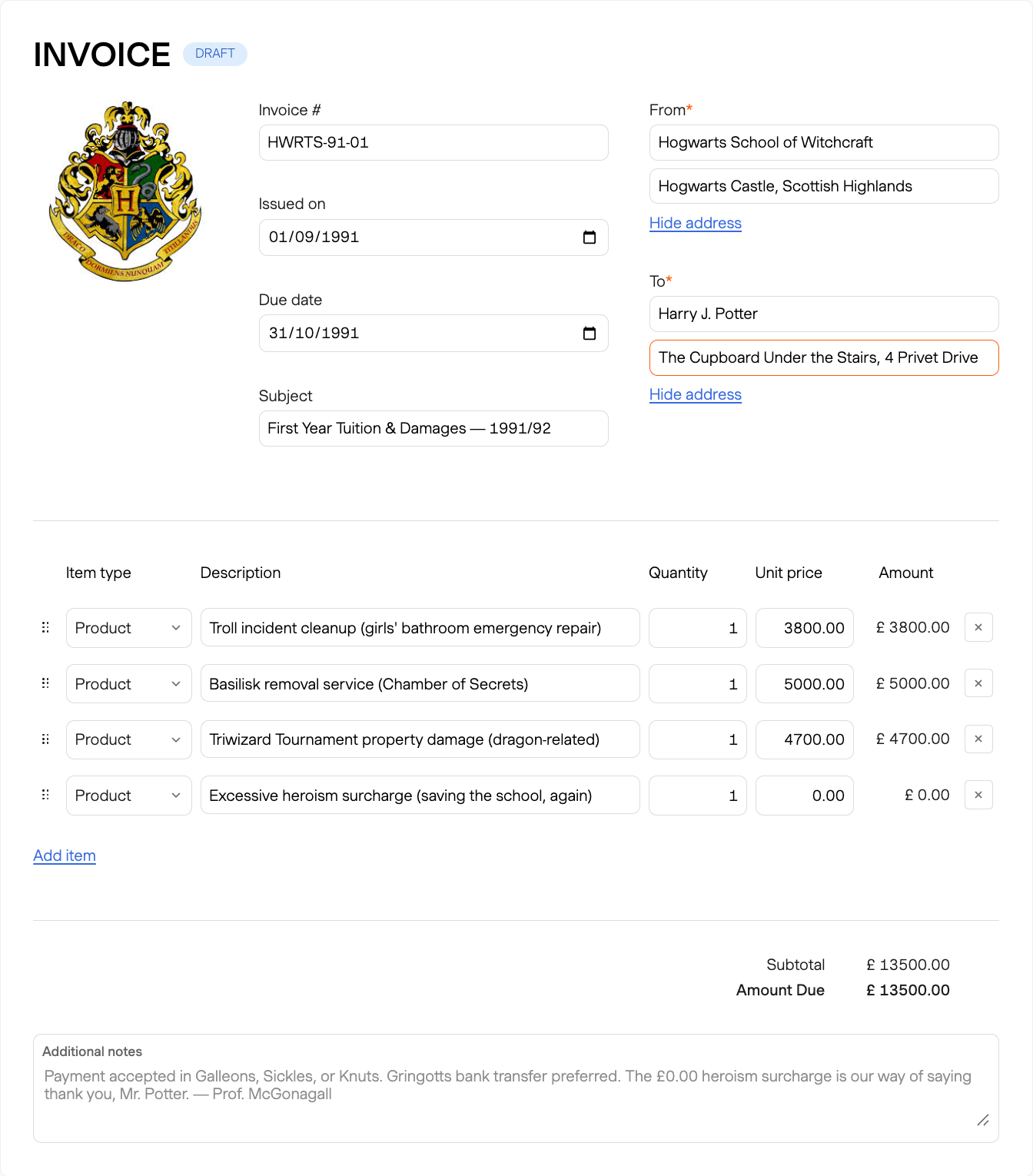
How to Customize Your Invoice Template

Personalizing your invoice template is straightforward and essential for professional branding and operational efficiency. Here's a practical guide:

  1. Select a Base Template: Start with a template that closely matches your industry or general layout preference. Many platforms offer a library of templates to choose from.
  2. Add Branding Elements: Upload your company logo, typically a PNG or JPG format, and adjust its alignment. Customize accent colors and fonts to align with your brand guidelines.
  3. Input Business and Client Details: Ensure your legal business name, address, contact information, and tax identification numbers (e.g., VAT, GST) are correctly pre-filled. Similarly, set up fields for client details.
  4. Define Line Items and Totals: Customize the description fields for goods or services, quantities, unit prices, and ensure automatic calculation of subtotals, taxes, and the total amount due.
  5. Specify Payment Terms: Clearly state payment deadlines (e.g., Net 14, Net 30), accepted payment methods, and any late payment penalties or early payment discounts.

A common pitfall is neglecting to review compliance requirements for your jurisdiction, especially regarding tax information. Always preview modifications before saving to ensure the invoice appears exactly as intended.

Integrating Your Invoice Template with Accounting Software

Integrating your invoice template with accounting software offers significant benefits, primarily by streamlining financial operations and enhancing accuracy. This connection reduces manual data entry, which can decrease data entry errors by as much as 30% in the first quarter for some businesses. It also automates data transfer, keeping financial records organized and improving cash flow management.

Here are key steps for effective integration:

  1. Assess Current Systems: Document your existing accounting platform and its integration capabilities, including available APIs.
  2. Choose Compatible Solutions: Select an invoice template or invoicing system that is known to integrate seamlessly with your accounting software.
  3. Map Data Fields: Identify which data points from your invoices (e.g., client details, line items, amounts) need to transfer to your accounting software.
  4. Configure Integration Settings: Follow the software's instructions to connect the two systems, often involving API keys or specific connectors. Look for real-time synchronization features to minimize errors.
  5. Test Thoroughly: Send test invoices to ensure all data transfers correctly and appears accurately in your accounting records.

Common integration challenges include compatibility issues with legacy systems and ensuring regulatory compliance across platforms. Selecting solutions with built-in API compatibility and automatic updates for regulation changes can help mitigate these issues.

See Your All-in-One Invoice Template in Action

Preview an invoice template that integrates with accounting software, customizable for various business needs like itemized billing and project descriptions.

All-in-One Invoice Template FAQs

  • Freelancers can customize their invoices in Harvest to include project descriptions and hourly rates.

  • Legal requirements for invoice templates vary significantly across industries and regions. Typically, invoices must include the business name, address, tax identification number, and a detailed description of the goods or services provided. Additionally, they should clearly state the payment terms and applicable taxes. It's crucial to ensure compliance with local regulations, which may require specific formats or additional information.

  • There is no specific limit on the number of clients you can manage and invoice in Harvest, making it suitable for businesses of various sizes.
  • While many invoice templates can automate basic tax calculations, such as applying a standard percentage tax rate to line items, they may not be able to handle complex tax scenarios like multi-tiered tax rates or specific exemptions. Users often need to ensure that the correct tax rules are applied and updated regularly, particularly in jurisdictions with frequent tax law changes.

  • Harvest integrates with Xero and QuickBooks Online to streamline financial management by syncing invoices and payments.