Harvest
Invoices
Sign up

Create Invoice for Norway

Harvest provides flexible invoicing solutions tailored to Norwegian business needs, including VAT and electronic invoicing standards.

INVOICE DRAFT

Add your logo here
Item type
Description
Quantity
Unit price
Tax
Amount
Subtotal
$0.00
Discount
$0.00
Amount Due
$0.00
Get paid via:
Credit card / Debit card
ACH
Wire transfer

Customise invoice

Appearance

Add a logo
Show invoice title

Invoice settings

Tax Add up to 2 tax rates
%
Discount Apply a discount percentage
%

Understanding Norwegian VAT Regulations

The Norwegian VAT system, known as Merverdiavgift (MVA), is a consumption tax applied to most goods and services sold in Norway. Businesses operating in Norway must understand the MVA system to ensure their invoices are compliant. Generally, businesses are required to register for MVA once their taxable turnover exceeds 50,000 NOK within a 12-month period. This threshold applies to both domestic and foreign businesses providing taxable goods or services in Norway. Once registered, businesses must charge MVA on their sales, collect it, and periodically report and remit it to the Norwegian Tax Administration (Skatteetaten). The MVA system is crucial for ensuring fair taxation and proper revenue collection for the state.

To create VAT-compliant invoices in Norway, several mandatory fields must be included:

  • Seller's name and organization number (VAT number): This uniquely identifies the business.
  • Buyer's name and address: Essential for identifying the recipient.
  • Invoice date: The date the invoice was issued.
  • Invoice number: A unique, sequential number for each invoice.
  • Description of goods or services: Clear details of what was sold.
  • Quantity and unit price: For each item or service.
  • Total amount excluding MVA: The net amount.
  • Applicable MVA rate: The percentage charged.
  • Total MVA amount: The calculated tax.
  • Total amount including MVA: The gross amount payable.
Detailed Invoice Format and Content Requirements

For an invoice to be legally valid and compliant in Norway, it must adhere to specific formatting and content requirements, ensuring transparency and traceability. Beyond the basic information, the organization number of the seller, which serves as their VAT registration number, is a critical mandatory field that must be clearly stated on every invoice. This number typically starts with "NO" followed by nine digits and the suffix "MVA" (e.g., NO999999999MVA), signifying the business is registered for VAT.

The invoice number is another crucial element, requiring strict sequential numbering without gaps. This means each invoice must have a unique number that follows the previous one in an unbroken sequence, which is vital for auditing purposes and preventing fraud. Businesses must maintain records of these sequences. Furthermore, a detailed description of the goods or services provided is paramount. This description should be specific enough to clearly identify what was sold, including the type, quantity, and unit price. For example, instead of "Consulting Services," an invoice should specify "IT Consulting: 10 hours of network configuration at 1000 NOK/hour." This level of detail helps prevent disputes, clarifies the basis for the charge, and supports correct VAT application. The invoice must also clearly state the date of supply if it differs from the invoice date.

Applying VAT Rates Correctly

Applying the correct VAT rates is fundamental to creating compliant invoices in Norway, as different goods and services are subject to varying rates. The standard VAT rate in Norway is 25% and applies to most goods and services. However, several reduced rates exist for specific categories. For instance, foodstuffs generally have a reduced rate of 15%. Passenger transport, cinema tickets, and cultural events often benefit from an even lower rate of 12%. Some services, such as financial services, health services, and educational services, are entirely exempt from MVA. Exports of goods and services from Norway are typically zero-rated, meaning no MVA is charged, but the transaction still needs to be reported.

To calculate and apply VAT, you first determine the net amount (price before MVA). Then, multiply this net amount by the applicable MVA rate. For example, if a service costs 1,000 NOK (net) and is subject to the standard 25% MVA, the MVA amount would be 1,000 NOK * 0.25 = 250 NOK. The total amount payable would then be 1,000 NOK + 250 NOK = 1,250 NOK. It's crucial to clearly show both the net amount, the MVA amount, and the gross amount on the invoice. Incorrectly applied MVA rates can lead to penalties and compliance issues with the Norwegian Tax Administration.

Electronic Invoicing Guidelines in Norway

Norway has been a frontrunner in adopting electronic invoicing, particularly within the public sector, to streamline processes and enhance efficiency. The primary standard for electronic invoicing in Norway is the EHF (Elektronisk HandelsFormat), which is based on the Peppol BIS standard. Since 2012, it has been mandatory for all central government entities to receive invoices in the EHF format. This mandate has since expanded, encouraging broader adoption across the public and private sectors. EHF ensures a standardized, machine-readable format for invoices, allowing for automated processing from sender to receiver.

The benefits of electronic invoicing, especially using EHF, are substantial. It significantly reduces manual data entry, leading to fewer errors and faster processing times. Businesses can experience cost savings by eliminating printing, postage, and archiving of paper invoices. For the public sector, it improves transparency and efficiency in procurement. However, adopting electronic invoicing can present challenges, particularly for smaller businesses. Initial setup costs for compatible software or integration with existing systems can be a barrier. Ensuring data security and compliance with evolving technical standards also requires ongoing attention. Despite these challenges, the long-term benefits of increased efficiency, reduced costs, and improved accuracy make electronic invoicing a valuable practice for businesses operating in Norway.

Best Practices for Invoice Clarity and Compliance

Ensuring invoice clarity and compliance goes beyond merely including mandatory fields; it involves adopting best practices that prevent disputes and foster good business relationships. One critical best practice is to include detailed descriptions of goods and services. Vague descriptions like "Consulting" can lead to misunderstandings about the work performed or the products delivered. Instead, specify "Website Redesign - Phase 1: Wireframing and UI/UX Mockups (20 hours)" to leave no room for ambiguity. This level of detail helps both the seller and the buyer understand the exact nature of the transaction and supports correct VAT application.

Setting clear payment terms and conditions is equally important. This includes specifying the due date (e.g., "Payment due within 14 days of invoice date"), accepted payment methods, and any late payment penalties. Clearly stating these terms upfront minimizes delays and potential disputes over payment. For example, "A late payment fee of 8% per annum will be applied to overdue amounts" provides a clear consequence. Common mistakes to avoid in invoice creation include:

  • Incorrect VAT rates: Always double-check the applicable MVA rate for each item.
  • Missing mandatory information: Ensure all legally required fields are present.
  • Non-sequential invoice numbers: Maintain a strict, unbroken sequence.
  • Mathematical errors: Carefully review all calculations for accuracy.
  • Lack of clarity: Avoid ambiguous descriptions or terms.

By proactively addressing these areas, businesses can create invoices that are not only compliant with Norwegian regulations but also clear, professional, and conducive to smooth transactions.

See Your Norwegian VAT Invoice Template in Action

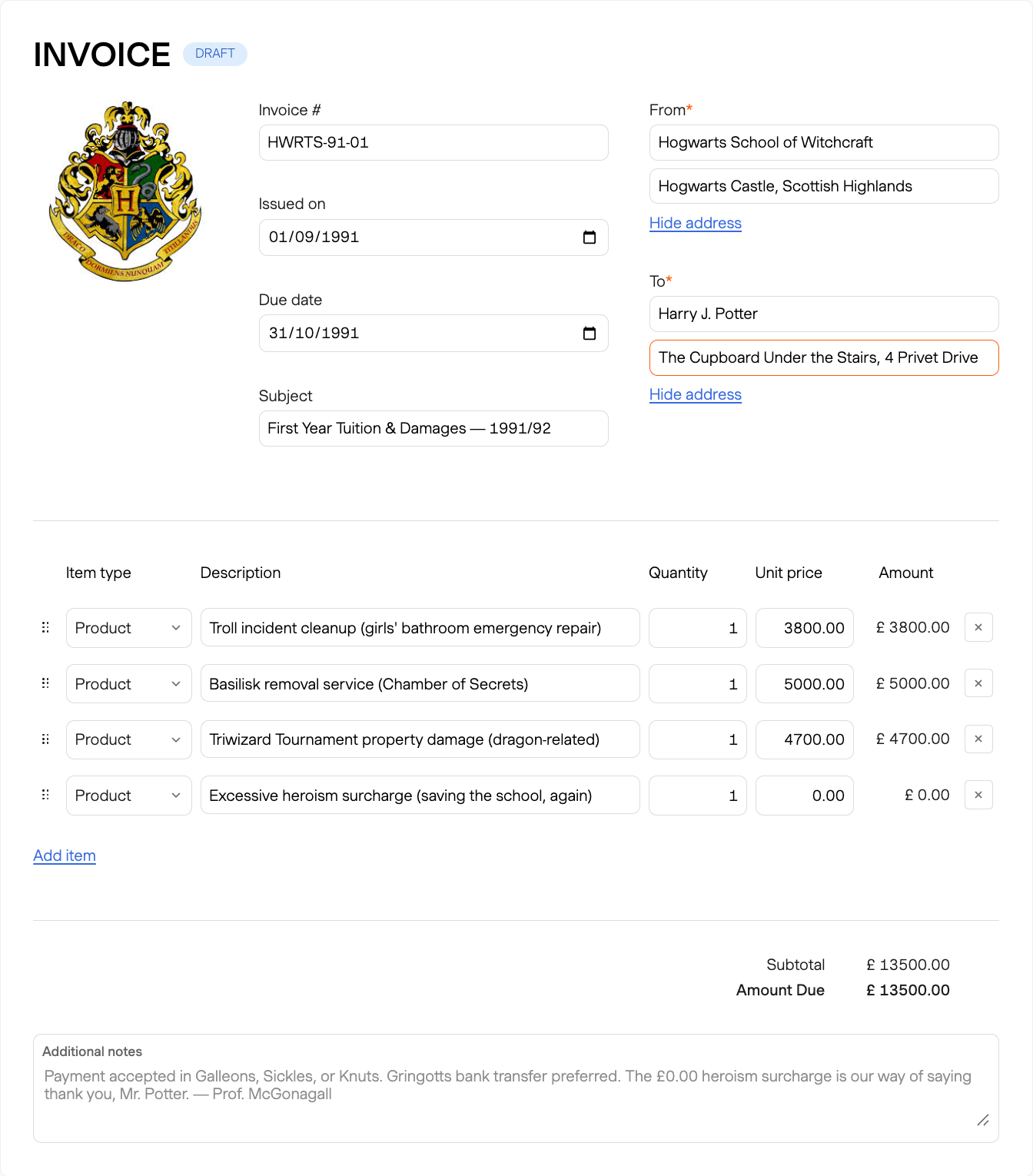
Preview how your invoice will look with NOK currency, VAT fields, and compliance with Norwegian MVA requirements — ready to send to clients in Norway.

Create Invoice for Norway FAQs

  • To ensure compliance with Norwegian VAT regulations, invoices must include fields such as the seller's VAT registration number, buyer's details, an invoice number, a detailed description of goods or services, total amounts with applicable VAT, and the VAT rate.
  • Harvest lets you apply specific tax rates to each line item on your invoices, which can be customized for Norwegian tax rates.
  • Yes, Harvest offers a mobile app for both iOS and Android devices, allowing users to manage invoices, track time, and monitor project progress while on the go. This feature ensures you can stay connected and productive anywhere.
  • The EHF format, or Elektronisk HandelsFormat, is a standardized format for electronic invoices in Norway, based on the Peppol BIS standard. It ensures invoices are machine-readable and can be processed automatically by public sector entities.
  • While invoicing tools can automate many aspects of compliance, users must still ensure that all relevant fields are correctly completed and that the correct VAT rates are applied. Tools may not automatically update with new regulations, so manual checks are necessary.