Harvest
Invoices
Sign up

Easy Invoicing Software

Harvest simplifies invoicing for freelancers and small businesses with features like easy setup, multiple currency support, and seamless payment integrations. Its user-friendly interface makes it an excellent choice for managing billing efficiently.

INVOICE DRAFT

Add your logo here
Item type
Description
Quantity
Unit price
Tax
Amount
Subtotal
$0.00
Discount
$0.00
Amount Due
$0.00
Get paid via:
Credit card / Debit card
ACH
Wire transfer

Customise invoice

Appearance

Add a logo
Show invoice title

Invoice settings

Tax Add up to 2 tax rates
%
Discount Apply a discount percentage
%

Key Features to Look for in Easy Invoicing Software

When evaluating easy invoicing software, prioritize features that streamline your billing process and enhance efficiency. A user-friendly interface is paramount, as it reduces the learning curve and allows for quick invoice generation and management. Look for intuitive designs that minimize clicks and offer clear navigation. Automated recurring invoices are a significant time-saver, especially for businesses with subscription models or regular clients; over 53% of organizations report at least 40% of their revenue as recurring. This automation can save 2-3 hours weekly on invoice and payment workflows alone. Additionally, customizable invoice templates are essential for maintaining brand consistency and professional appearance. These templates should allow for easy modification of logos, colors, and layouts, and support common formats like PDF, DOCX, and Excel. Finally, seamless integration with payment gateways is crucial for faster payments and improved cash flow, as 68% of small businesses have reduced their use of cash and paper checks. This integration enables secure digital payments, reducing cart abandonment rates and enhancing customer trust.
How to Choose the Right Invoicing Software for Your Business

Selecting the appropriate invoicing software requires a thoughtful approach tailored to your specific operations.

  • Assess your business needs: Begin by identifying your core workflow requirements. Do you need multi-currency support, complex approval workflows, or integration with purchase order (PO) processing? Understanding these specifics ensures the software aligns with your daily tasks and growth trajectory.
  • Evaluate integration capabilities: The software should integrate smoothly with your existing financial ecosystem, including CRM, accounting software (like ERP systems), and project management tools. This connectivity eliminates duplicate data entry, which typically accounts for 1-3% error rates in manual processes, reducing it to under 0.5% with automated integration.
  • Consider customer support options: Reliable customer support is vital. Poor technical support can lead to decreased productivity, missed opportunities, and even revenue loss. Look for providers offering responsive support channels and clear service level agreements (SLAs) to ensure timely assistance when issues arise. Remember, 86% of buyers are willing to pay more for a better customer experience.

Common Pitfalls to Avoid When Selecting Invoicing Software

When choosing invoicing software, be aware of common mistakes that can lead to future complications.

  • Overlooking integration needs: Failing to consider how the invoicing software will connect with your other business systems is a significant pitfall. Fragmented financial data across multiple platforms can cause revenue leakage and increase administrative hours due to manual data entry. Manual invoice entry can result in 1-3% error rates, which robust integration can drastically reduce.
  • Ignoring scalability: Choosing a system that cannot grow with your business is a critical error. Scalability refers to the software's ability to handle increasing demands, such as more users, larger data volumes, and new functionalities, without performance degradation. Without it, you risk costly disruptions and upgrades as your business expands.
  • Neglecting user feedback: Disregarding the experiences of your team members who will use the software daily can lead to low adoption rates and inefficiencies. A feature-rich platform, while powerful, can become complex and require extensive training if not user-friendly, hindering its "ease of use" promise. Prioritize software that receives positive feedback for its intuitive design and workflow.

Explore Easy-to-Use Invoice Templates

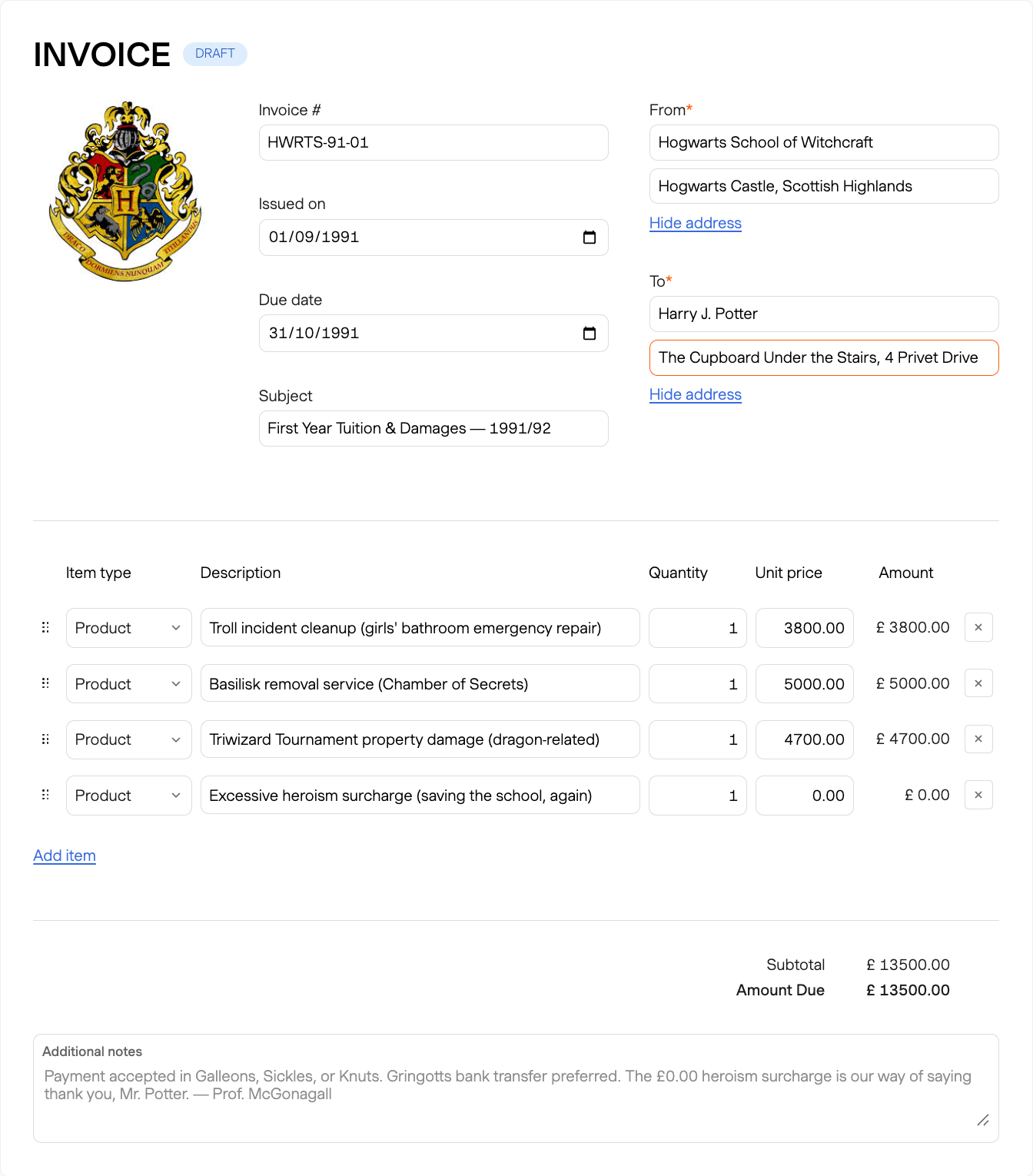
Preview how your invoices will look with customizable templates, multi-currency support, and seamless payment gateway integration — perfect for small businesses.

Easy Invoicing Software FAQs

  • Invoicing software is considered easy to use when it features an intuitive interface, which minimizes the steps required to create and send invoices. It should offer straightforward navigation, clear instructions, and automation options like recurring billing, which reduce manual input and streamline processes. Additionally, ease of use is enhanced by integration capabilities with existing business tools, reducing the need for duplicate data entry and manual updates.

  • Yes, Harvest supports multiple currencies by allowing you to set a default currency for your account and a preferred currency for each client. This feature is particularly useful for businesses that deal with international clients, ensuring accurate invoicing and financial reporting in the appropriate currencies.

  • The Harvest interface and PDF labels (Invoice, Due Date, etc.) are in English only. However, you can type invoice content — like descriptions and notes — in any language.
  • Yes, Harvest integrates with Stripe and PayPal, enabling seamless online payment transactions directly from the invoice. This integration facilitates quick and secure payments, enhancing the efficiency of the invoicing process and improving cash flow.

  • While invoicing software can automate many tasks, such as recurring billing and payment reminders, there are limitations. It typically cannot automate complex decision-making processes or completely replace the need for human oversight in financial management. Additionally, some software may not integrate with all systems, requiring manual intervention for certain operations.