Harvest
Invoices
Sign up

Email Invoice

Harvest streamlines the invoicing process by offering customizable email options and automated features to enhance client communication and payment efficiency.

INVOICE DRAFT

Add your logo here
Item type
Description
Quantity
Unit price
Tax
Amount
Subtotal
$0.00
Discount
$0.00
Amount Due
$0.00
Get paid via:
Credit card / Debit card
ACH
Wire transfer

Customise invoice

Appearance

Add a logo
Show invoice title

Invoice settings

Tax Add up to 2 tax rates
%
Discount Apply a discount percentage
%

Crafting the Perfect Invoice Email Subject Line

A clear and professional subject line is paramount for an invoice email, as it significantly impacts whether the email is opened and processed promptly. The subject line acts as a gatekeeper, immediately informing the recipient about the email's purpose and encouraging timely action. Research indicates that descriptive and action-oriented subject lines lead to higher open rates.

  • Be direct and informative: Always include the word "Invoice," the invoice number, and your business name. For example, "Invoice #12345 from [Your Business Name]" or "Invoice for [Project Name] – Due [Due Date]" are effective formats.
  • Include key details: Adding the due date in the subject line can provide a gentle nudge for prompt payment, especially for recurring invoices.
  • Keep it concise: Subject lines that are too long may be truncated, particularly on mobile devices, so aim for necessary details only. A concise subject line, at most 50 characters, is recommended to ensure it is not overlooked.
  • Personalize appropriately: While personalization can be effective, for invoices, it's more about clarity and identification than a casual tone.

Common mistakes to avoid include vague subject lines like "Invoice" or "Payment Due," which can easily be ignored or lost in a busy inbox. Overusing punctuation or special characters can also make an email appear like spam. Avoid phrases like "friendly reminder" in the initial invoice email; these are better reserved for follow-up communications if an invoice becomes overdue.
Essential Components of an Invoice Email

A well-structured invoice email is a critical tool for ensuring smooth transactions and timely payments. Beyond the attached invoice, the email body itself should contain several essential components to facilitate clarity and professionalism.

  • Polite Greetings and Thank-You Notes: Start with a simple, friendly, and personalized greeting, addressing the client by name. A brief thank-you for their business sets a positive tone and reinforces the client relationship. For instance, "Hi [Client's Name]," followed by an expression of gratitude, can foster goodwill.
  • Brief Summary of Invoice Details: The email should briefly mention what the invoice is for, providing a heads-up to the client. Include a concise summary of key details such as the invoice number, invoice date, total amount due, and the due date directly in the email body.
  • Contact Information: Always include your business's contact information, making it easy for the client to reach out with any questions or clarifications. This demonstrates professionalism and accessibility.
  • Payment Instructions: Clear and straightforward payment instructions are crucial. This should include accepted payment methods (e.g., bank transfer, credit card, online payment link) and any specific details required to complete the payment.

Strategies for Following Up on Unpaid Invoices

Following up on unpaid invoices is a delicate balance of persistence and politeness, crucial for maintaining cash flow and client relationships. Research indicates that 39% of invoices in the United States miss their due dates, highlighting the necessity of effective follow-up strategies.

  • Timing of Follow-Up Emails: A systematic approach to follow-ups is key. The first follow-up can often be a gentle reminder sent shortly after the due date, assuming an oversight. If payment is still not received, subsequent reminders can be sent at regular, scheduled intervals, such as 7, 14, or 30 days past the due date.
  • Tone and Language to Use: Maintain a factual, polite, and professional tone throughout your communications, avoiding accusatory or impatient language. Phrases like "We have yet to receive payment for invoice number [invoice number]... Please let us know when we can expect to receive payment" are effective.
  • Legal Considerations for Persistent Non-Payment: If informal follow-ups are unsuccessful, legal avenues may need to be explored. Businesses are legally entitled to charge interest on overdue invoices, often 8% above the Bank of England's base rate if not specified in the contract.

Enhancing Professionalism in Invoice Emails

Enhancing professionalism in invoice emails goes beyond mere formality; it's a strategic approach that significantly impacts client perception and payment timeliness. A well-crafted invoice email is an extension of your business's professionalism and the value you provide.

  • Design and Formatting Tips: A professional invoice email should be clear, concise, and easy to read. Always attach the invoice as a PDF file, as it is the standard format, looks professional, and is easily accessible on various devices. The email body should be brief, summarizing key details like the invoice number, total amount, and due date.
  • Using Templates for Consistency: Invoice email templates offer numerous benefits, including time savings, consistency, and accuracy. They provide a pre-designed format that can be quickly customized, ensuring uniform appearance and preventing important information from being accidentally omitted.
  • Customizing Email Content Based on Client History: While templates provide a solid foundation, customizing content based on client history adds a personal touch that can strengthen relationships. For new clients, a slightly more detailed explanation of payment terms might be beneficial.
  • Impact of Email Branding on Client Perception: Incorporating your company logo, colors, and branding elements into your invoice emails and templates reinforces your corporate identity and builds trust.

Innovative Payment Options in Invoice Emails

Integrating innovative payment options directly into invoice emails can significantly streamline the payment process, enhance customer experience, and accelerate cash flow. The shift toward digital and contactless payments has accelerated, with consumers expecting quick, secure, and frictionless payment methods.

  • Incorporating Payment Links: Payment links, also known as checkout links, are secure URLs that direct customers to a branded checkout page where they can complete their payment. These links can be easily embedded into invoice emails, SMS, or messaging apps.
  • Exploring New Digital Payment Methods: Beyond traditional bank transfers and credit cards, businesses are increasingly offering a variety of digital payment methods. These include mobile wallets (like Apple Pay and Google Pay), NFC payments, and QR code-based transactions.
  • Security Considerations for Online Payments: While convenience is key, security remains paramount. Today's online payment systems implement multi-layer security measures to protect financial data.
  • Examining Emerging Technologies in Digital Payments: The future of payments is dynamic, with several emerging technologies poised to transform the landscape.

See Your Email Invoice Template in Action

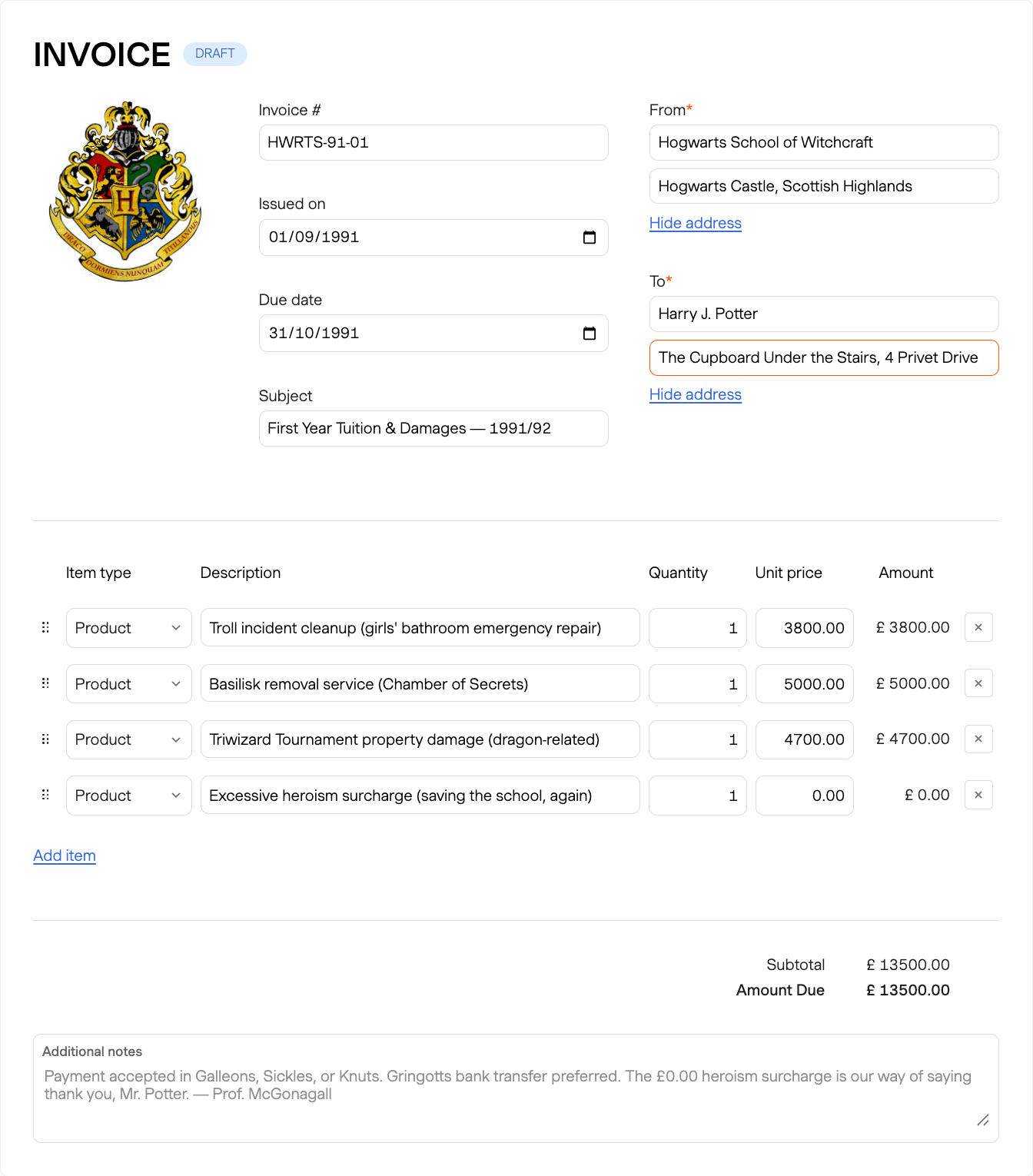
Preview how your invoice email looks with a clear subject line, personalized greetings, and payment links — ready to send for efficient client communication.

Email Invoice FAQs

  • Harvest allows you to set a default subject line for invoice emails to ensure clarity and consistency.

  • To write a professional invoice email, start with a polite greeting and include all necessary details such as the invoice number, amount due, and due date. Make sure to provide clear payment instructions and offer your contact information for any questions. Using a professional and concise tone is key, and customizing the email to the client's history can also enhance the communication.

  • Yes, you can set different billing rates per client, project, or team member. This lets you bill accurately based on each client's specific agreement.
  • Harvest can include online payment links in invoice emails to facilitate quicker payments.

  • Invoice emails may not reach the recipient's inbox due to issues such as spam filters, incorrect email addresses, or server issues. It is important to ensure that the email address is correct and to follow best practices for avoiding spam filters, such as using a clear subject line and avoiding excessive use of special characters.