Harvest
Invoices
Sign up

Invoice App for Transportation

Harvest provides customizable invoicing solutions, ideal for transportation businesses needing flexible billing terms tailored to freight contracts.

INVOICE DRAFT

Add your logo here
Item type
Description
Quantity
Unit price
Tax
Amount
Subtotal
$0.00
Discount
$0.00
Amount Due
$0.00
Get paid via:
Credit card / Debit card
ACH
Wire transfer

Customise invoice

Appearance

Add a logo
Show invoice title

Invoice settings

Tax Add up to 2 tax rates
%
Discount Apply a discount percentage
%

Key Features to Look for in a Transportation Invoicing App

When selecting a transportation invoicing app, prioritize features that directly address the complexities of logistics billing. An essential capability is automated e-way bill generation, which instantly creates compliant electronic waybills directly from invoices, significantly reducing manual data entry errors and ensuring adherence to regulations, especially for goods valued above ₹50,000 in regions like India. Look for systems that support flexible billing by distance, load, or route, accommodating diverse pricing models with hundreds of built-in charge bases and customizable rule engines for fuel surcharges or tiered pricing. Seamless integration with dispatch management systems (DMS), warehouse management systems (WMS), and ERPs is crucial to avoid data silos and streamline workflows, with 89% of reviewers rating billing and invoicing integration as important. Finally, robust multi-state and cross-border tax compliance features are non-negotiable, handling varying state tax rules, IFTA reporting, and international VAT/GST requirements to prevent penalties and audits.
Common Pitfalls When Choosing a Transportation Invoicing App

Ignoring critical aspects during app selection can lead to significant operational hurdles and financial losses. A common pitfall is overlooking integration capabilities with existing systems like accounting software, inventory management, or CRM. This oversight often results in data silos, redundant manual data entry, and increased chances of errors, hindering overall efficiency. Another mistake is ignoring scalability for growing fleets. An app that can't handle increasing transaction volumes, new users, or additional services as your business expands will quickly become a bottleneck, leading to performance issues and the need for costly replacements. Lastly, underestimating the importance of compliance features can expose your business to severe risks. Without robust support for multi-state and cross-border tax regulations, you face potential penalties, fines, and audits, which can significantly impact cash flow and reputation.

How to Evaluate Invoicing Apps for Transportation

To effectively evaluate transportation invoicing apps, adopt a structured approach focusing on practical business alignment.

  • Assess Pricing Structures: Go beyond initial costs. Understand the vendor's pricing model, looking for value-based methods, and ensure transparency regarding potential hidden charges or long-term maintenance fees. Some solutions may offer per-user or per-shipment pricing.
  • Review User Testimonials and Case Studies: While not a direct replacement for testing, insights from other transportation businesses can highlight real-world performance, customer service quality, and satisfaction levels. Look for feedback on ease of use and reliability.
  • Test Customization Options for Payment Terms: Your business needs flexibility. Evaluate if the app allows you to define and automate various payment terms like Net 30, Net 60, early payment discounts, or installment plans. This ensures the app can adapt to diverse client agreements and improve cash flow management.

See Your Transportation Invoice Template in Action

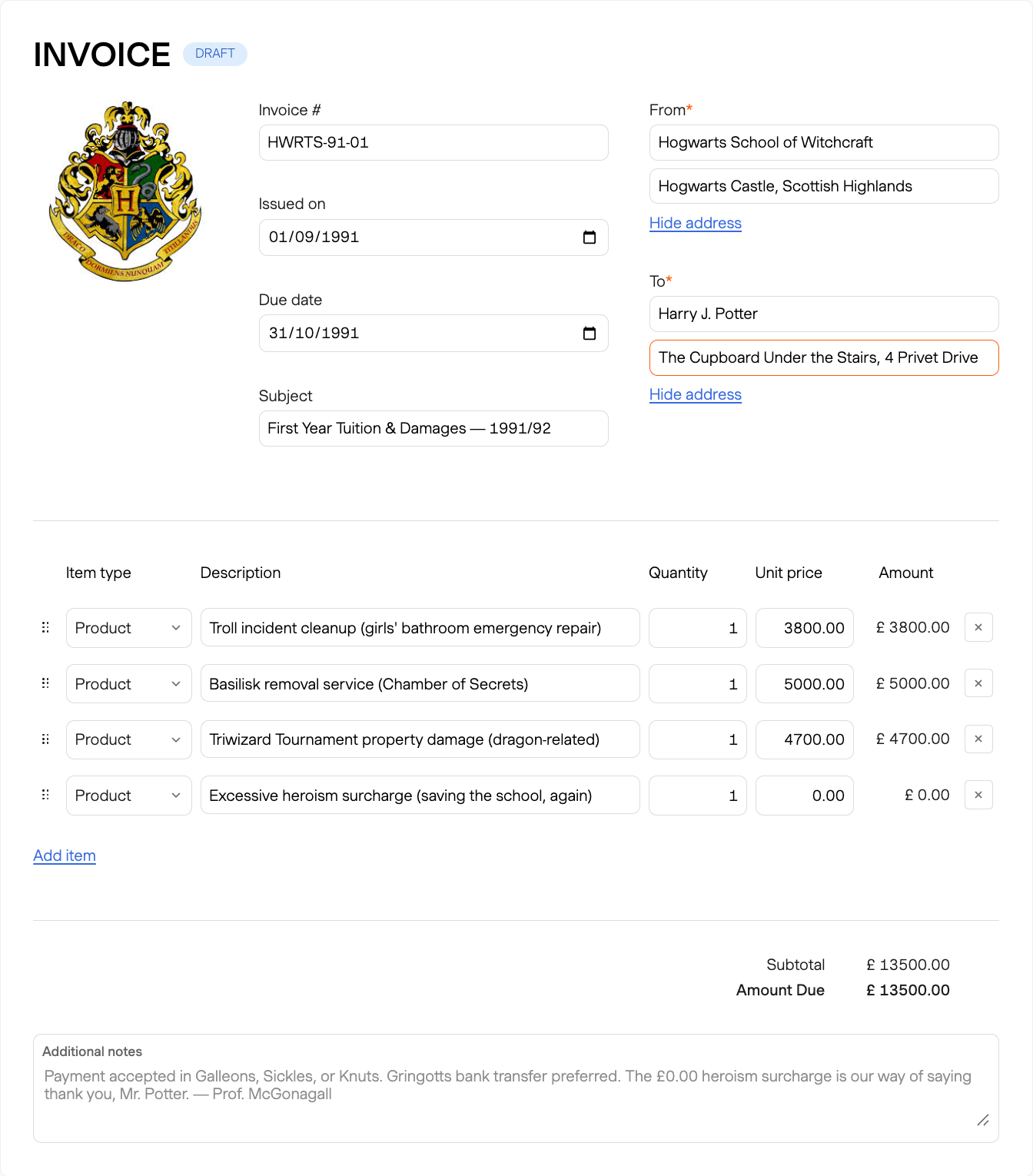
Preview how your invoice will handle distance-based charges, integration with dispatch systems, and tax compliance for the transportation industry.

Invoice App for Transportation FAQs

  • Harvest allows you to customize payment terms by setting default payment due parameters like 'Upon receipt' or 'Net 30' for your invoices. This feature is particularly beneficial for freight contracts that need tailored billing conditions.

  • Invoicing apps can support multi-state tax compliance by automating the calculation of state-specific taxes and generating reports that align with different state requirements. This helps ensure businesses adhere to varying tax codes without manual intervention, reducing the risk of errors and penalties.

  • Yes, you can assign a specific currency to each client. Invoices for that client will use their assigned currency automatically.
  • Invoicing apps may struggle with complex logistics billing due to limitations in handling varied pricing models, such as tiered or dynamic pricing based on fuel surcharges and route changes. They may also have difficulty integrating with all necessary systems, potentially creating data silos.

  • Integration with dispatch systems is crucial as it ensures that billing data aligns with operational data, reducing errors and duplicate entries. It streamlines the workflow by syncing schedules, loads, and invoices, ultimately improving efficiency and accuracy in billing processes.