Harvest
Invoices
Sign up

Invoice Software for Healthcare

Harvest offers customizable financial reporting, making it ideal for healthcare providers who need detailed insights into patient billing and payments.

INVOICE DRAFT

Add your logo here
Item type
Description
Quantity
Unit price
Tax
Amount
Subtotal
$0.00
Discount
$0.00
Amount Due
$0.00
Get paid via:
Credit card / Debit card
ACH
Wire transfer

Customise invoice

Appearance

Add a logo
Show invoice title

Invoice settings

Tax Add up to 2 tax rates
%
Discount Apply a discount percentage
%

Essential Features for Healthcare Invoicing Software

Effective healthcare invoicing software must prioritize compliance and seamless integration to streamline operations and protect patient data. Key among these is HIPAA compliance, which mandates robust security measures like data encryption, access controls, and comprehensive audit trails to safeguard Protected Health Information (PHI). Without these, practices face significant legal and financial risks, with potential fines reaching tens of thousands of dollars per violation. Furthermore, deep integration with Electronic Health Record (EHR) systems is crucial, enabling automatic transfer of patient demographics, diagnoses, and procedure codes directly into invoices, thereby reducing manual data entry errors and improving billing accuracy by up to 30%. Finally, look for specialized billing features tailored to medical specialties, including support for specific CPT and ICD-10 codes, modifiers, and complex claim rules unique to fields like cardiology or orthopedics, ensuring accurate and timely reimbursement.
Avoiding Common Pitfalls in Healthcare Billing Software

Navigating the complexities of healthcare billing requires vigilance to avoid common pitfalls that can lead to revenue loss and operational headaches. A primary concern is compliance issues, where inadequate software can result in rejected claims due to outdated coding, incorrect modifiers, or insufficient documentation, leading to significant delays in payment. Ensure the software offers regular updates to stay current with ever-evolving regulatory changes, such as annual CPT code revisions. Another trap is integration challenges; poorly integrated systems often create data silos, requiring staff to manually reconcile information between the EHR and billing software, which can consume 10-15 hours per week in larger practices. Prioritize solutions with proven, robust APIs for smooth data exchange. Lastly, effectively handling complex billing scenarios like bundled payments, capitation, or multiple insurance payers demands software capable of intricate rule-based processing to prevent underbilling or overbilling.

Selection Criteria for Choosing Healthcare Invoicing Solutions

Selecting the right healthcare invoicing solution hinges on its ability to enhance efficiency, accuracy, and financial visibility. First, prioritize software offering automated eligibility verification, which checks patient insurance status and benefits in real-time, reducing claim rejections by up to 20% and improving upfront collections. This feature is critical for minimizing administrative burden and ensuring patients understand their financial responsibility. Second, robust real-time claim tracking capabilities are essential, allowing your team to monitor the status of every claim from submission to payment. This transparency helps identify bottlenecks, follow up on denials promptly, and accelerate the revenue cycle. Finally, look for solutions with customizable reporting features. These allow you to generate tailored reports on key performance indicators (KPIs) such as claim denial rates, average days in accounts receivable, and revenue by payer or service line, providing actionable insights for continuous improvement.

Preview Your Healthcare Invoice Template in Action

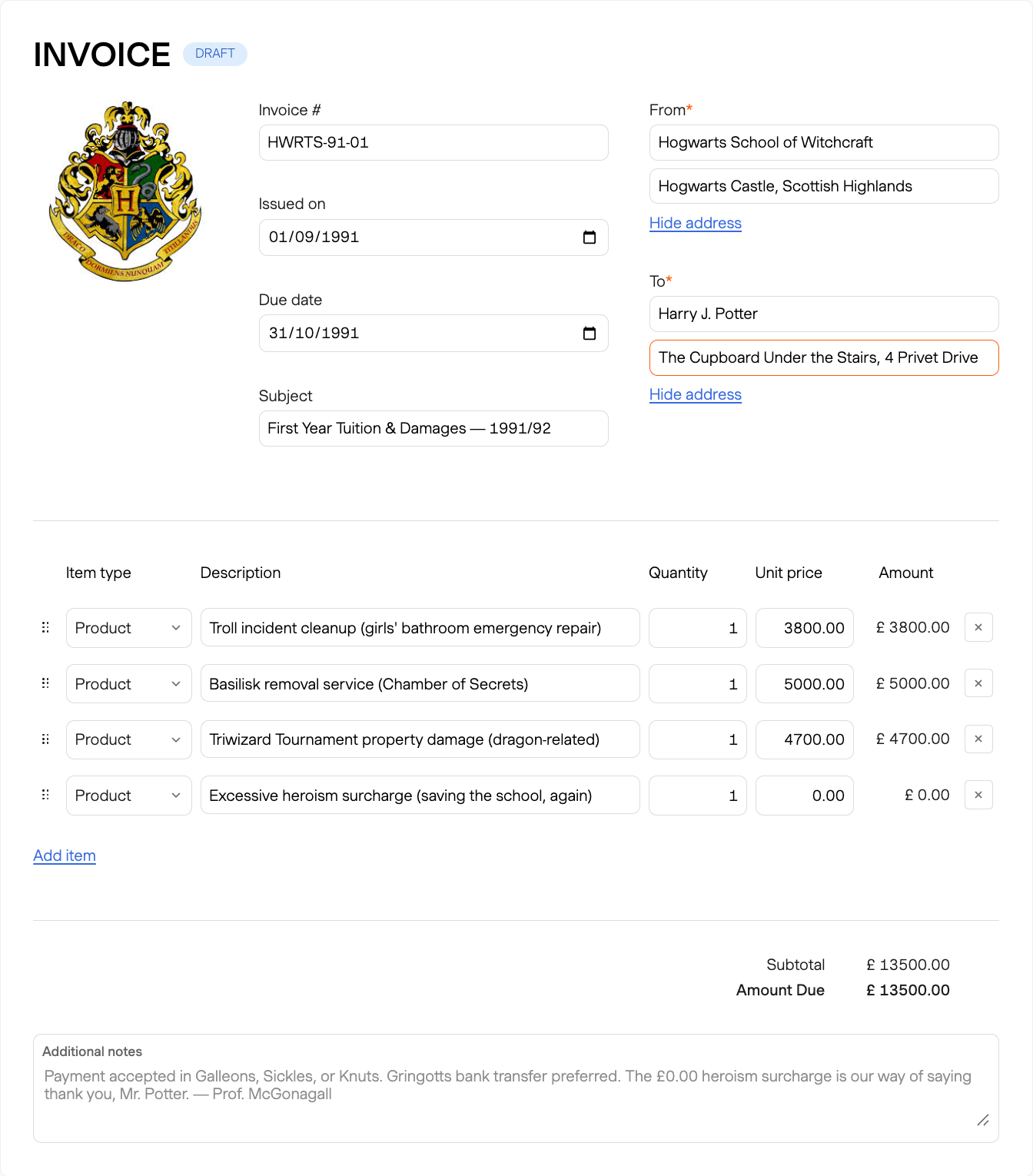
View how your invoice includes medical billing fields, EHR integration, and HIPAA compliance — ready for healthcare providers.

Invoice Software for Healthcare FAQs

  • Customizable reporting in healthcare invoicing allows providers to filter and export reports on financial performance and patient billing. This capability offers detailed insights into invoice and payment statuses, helping healthcare providers make informed decisions and optimize their billing processes.

  • Key compliance issues with healthcare invoicing software include ensuring HIPAA compliance by protecting patient data through encryption and access controls. Additionally, software must regularly update to accommodate changes in coding standards and healthcare regulations to prevent claim rejections and ensure timely reimbursements.

  • You need a Stripe or PayPal account connected to Harvest. Once set up, clients can pay invoices directly through a link in the invoice email.
  • While invoice software can streamline and assist in managing claim denials through alerts and reports, full automation is challenging due to the complexity of claim adjudication processes. Human oversight is often necessary to interpret and resolve denials effectively.

  • Harvest offers customizable reporting options that can be used alongside EHR systems to provide detailed financial insights, although specific integration capabilities should be confirmed based on the healthcare provider's system requirements.