Harvest
Invoices
Sign up

Purchase Order Template for Japan

Harvest provides flexible invoice and estimate customization, allowing you to adapt templates to meet various business needs, though specific support for Japanese requirements is not detailed.

INVOICE DRAFT

Add your logo here
Item type
Description
Quantity
Unit price
Tax
Amount
Subtotal
$0.00
Discount
$0.00
Amount Due
$0.00
Get paid via:
Credit card / Debit card
ACH
Wire transfer

Customise invoice

Appearance

Add a logo
Show invoice title

Invoice settings

Tax Add up to 2 tax rates
%
Discount Apply a discount percentage
%

Essential Fields for Japanese Purchase Orders

For B2B transactions in Japan, your purchase order (PO) template should align with the requirements of the Qualified Invoice System (QIS), implemented on October 1, 2023, to enable buyers to claim consumption tax input credits. Key mandatory fields for a compliant Japanese PO include the name or title of the qualified invoice issuer and the transaction date. You must also detail the transaction, including a clear description of goods or services. Crucially, the supplier's Japan Consumption Tax (JCT) registration number, known as a T-Number, is required; this is "T" followed by a 13-digit Corporate Number. Additionally, specify the total cost, the applied tax rate (either the standard 10% or the reduced 8% for certain foodstuffs and newspapers), and the total consumption tax amount for each rate. If any items are subject to the reduced tax rate, this must be clearly indicated.
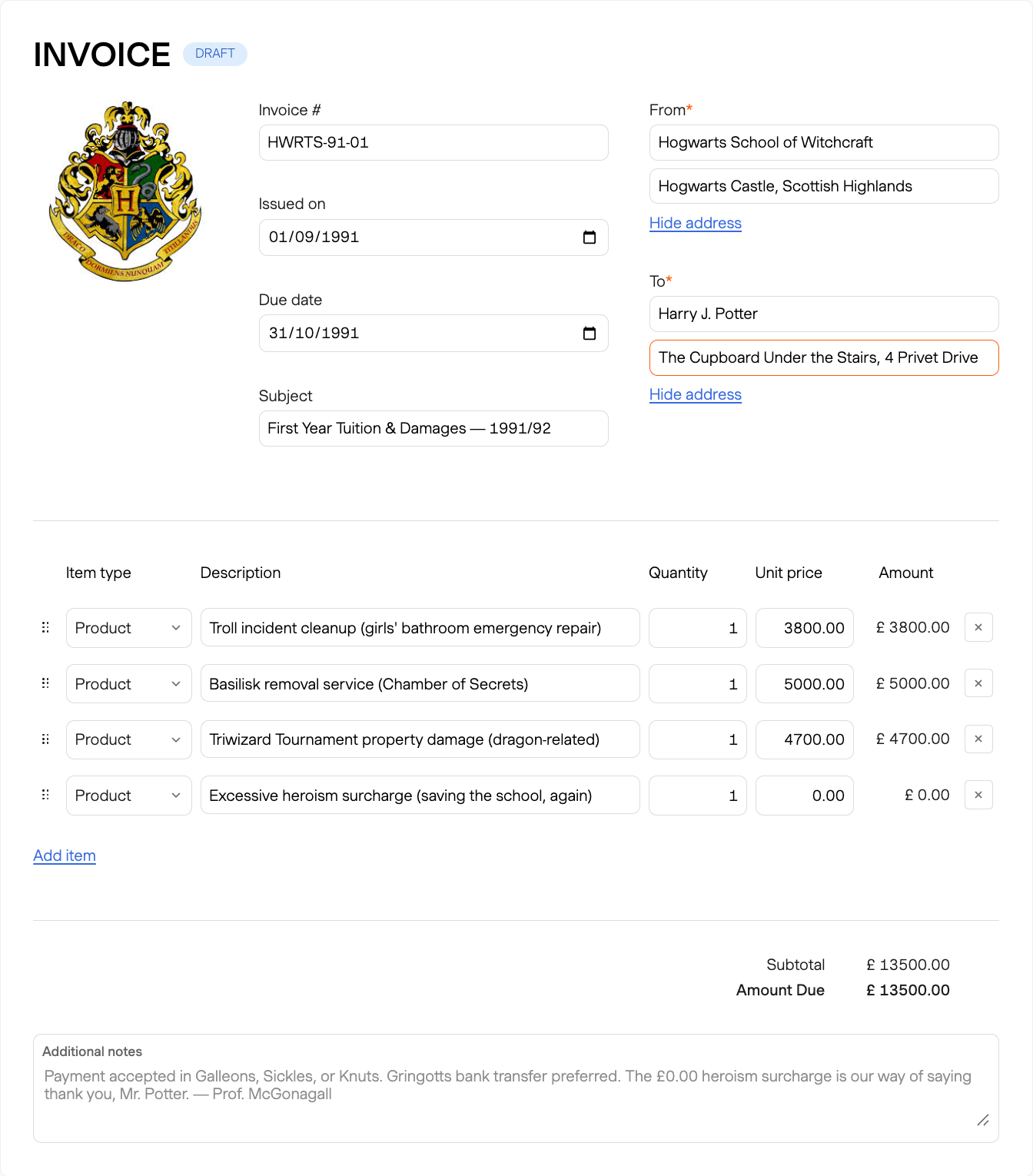
Customizing Your Purchase Order Template for Japan

When customizing your purchase order template for Japan, prioritize clear communication and cultural appropriateness. Ensure your template fully supports Japanese characters (Kanji, Hiragana, Katakana) by using appropriate fonts like Adobe font sets or specific Japanese fonts such as M PLUS 1, as default fonts may not display correctly. For readability, aim for line lengths between 15 and 35 characters for Japanese text. Avoid using italics; instead, use font weight variations or brackets for emphasis. Japanese characters often appear larger than Latin characters at the same point size, so consider reducing Japanese font sizes by 10-15% for visual harmony. Professionally, business documents in Japan often utilize the です・ます style and keigo (honorific language).

Legal Considerations for Purchase Orders in Japan

In Japan, purchase orders are not just a customary business practice but also carry certain legal implications. They can serve as binding agreements between buyers and sellers, outlining the terms and conditions of a transaction. Ensuring that your purchase order complies with local legal requirements is crucial to avoid potential disputes. It is also important to consider the local tax implications, especially with the introduction of the Qualified Invoice System, which affects how consumption tax is handled. Proper documentation is essential to meet these legal standards and facilitate smooth business operations.

See Your Japanese Purchase Order Template in Action

Preview how your purchase order will look with JCT registration fields and Japanese character support — ready for your business transactions in Japan.

Purchase Order Template for Japan FAQs

  • In Japan, a purchase order can act as a legally binding document that specifies the terms of a business transaction between a buyer and a seller. It is crucial to ensure that all terms are clearly defined and mutually agreed upon to prevent disputes. Additionally, purchase orders must adhere to local regulations, including tax compliance under the Qualified Invoice System, to ensure their validity.

  • Generally, purchase order templates cannot automatically adapt to Japanese tax regulations. Businesses need to manually ensure that their templates are updated to reflect current tax laws and rates, such as the Qualified Invoice System and the applicable consumption tax rates. Automatic adaptation would require advanced software capabilities and constant updates aligned with legal changes.

  • Harvest offers several user roles, including Admin, Project Manager, and Team Member. Each role has different permissions, such as managing projects, viewing reports, or tracking time, allowing you to control access and maintain security within your team.
  • In Japan, common types of purchase orders include standard purchase orders, which specify the details of a purchase agreement, and blanket purchase orders, which outline terms for recurring purchases over a specified period. These documents often contain detailed terms and conditions to ensure clarity and compliance with local business practices.

  • Free purchase order templates tailored for Japan can often be found on business resource websites, government portals, or through industry-specific associations. These sources provide templates that are generally aligned with local business practices and regulatory requirements.