Harvest
Invoices
Sign up

Receipt Template for Germany

Harvest simplifies the process of adding essential tax information, like VAT numbers, to your receipts, ensuring compliance with basic requirements in Germany.

INVOICE DRAFT

Add your logo here
Item type
Description
Quantity
Unit price
Tax
Amount
Subtotal
$0.00
Discount
$0.00
Amount Due
$0.00
Get paid via:
Credit card / Debit card
ACH
Wire transfer

Customise invoice

Appearance

Add a logo
Show invoice title

Invoice settings

Tax Add up to 2 tax rates
%
Discount Apply a discount percentage
%

Key Features of a Compliant German Receipt

To ensure your German receipt is legally compliant, it must include several mandatory fields that satisfy tax authority requirements. Essential elements include the full name and address of both the issuer and the recipient, a unique and sequential invoice number, and the date of issue. Crucially, the receipt must clearly state the tax number or VAT identification number (USt-IdNr.) of the issuing business. For each item or service, you need a precise description, the quantity, the unit price, the net amount, the applicable VAT rate (typically 19% standard or 7% reduced), the calculated VAT amount, and the total gross amount due. Proper sequential numbering of receipts is vital for audit trails.
Customizing Your Receipt Template

Tailoring your receipt template is crucial for different transaction types, whether you're dealing with businesses (B2B) or consumers (B2C), and for varying service or product offerings. For B2B transactions, it's often beneficial to include fields for the recipient's VAT ID number, especially for cross-border services where reverse charge might apply. In contrast, B2C receipts can be simpler, focusing on clarity for the end-consumer. If you provide digital services, your template should clearly differentiate these from physical goods, perhaps by including specific service periods or usage details. Customizing fields allows you to capture relevant information efficiently and present it professionally, aligning with your specific business model.

Avoiding Common Pitfalls in Receipt Compliance

One significant area to watch for in German receipt compliance is the correct application of reverse charge mechanisms for certain B2B services, particularly cross-border transactions within the EU. Here, the recipient, not the issuer, is responsible for declaring and paying the VAT, and your receipt must explicitly state "Reverse Charge" or "Steuerschuldnerschaft des Leistungsempfängers." Another common pitfall is inconsistent or non-sequential invoice numbering, which can lead to issues during tax audits. Always ensure your numbering system is unbroken. Finally, pay close attention to the formatting of receipts for tax authorities; while digital receipts are accepted, they must be stored securely and be easily accessible and readable for the mandatory retention period, typically ten years.

See Your German Receipt Template in Action

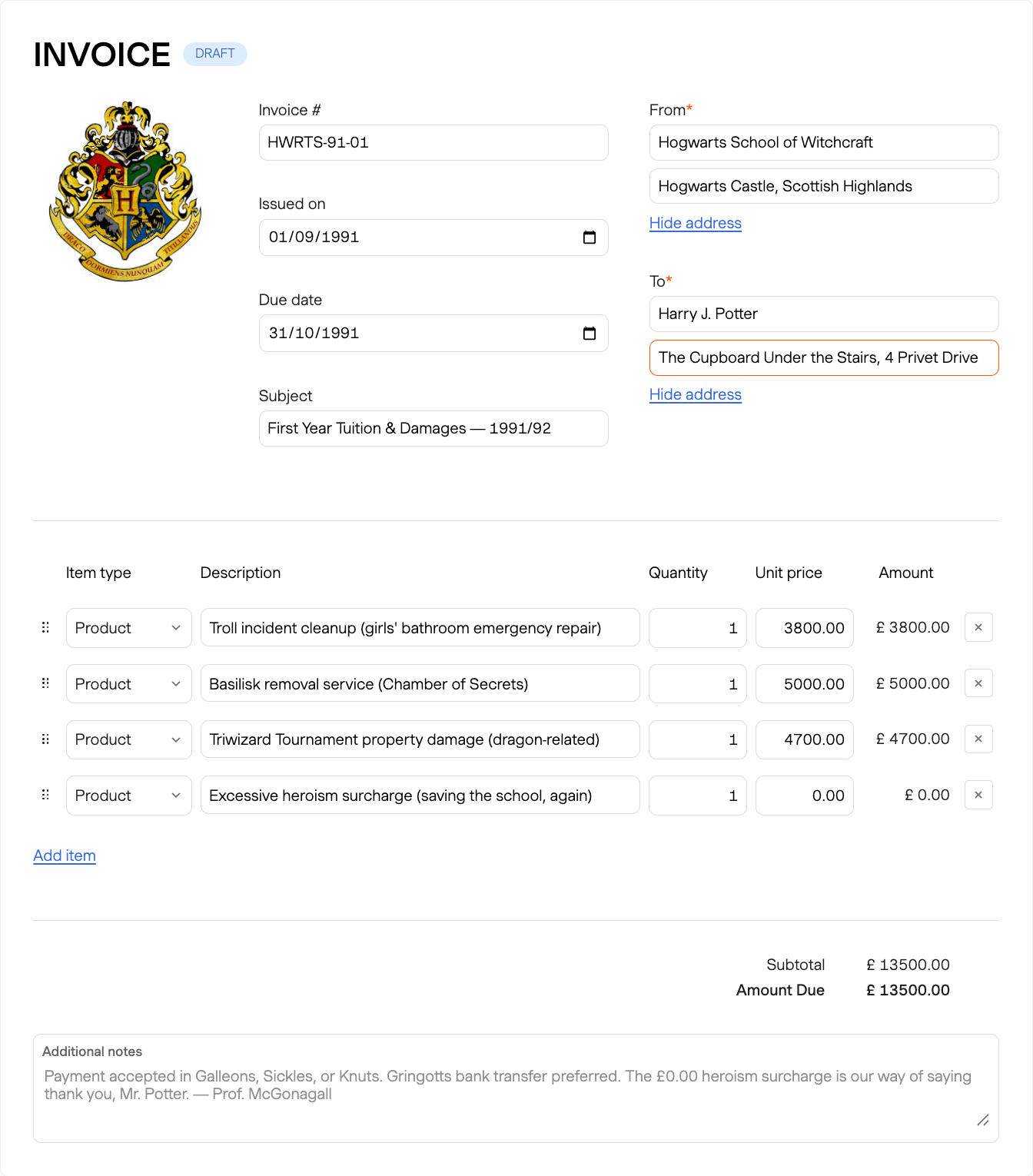
Preview how your receipt will display mandatory fields like VAT numbers and address, ensuring compliance with German tax requirements.

Receipt Template for Germany FAQs

  • Harvest allows you to add mandatory fields like VAT numbers to your receipts, ensuring compliance with German VAT requirements.

  • Harvest simplifies the process of adding essential tax information, like VAT numbers, to your receipts, ensuring compliance with basic requirements in Germany.

  • Yes, in Harvest, you can set up project budgets to track spending and manage costs effectively. This helps you ensure projects remain within budget and on target.
  • In Germany, the standard VAT rate is 19%, while a reduced rate of 7% applies to certain goods and services, such as food and books.

  • Receipt templates can automate many aspects of compliance, but they may not fully capture complex transaction types or dynamically adjust for unique tax scenarios without manual input.