Harvest
Invoices
Sign up

Send Invoice in Japan

Harvest provides flexible invoicing options that are adaptable for various international needs, including customization for necessary tax details and company information.

INVOICE DRAFT

Add your logo here
Item type
Description
Quantity
Unit price
Tax
Amount
Subtotal
$0.00
Discount
$0.00
Amount Due
$0.00
Get paid via:
Credit card / Debit card
ACH
Wire transfer

Customise invoice

Appearance

Add a logo
Show invoice title

Invoice settings

Tax Add up to 2 tax rates
%
Discount Apply a discount percentage
%

Understanding Japan's Invoicing Regulations

Japan's invoicing regulations are primarily governed by the National Tax Agency (NTA) and are crucial for businesses operating within the country. The NTA is the key regulatory body responsible for the administration of tax laws, including those related to the Japanese Consumption Tax (JCT), which functions similarly to a Value Added Tax (VAT) system in other countries. The JCT currently has a standard rate of 10% and a reduced rate of 8% for certain goods and services, such as food and newspapers. Adhering to these regulations is not merely a formality; it's essential for maintaining legal standing and financial health.

Legal implications of non-compliance can be severe, ranging from significant tax penalties and fines to the disallowance of input tax credits, which directly impacts a business's net tax liabilities. Improper documentation or retention of invoices can lead to increased scrutiny from tax authorities, potentially triggering time-consuming audits and operational disruptions. In serious cases, such as fraud, businesses may even face legal repercussions and substantial reputational damage, impacting customer trust and business relationships. Therefore, a proactive approach to understanding and complying with these regulations is paramount.
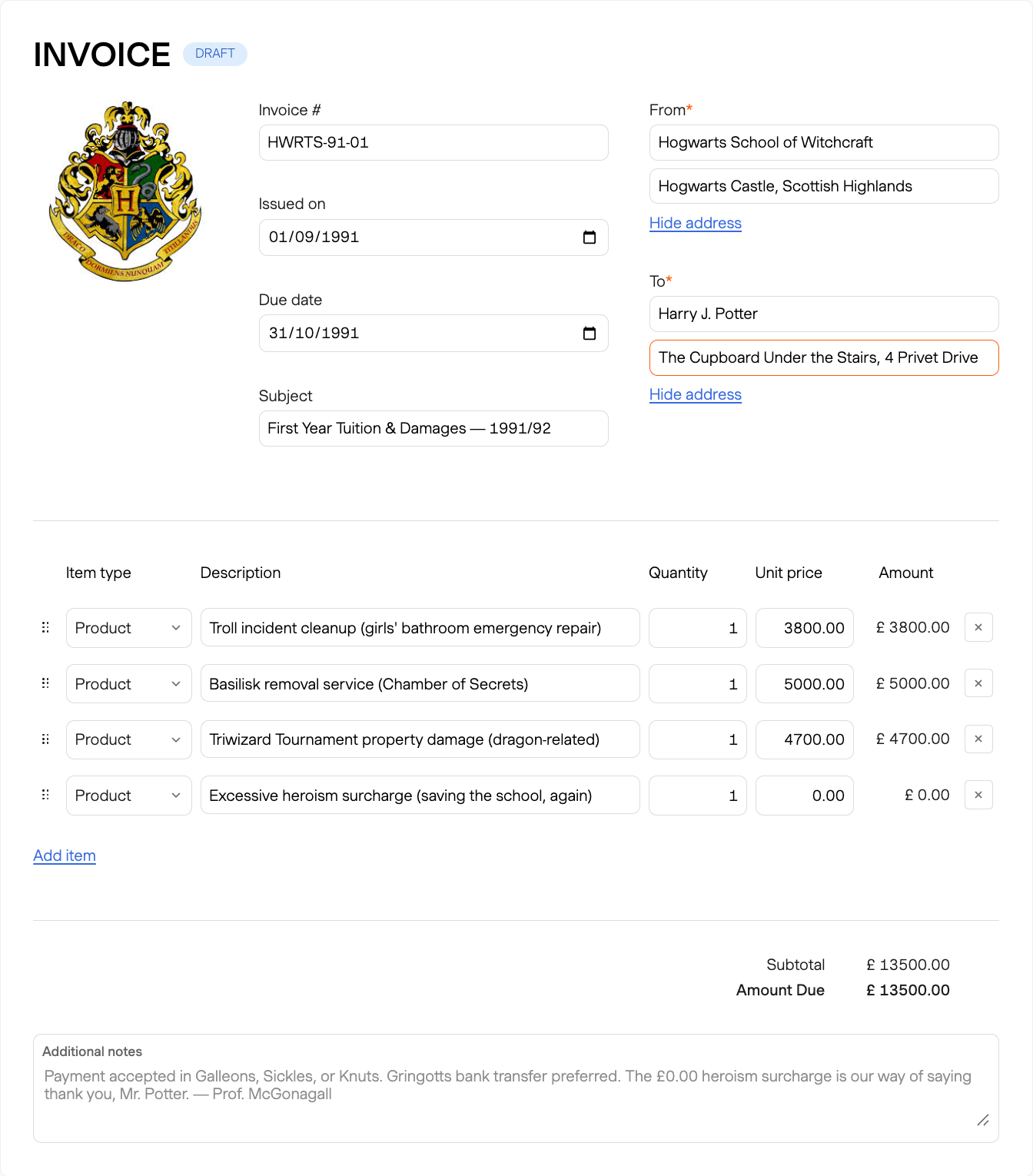
Essential Information for Japanese Invoices

Crafting an invoice for a Japanese business requires attention to specific mandatory details and an understanding of cultural nuances in presentation. While there are no strict legal requirements for how an invoice should be formatted, clarity and comprehensibility are highly valued.

  • The name or title and registration number (a 13-character "T-Number") of the qualified invoice issuer.
  • The date of the transaction.
  • A detailed description of the transaction, including a clear indication if any goods or services are subject to a reduced tax rate.
  • The total amount of consideration for each tax rate (either excluding or including tax) and the applicable tax rates (8% or 10%).
  • The amount of consumption tax classified by each tax rate, rounded only once per tax rate per invoice.
  • The name or title of the entity to which the invoice is delivered (the recipient).

Culturally, Japanese business practices emphasize respect, meticulous attention to detail, and harmony ("Wa"). This translates to invoices that are not only accurate but also professionally presented. Common mistakes to avoid include calculation errors, especially with multiple consumption tax rates. Incorrect dates, names, or addresses can also cause issues and leave a negative impression. While less common now, historically, forgetting to add a hanko (seal) could be an issue, though government efforts are reducing its necessity. Ensuring clear separation of tax-included and tax-excluded amounts is also crucial for transparency and compliance.

The Qualified Invoice System in Japan

The Qualified Invoice System (QIS), implemented on October 1, 2023, represents a significant shift in Japan's consumption tax framework, impacting how businesses claim input tax credits. Under this system, only invoices issued by registered "qualified invoice issuers" are eligible for claiming purchase tax credits. This means that businesses must ensure their suppliers are registered to deduct consumption tax on their purchases.

To register and comply with the QIS, businesses need to follow a structured process:

  • Eligibility: Any business that is a taxable person under the Consumption Tax Act can apply to become a qualified invoice issuer. This includes corporations and sole proprietors.
  • Application Process: Businesses must submit the "Application for Registration of Qualified Invoice Issuer" (適格請求書発行事業者の登録申請書) to the National Tax Agency (NTA). This can be done online through the NTA's e-Tax system or by submitting a paper form to the local tax office. Foreign companies without a legal presence in Japan cannot register online but can apply via paper.
  • Registration Number: Upon approval, the business will receive a unique 13-character registration number, often referred to as a "T-Number," which must be included on all qualified invoices issued. The details of registered issuers are published on the NTA's public website.
  • Impact on Businesses: The QIS has a profound impact, as it has become a critical factor in business partner selection. Businesses that do not register risk losing customers, as their partners will be unable to claim input tax credits without a qualified invoice. Even tax-exempt businesses may consider registering, though it would make them liable for consumption tax. Transitional measures are in place until September 30, 2026, allowing 80% of non-qualified invoices to be deductible, decreasing to 50% until September 30, 2029. Purchases under ¥10,000 can also be deducted without a qualified invoice until September 30, 2029.

E-Invoicing vs. Traditional Invoicing in Japan

While traditional paper invoicing remains common, e-invoicing is gaining traction in Japan, offering distinct benefits and challenges for businesses. E-invoicing involves the electronic generation, transmission, and receipt of invoices in a structured digital format, replacing manual paper processes. In contrast, traditional invoicing relies on physical paper documents, often sent via postal services.

The benefits of e-invoicing are numerous:

  • Cost Reduction: It eliminates expenses associated with printing, paper, postage, and physical storage.
  • Improved Processing Times: E-invoicing enables instant delivery and receipt, significantly reducing processing and payment cycles, which optimizes cash flow.
  • Enhanced Accuracy: Automation minimizes manual data entry errors, leading to more accurate billing data.
  • Increased Efficiency: It streamlines operations, making it easier to review, approve, and issue invoices, especially for businesses with remote workforces.
  • Environmental Sustainability: Reducing paper usage contributes to greener business practices.

However, businesses may face challenges such as the initial investment in compatible systems and the need for staff training. Legal considerations for e-invoicing in Japan are primarily governed by the Qualified Invoice System and the amended Electronic Books Preservation Act, which went into effect in January 2022. While e-invoicing is not yet fully mandatory for all transactions, Japan has adopted the Peppol JP PINT format (based on Peppol BIS Billing 3.0) as its national standard, with the Japan Peppol Authority overseeing compliance. E-invoices must adhere to QIS standards and be retained digitally for 7 years under Japanese tax laws. Businesses that wish to claim input tax credits under the QIS are strongly encouraged to issue qualified invoices, which can be done electronically.

Preview Your Japanese Invoice Template

See how your invoice will display with Japanese tax rates and compliance details — ready to send to clients in Japan.

Send Invoice in Japan FAQs

  • Harvest allows you to customize invoice details, including company name and address, which can be used to include necessary information like transaction date and issuer name.

  • The Qualified Invoice System requires businesses to use invoices from registered issuers to claim tax deductions. Only qualified invoices are eligible for claiming purchase tax credits, making it crucial for businesses to ensure compliance with this system to maintain their tax benefits.

  • Harvest takes data security seriously and uses industry-standard encryption to protect your information. They also have secure data centers and conduct regular security audits to ensure compliance with best practices.
  • While invoicing tools can greatly assist in adhering to many regulatory requirements, they may not automatically comply with all specific local regulations. It is important for businesses to stay informed about local laws and make necessary adjustments to ensure full compliance.

  • Harvest supports the inclusion of consumption tax on invoices by allowing you to apply taxes to each line item, ensuring that your invoices reflect the correct tax amounts required by Japanese regulations.