Harvest
Invoices
Sign up

Send Invoice in Philippines

Harvest simplifies international invoicing with multi-currency support and easy online payment integration.

INVOICE DRAFT

Add your logo here
Item type
Description
Quantity
Unit price
Tax
Amount
Subtotal
$0.00
Discount
$0.00
Amount Due
$0.00
Get paid via:
Credit card / Debit card
ACH
Wire transfer

Customise invoice

Appearance

Add a logo
Show invoice title

Invoice settings

Tax Add up to 2 tax rates
%
Discount Apply a discount percentage
%

Understanding Philippine Invoicing Regulations

Navigating Philippine invoicing regulations is crucial for any business operating in the country, as compliance with the Bureau of Internal Revenue (BIR) is strictly enforced. The legal framework for invoicing has seen significant updates, particularly with the implementation of the Ease of Paying Taxes (EoPT) Act and the ongoing transition to electronic invoicing. As of April 27, 2024, the sales invoice has replaced the official receipt as the primary document for evidencing both sales of goods and services. This means that service providers, who traditionally issued official receipts, must now issue sales invoices for their transactions.

For VAT-registered businesses, a VAT invoice must be issued for every sale, regardless of the amount, and must clearly state that the seller is VAT-registered, include their Taxpayer Identification Number (TIN) with the branch code, the total amount inclusive of 12% VAT (with the VAT amount shown separately), the transaction date, quantity, unit cost, and description of goods or services. Non-VAT registered businesses are required to issue a non-VAT invoice for transactions valued at ₱500 or more, or upon buyer's request. If the aggregate amount of transactions less than ₱500 exceeds the ₱500 threshold at the end of the day, an invoice must also be issued. All invoices must include the seller's registered name, TIN, business address, and a unique serial number.

The Philippines is also moving towards mandatory e-invoicing. While a pilot program began in July 2022 for the top 100 large taxpayers, the mandatory rollout for Phase 1, which includes Large Taxpayers Service (LTS), e-commerce businesses, and exporters, has been extended to December 31, 2026. E-invoices must be generated and reported in JSON/XML format with a digital signature and transmitted to the BIR's Electronic Invoicing/Receipting System (EIS) within three calendar days of the transaction. Businesses are required to archive e-invoices for 10 years.
Best Practices for Sending Invoices in the Philippines

Effective invoicing in the Philippines goes beyond mere compliance; it also involves understanding local business etiquette and ensuring smooth payment processes. To ensure timely payments and maintain good client relationships, consider these best practices:

  • Clarity and Detail are Paramount: Always provide clear, itemized descriptions of services or goods, including quantities, unit costs, and the total amount due. This minimizes disputes and helps clients understand exactly what they are paying for. For VAT-registered businesses, explicitly show the 12% VAT amount separately.
  • Standardized Templates: Using a consistent, professional invoice template helps maintain consistency and reduces errors. Many invoicing software solutions offer customizable templates that automatically include essential information like your business name, TIN, address, and invoice number.
  • Clear Payment Terms: Clearly state your payment terms, including the due date, accepted payment methods, and any late payment policies, upfront. Common payment terms might be "Net 30" (payment due in 30 days) or "Due Upon Receipt".
  • Diverse Payment Methods: Offering a variety of payment methods caters to diverse client preferences and the evolving digital payment landscape in the Philippines. Popular options include bank transfers (InstaPay for instant transfers up to ₱50,000, PESONet for larger, end-of-day transfers), digital wallets like GCash and Maya, and credit/debit cards. Cash remains prevalent, especially in smaller businesses.
  • Proactive Follow-up: Implement a system to track outstanding invoices and send timely reminders as the due date approaches. While direct and polite, follow-ups should respect local business communication styles. For late payments, a professional and reassuring approach is recommended, documenting the entire process.

Invoicing for Freelancers and Small Businesses

Freelancers and small businesses in the Philippines face unique invoicing challenges, making tailored strategies essential for compliance and efficient cash flow. All freelancers are legally required to register with the Bureau of Internal Revenue (BIR) and obtain a Tax Identification Number (TIN) to legitimize their business and issue official receipts or invoices. As of April 27, 2024, freelancers, like other service providers, must issue sales invoices as the primary document for their services, replacing the traditional official receipt.

To register with the BIR as a self-employed individual or sole proprietor, freelancers typically need to file BIR Form 1901, provide a government-issued ID, proof of address, and potentially a DTI certificate if using a business name. The ₱500 annual registration fee has been abolished as of 2025, with only a ₱30 documentary stamp tax upon initial registration. After registration, freelancers must also register their books of accounts and apply for an Authority to Print (ATP) invoices.

  • Your business details: Full name or business name, address, email, and TIN.
  • Client details: Name, address, and contact person (for companies).
  • Unique invoice number and date: Use a sequential numbering system.
  • Itemized services: Clearly describe the work done, hours, or project rate, and the period covered.
  • Payment terms and methods: Specify the due date and how clients can pay.
  • Total amount payable: Include any applicable taxes (e.g., 12% VAT if VAT-registered).

Many freelancers utilize simple tools like Google Docs or Excel for invoicing, while others opt for invoicing software that can automate tasks like generating professional templates, tracking payments, and sending reminders.

Managing Multi-Currency Invoicing

When invoicing international clients from the Philippines, managing multiple currencies and exchange rate considerations becomes a critical aspect of financial management. The primary goal is to ensure clarity for both parties and minimize potential currency conversion losses.

  • Clearly State the Currency: Always specify the currency of payment prominently on your invoice to avoid any misunderstandings or disputes. This is fundamental for international transactions.
  • Agree on Exchange Rates Upfront: If the payment is to be made in a currency different from your operating currency, it's advisable to agree on the exchange rate with your client before issuing the invoice. This can be a fixed rate for the transaction or based on a specific market rate on the invoice date.
  • Consider Multi-Currency Accounts: Utilizing multi-currency accounts can help minimize conversion losses by allowing you to receive and hold payments in different currencies. Some international payment solutions offer this feature, enabling you to avoid immediate conversion to Philippine Pesos (PHP) and convert funds when exchange rates are more favorable.
  • Choose Reliable Payment Platforms: For international transactions, select payment gateways that support multiple currencies and offer competitive exchange rates. Platforms like PayPal and Stripe are widely used for their global reach and multi-currency capabilities. Some local platforms also facilitate international payments.
  • Factor in Conversion Fees: Be aware of potential conversion fees charged by banks or payment processors. These fees can impact your final received amount, so it's wise to factor them into your pricing or discuss them with your client.
  • Invoice Details for International Clients: Ensure your invoice includes your full name or business name, address, email, and any registration numbers (TIN, business permit, or BIR registration). Also, include the client's name, address, contact person, and country of registration. A unique, sequential invoice number is also crucial for international clients' auditing purposes.

See Your Philippine Invoice Template in Action

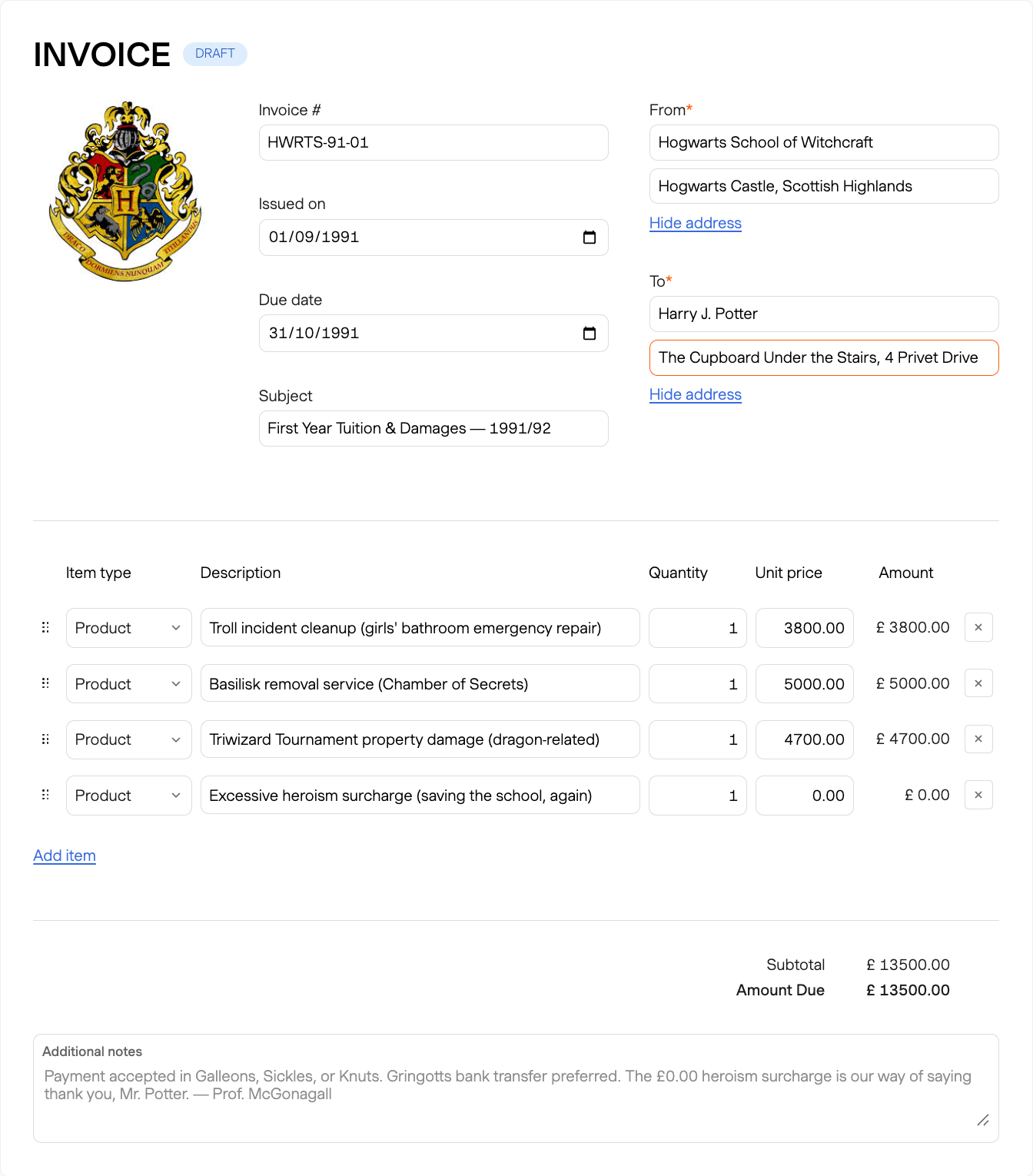
Preview how your invoice will look with PHP currency, tax details, and compliance with Philippine regulations — ready to send.

Send Invoice in Philippines FAQs

  • Harvest allows you to invoice clients in different currencies by setting a default currency for your account and a specific currency for each client.

  • In the Philippines, legal requirements for sending invoices include issuing a VAT invoice for every sale if VAT-registered, which must contain the seller's TIN, the total amount with 12% VAT, and details of the goods or services. Non-VAT registered businesses must issue a non-VAT invoice for transactions over ₱500. The shift to electronic invoicing mandates that e-invoices be reported to the BIR's system within three days.

  • Yes, Harvest allows you to add notes and comments to your invoices. This feature can be useful for providing additional context or information to clients regarding specific charges or billing periods.
  • While invoicing software can help with many aspects of generating compliant invoices, such as format and content, full compliance with BIR requirements often needs manual verification, especially for new regulatory changes. Businesses should stay informed about current regulations and ensure their processes align with BIR standards.

  • Harvest enables you to send invoices directly to clients, include payment links, and follow up with reminders and thank-yous.