
Harvest
Time Tracking
Sign up free

Billable Hours Tracker for Ux Designers

UX designers often struggle with accurately tracking billable hours. Harvest offers a comprehensive solution with one-click timers and detailed reporting tailored for UX workflows.

Try Harvest Free

What should you charge per hour?

Most freelancers and consultants dramatically undercharge. This calculator accounts for what most people miss: non-billable time, taxes, and overhead.

$
Accounting for vacation, holidays, sick days
60%
Most freelancers can bill 50-70% of their time. The rest goes to admin, marketing, proposals, and learning.
$
Software, insurance, equipment, accounting, taxes beyond income tax, etc.
Your break-even rate $0
Recommended rate (+20% buffer) $0
Billable hours per week 0h
Equivalent daily rate $0

Start tracking your billable hours

Walk through the entire flow below. Start a timer, check your reports, and create a real invoice — all in three clicks.

Go ahead — start tracking!

One click and you're timing. Try it right here: start a timer, add an entry, edit the details. This is exactly how it feels in Harvest.

  • One-click timer from browser, desktop & mobile
  • Works inside Jira, Asana, Trello, GitHub & 50+ tools
  • Duration or start/end — your call
  • Day, week & calendar views to stay on top of it all
  • Friendly reminders so no hour gets left behind
Acme Corp
Website Redesign
Homepage layout revisions
1:24:09
Content Strategy
Blog calendar planning
1:30:00
SEO Audit
Technical audit report
0:45:00
Brand Guidelines
Color system documentation
2:15:00
Logo Concepts
Initial sketches round 1
1:00:00

Understanding Billable vs. Non-Billable Hours in UX Design

Billable hours for UX designers encompass direct client work such as user research, wireframing, prototyping, client meetings, and design iterations. Non-billable hours, while essential, include administrative tasks, business development, and internal meetings. Tracking both types is vital for accurate pricing and business sustainability. However, achieving high utilization rates (typically 60-75%) is challenging due to the nature of non-billable tasks eating into capacity. For instance, many agencies aim for about 35 billable hours per week, translating to a 90% billability target, though this is often difficult to maintain due to internal overheads.

Understanding the distinction between billable and non-billable activities helps UX designers manage time effectively and optimize profitability. Many creative professionals struggle with this balance, which can impact profit margins that typically range between 10% and 20%. Properly categorizing tasks and recording time accurately ensures designers can justify costs to clients, enhancing trust and financial success.
Essential Features of a UX-Friendly Time Tracking Tool

For UX designers, a time tracking tool must offer features that align seamlessly with design workflows. Automatic tracking capabilities are crucial, allowing passive recording of activities across applications to enhance accuracy without burdening the designer. Tools like Harvest offer one-click start/stop timers, capturing time efficiently and supporting manual entries for flexibility.

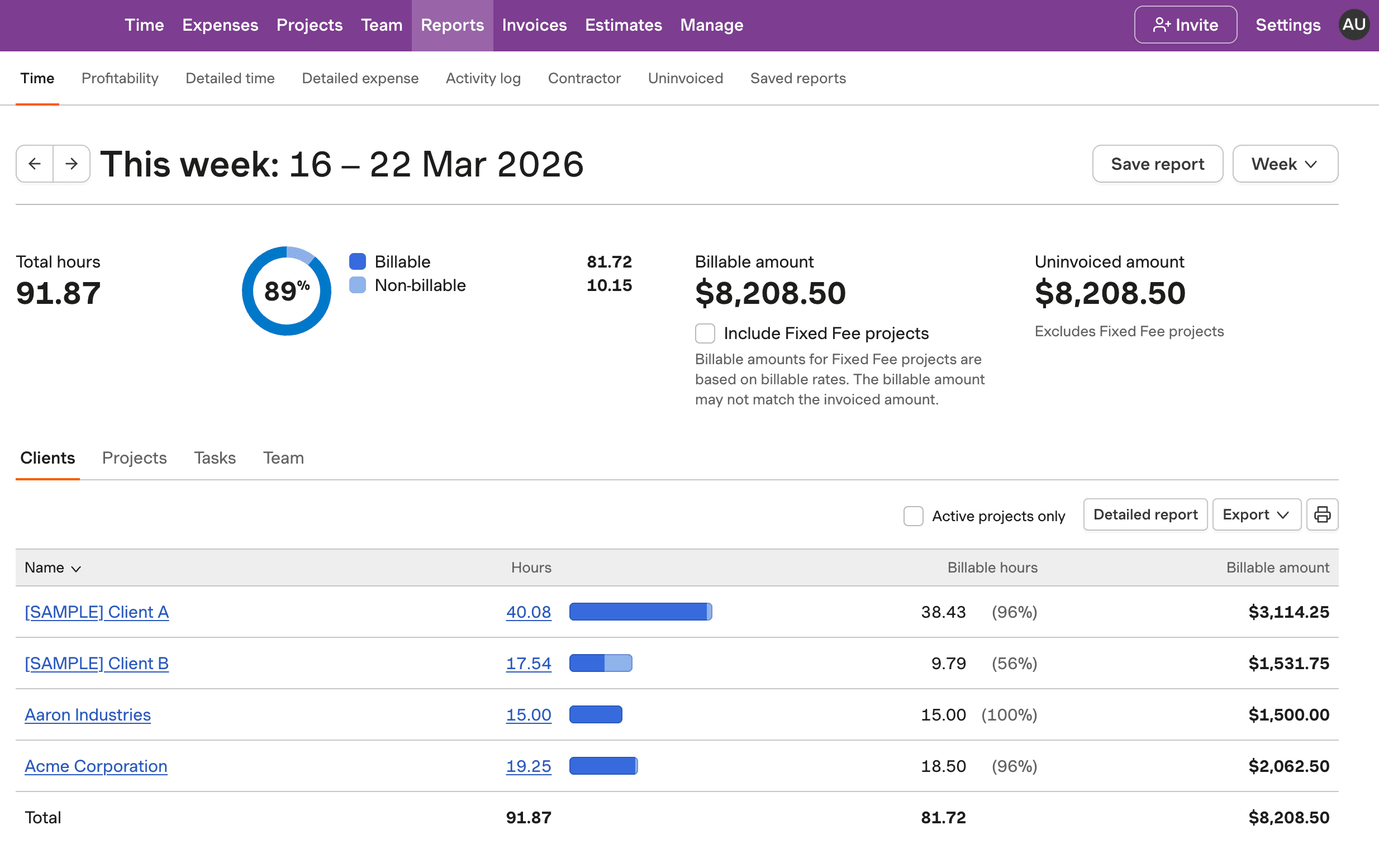
Effective time tracking software should enable project and task management, allowing categorization by client, project, and specific UX tasks such as "Discovery - User Interviews" or "Design - Wireframing." Moreover, comprehensive reporting and analytics are essential, providing insights into project profitability and productivity. Harvest excels here, allowing customization of reports for accurate future estimations. Additionally, invoicing capabilities that generate client-ready invoices directly from tracked hours further streamline operations.

Integrating Time Tracking into the UX Workflow

Integrating time tracking into the UX workflow requires seamless compatibility with existing design tools. Harvest addresses this need by offering integrations with project management platforms like Jira and Asana, linking time entries directly to tasks. Additionally, its ability to sync with calendars ensures that time spent in meetings or scheduled focus blocks is automatically logged, reducing manual entry and minimizing workflow disruption.

For UX designers, maintaining a creative flow without constant interruptions is crucial. Harvest is designed to be unobtrusive, allowing designers to track their time efficiently without breaking concentration. These integrations and minimal disruptions enable UX designers to focus more on creativity while ensuring precise time management for better project outcomes.

Best Practices for Maximizing Billable Hours and Efficiency

Maximizing billable hours requires strategic time management techniques. Real-time tracking is essential to ensure accuracy and capture all billable increments. Strategies such as time blocking, where designers schedule uninterrupted blocks for deep work, and the Pomodoro Technique, which involves working in focused intervals, help maintain concentration and prevent burnout.

It is also vital to manage non-billable tasks strategically. By identifying, optimizing, and potentially delegating these tasks, designers can free up capacity for billable work. Regularly reviewing time reports helps refine project scopes, adjust pricing, and identify inefficiencies. Transparent communication with clients about time allocation further justifies costs and aligns expectations, enhancing client relationships and project success.

Legal and Financial Considerations for UX Designers

UX designers must adhere to legal requirements like the Fair Labor Standards Act (FLSA) in the U.S., which mandates accurate record-keeping of hours worked. Detailed timesheets are not just essential for payroll but also serve as legal documents for audits and dispute resolution. Harvest facilitates this compliance by providing detailed, accurate time logs.

Financially, understanding how to price for profitability is crucial. Designers should calculate effective hourly rates that include overhead and desired profit margins. While free time tracking solutions are available, they may lack advanced features needed for comprehensive time management, making robust paid platforms like Harvest a wise investment for serious professionals.

Track Billable Hours with Harvest

See how Harvest helps UX designers track billable hours efficiently with one-click timers and detailed project reports.

Harvest tool showing billable hours tracking for UX designers

Billable Hours Tracker for Ux Designers FAQs

  • UX designers track billable hours using time tracking tools that integrate with design software. Harvest, for example, offers one-click timers and project management features to categorize work and ensure precise billing.

  • Tracking non-billable hours helps UX designers understand the true cost of their work, optimize workflows, and ensure profitability. Non-billable tasks often impact the overall capacity and need to be managed effectively.

  • Harvest integrates with project management and productivity tools but may require additional steps for specific design tools like Figma. Its flexible integrations support a variety of workflows.

  • Common challenges include inaccurate time tracking and disruption of creative flow. Harvest addresses these with automatic timers and integrations that reduce manual effort and maintain focus.

  • Harvest offers detailed reporting that helps UX designers analyze project phases and productivity. These insights aid in project estimation, workload management, and identifying workflow inefficiencies.

  • UX designers typically aim for utilization rates of 60-75%. This percentage reflects the time spent on billable work versus total working hours, helping in setting realistic targets and pricing strategies.

  • Creatives often find time tracking burdensome due to its interruption of workflow. Tools like Harvest minimize these issues with unobtrusive tracking features that blend into existing workflows.