
Harvest
Time Tracking
Sign up free

Employee Utilization Calculator

Harvest is a time tracking and invoicing tool that helps teams optimize employee utilization, ensuring profitability with accurate billing and insightful reports.

Try Harvest Free

How much revenue is your team leaving on the table?

Most agencies run at 55-60% utilization. Even a small improvement means significant revenue. See what closing the gap looks like for your team.

Number of people who track billable time
$
Blended rate across roles (junior, senior, lead)
55%
Percentage of total hours that are billable. Industry average is 55-60%.
75%
A realistic target for service businesses is 70-80%.
Monthly revenue gap $0
Revenue at current utilization $0/mo
Revenue at target utilization $0/mo
Extra billable hours needed per person/day 0h
Annual revenue opportunity $0

Start tracking team utilization

Walk through the entire flow below. Start a timer, check your reports, and create a real invoice — all in three clicks.

Go ahead — start tracking!

One click and you're timing. Try it right here: start a timer, add an entry, edit the details. This is exactly how it feels in Harvest.

  • One-click timer from browser, desktop & mobile
  • Works inside Jira, Asana, Trello, GitHub & 50+ tools
  • Duration or start/end — your call
  • Day, week & calendar views to stay on top of it all
  • Friendly reminders so no hour gets left behind
Acme Corp
Website Redesign
Homepage layout revisions
1:24:09
Content Strategy
Blog calendar planning
1:30:00
SEO Audit
Technical audit report
0:45:00
Brand Guidelines
Color system documentation
2:15:00
Logo Concepts
Initial sketches round 1
1:00:00

Understanding Employee Utilization

Employee utilization is a critical metric for service-based businesses, representing the percentage of work hours spent on billable tasks compared to total available hours. This calculation is essential for ensuring profitability and efficient resource management. Typical utilization rates for professional services can range from 65% to 85%, depending on the role and industry. For instance, consultants often target a utilization rate of 75-85%, while creative professionals might aim for 65-75%.

Utilization data is typically aggregated from timesheets and project management systems. It is then used to calculate billable hours or track progress against fixed-price milestones. These figures directly influence invoicing processes, where accurate billing and compliance with regulations such as VAT in the EU or GST in Australia are crucial.
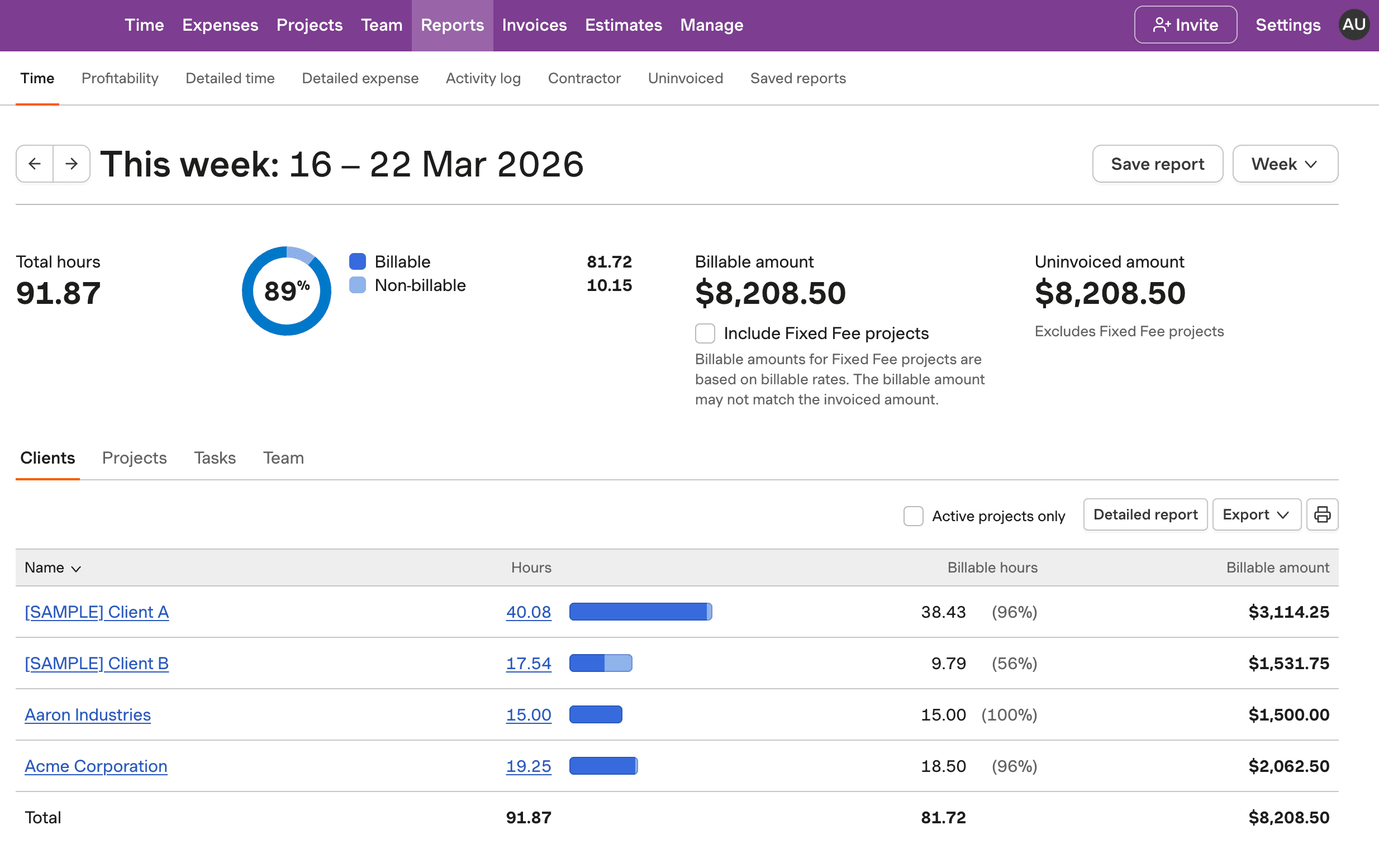
Calculating Utilization with Harvest

Calculating employee utilization can be complex, but Harvest simplifies this process with its robust tracking tools. Harvest allows users to log both billable and non-billable hours, offering insights into how time is spent across various projects. This level of detail helps firms to adjust billing rates and optimize resource allocation for maximum efficiency.

With Harvest, businesses can set flexible billing rates per project or person, ensuring that employee utilization is aligned with profitability goals. By tracking time accurately, companies can also generate detailed reports that inform strategic decisions and enhance financial performance. The tool's integration with platforms like Asana, Trello, and QuickBooks ensures that utilization data is seamlessly incorporated into broader business processes.

Improving Utilization Rates

Improving employee utilization rates is a key objective for many service-based firms. High utilization indicates efficient resource use, which can directly lead to increased profitability. To boost utilization, businesses can leverage detailed time tracking and reporting to identify areas for improvement. For example, identifying non-billable tasks that could be streamlined or automated can free up valuable time for billable work.

Harvest's detailed reports provide insights into team utilization, enabling managers to make informed decisions about resource allocation. Alerts can be set for project budgets, helping to keep utilization in check and avoid overburdening staff. By using Harvest, firms can ensure that their team is working effectively, maximizing the time spent on revenue-generating activities.

Additionally, integrating Harvest with tools like Slack and Jira facilitates real-time communication and collaboration, further enhancing team efficiency and utilization.

Setting Utilization Benchmarks

Setting realistic utilization benchmarks is crucial for managing expectations and driving performance in professional services. Industry benchmarks vary, with IT consultants typically targeting 75-85% utilization, while creative agencies might aim for lower rates due to the nature of their work. Regularly reviewing and adjusting these benchmarks ensures they remain aligned with business objectives and market conditions.

Harvest provides the tools needed to track and analyze utilization rates effectively. By generating detailed reports, businesses can compare actual utilization against set benchmarks, identifying trends and areas for improvement. This data-driven approach supports strategic planning and helps maintain competitive advantage in the marketplace.

Employee Utilization with Harvest

See how Harvest tracks employee utilization rates, providing insights for optimizing team efficiency and profitability.

Screenshot of Harvest tracking employee utilization rates

Employee Utilization Calculator FAQs

  • Employee utilization measures the percentage of available work hours spent on billable tasks. It's crucial for assessing team efficiency and profitability. Typical utilization rates range from 65% to 85%, depending on the industry and role.

  • Employee utilization is calculated by dividing the number of billable hours by the total available work hours. This metric helps businesses understand resource efficiency and optimize billing strategies.

  • Industry benchmarks for employee utilization rates vary. Consultants typically aim for 75-85%, while creative professionals might target 65-75%. These benchmarks help guide performance expectations.

  • To improve utilization rates, streamline non-billable tasks and enhance time tracking accuracy. Harvest's detailed reports can identify inefficiencies, allowing for better resource allocation and increased billable hours.

  • Billable utilization refers to time spent on tasks that are directly invoiced to clients, while non-billable utilization includes tasks that don't generate direct revenue. Understanding this distinction helps optimize team productivity.

  • Harvest tracks both billable and non-billable hours, providing detailed reports on team utilization. This data helps businesses optimize resource allocation and ensure profitability through strategic billing rates.

  • Yes, Harvest integrates with a variety of tools such as Asana, Trello, Jira, Slack, and QuickBooks. These integrations help streamline workflows and enhance the accuracy of utilization tracking.