
Harvest
Time Tracking
Sign up free

Profit Margin Calculator for Remote Workers

Harvest empowers remote workers to track project profitability and manage budgets, ensuring accurate financial insights and improved profit margins.

Try Harvest Free

Calculate markup and margin instantly

Enter cost and selling price to see markup percentage, profit margin, and profit. Switch between modes to price with confidence.

$
$
Markup 66.67%
Profit margin 40.00%
Profit $40.00
Selling price $100.00
Revenue multiplier 1.67x

Track your billable hours with Harvest

Walk through the entire flow below. Start a timer, check your reports, and create a real invoice — all in three clicks.

Go ahead — start tracking!

One click and you're timing. Try it right here: start a timer, add an entry, edit the details. This is exactly how it feels in Harvest.

  • One-click timer from browser, desktop & mobile
  • Works inside Jira, Asana, Trello, GitHub & 50+ tools
  • Duration or start/end — your call
  • Day, week & calendar views to stay on top of it all
  • Friendly reminders so no hour gets left behind
Acme Corp
Website Redesign
Homepage layout revisions
1:24:09
Content Strategy
Blog calendar planning
1:30:00
SEO Audit
Technical audit report
0:45:00
Brand Guidelines
Color system documentation
2:15:00
Logo Concepts
Initial sketches round 1
1:00:00

Understanding Your Remote Worker Income: Beyond the Hourly Rate

For remote workers, understanding income involves more than just tracking hourly rates. While the global average hourly rate for freelancers is $19, industry-specific rates can vary from $15-$55 per hour, depending on the profession. However, this doesn't always translate directly to profit. Gross income often differs significantly from net profit due to various business expenses and taxes that remote workers must consider.

Gross income includes all earnings from services provided, but net profit accounts for expenses like software subscriptions, equipment, and home office costs. For instance, U.S. freelancers can opt for a simplified home office deduction of up to $1,500 or calculate actual expenses based on the percentage of the home used for business. These deductions can significantly impact net profit, making it crucial for remote workers to track all expenses diligently.
Essential Expenses for Remote Workers: What to Track and Deduct

Tracking and deducting expenses is vital for remote workers to optimize their profit margins. Typical expenses include internet access, office supplies, and software subscriptions, which can range from $50 to $200 monthly, with setup costs reaching $1,000. The U.S. tax system allows remote workers to deduct these costs, provided they meet certain criteria, such as exclusive and regular use of a home office.

Remote workers can choose between the simplified deduction of $5 per square foot or actual expense method for their home office. Understanding these options and the requirements, like using the home as the principal place of business, can lead to significant savings. By effectively managing these deductions, remote workers can enhance their financial performance and ensure a higher net profit margin.

Navigating Taxes as a Self-Employed Remote Worker

Understanding self-employment taxes is crucial for remote workers to maintain profitability. In the U.S., self-employment tax is set at 15.3% for 2024, including Social Security and Medicare. Freelancers must pay this on net earnings over $400 and should save 25-30% of their net income for taxes, with higher savings for those in high-tax states.

Moreover, one-half of the self-employment tax is deductible, reducing adjusted gross income. It's essential for remote workers to make estimated tax payments to avoid penalties. By planning for these obligations, remote workers can better manage their finances and focus on maximizing their profit margins.

Calculating Your True Profit Margin: A Step-by-Step Guide

Calculating profit margins is key for remote workers to evaluate financial health. Begin by determining total revenue and identifying all costs, including direct project expenses and indirect costs like home office deductions. Subtracting these from revenue gives the gross profit, while further subtracting operating expenses yields net profit.

To find the profit margin percentage, divide net profit by total revenue and multiply by 100. For example, a freelancer earning $100,000 with $80,000 in expenses would have a 20% profit margin, generally considered good. Understanding and calculating these margins enables remote workers to benchmark against industry standards and identify areas for financial improvement.

Optimizing Profitability: Strategies for Remote Professionals

Optimizing profitability involves strategic pricing and effective management of non-billable time. Remote workers should calculate their minimum hourly rate by covering personal expenses and business costs, factoring in self-employment taxes and non-billable hours. Market research and value-based pricing can help set competitive rates.

For international clients, understanding VAT obligations through the EU's One-Stop Shop (OSS) can streamline tax compliance. Implementing strategies to manage non-billable time, such as using Harvest's detailed tracking features, can further enhance profitability by identifying and focusing on the most lucrative projects and clients.

Profit Margin Insights with Harvest

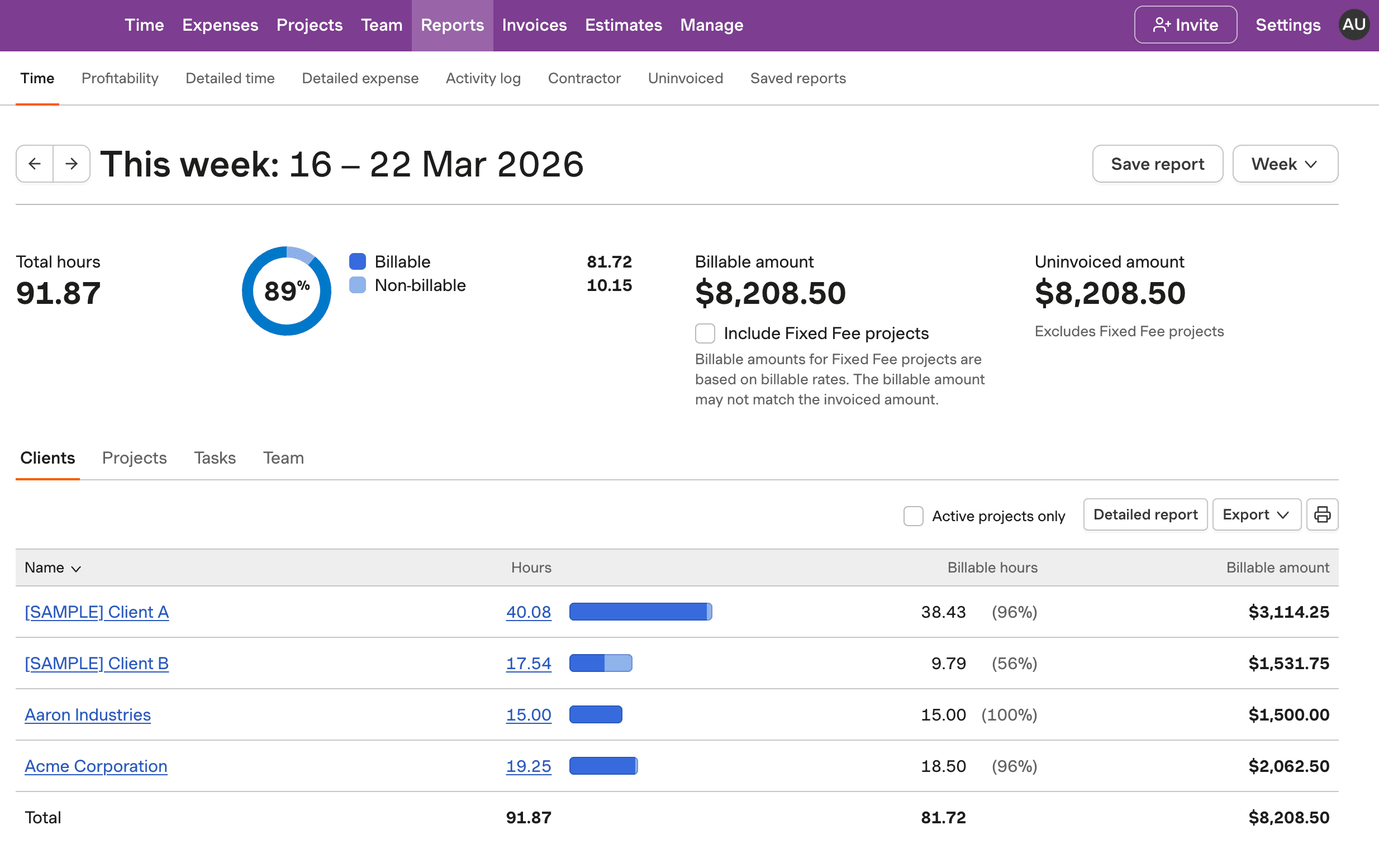
See how Harvest tracks and calculates profit margins for remote workers, providing valuable financial insights.

Screenshot of Harvest showing profit margin calculations for remote workers.

Profit Margin Calculator for Remote Workers FAQs

  • A profit margin is the percentage of revenue that exceeds the costs of delivering services. For remote workers, it's crucial to understand this to ensure they are not just earning but also profiting. A good profit margin is typically 20% or higher.

  • To calculate your profit margin, subtract all business expenses from your total revenue to find your net profit. Then, divide your net profit by total revenue and multiply by 100 to get the percentage. This helps evaluate financial health.

  • Remote workers should track expenses such as home office costs, internet, software subscriptions, and office supplies. Proper tracking and deduction of these costs can significantly improve profit margins.

  • A good profit margin for freelancers is generally considered to be 20% or higher. However, this can vary by industry, with some sectors having higher or lower benchmarks.

  • Harvest helps track project profitability by providing detailed project overviews and budget tracking features. This allows remote workers to identify profitable clients and services effectively.

  • To optimize freelance rates, calculate the minimum needed to cover all expenses, conduct market research, and consider value-based pricing. Including non-billable time in your calculations ensures comprehensive rate setting.

  • Self-employed remote workers must consider self-employment taxes, including Social Security and Medicare, amounting to 15.3% in 2024. Planning for estimated tax payments is crucial to avoid penalties and maintain profitability.

  • While Harvest is primarily focused on tracking and budgeting, understanding international VAT obligations, such as the EU's OSS, can help remote workers streamline tax compliance for international clients.

  • Harvest supports increasing revenue per project by allowing flexible billing and detailed tracking of time and expenses. This helps remote freelancers focus on the most profitable projects and clients.