Harvest
Invoices
Sign up

Email Invoice for Hungary

Harvest provides flexible e-invoicing solutions that support compliance with European standards and future-proofing for upcoming regulations.

INVOICE DRAFT

Add your logo here
Item type
Description
Quantity
Unit price
Tax
Amount
Subtotal
$0.00
Discount
$0.00
Amount Due
$0.00
Get paid via:
Credit card / Debit card
ACH
Wire transfer

Customise invoice

Appearance

Add a logo
Show invoice title

Invoice settings

Tax Add up to 2 tax rates
%
Discount Apply a discount percentage
%

Understanding Legal Requirements for Email Invoicing in Hungary

In Hungary, the legal framework for email invoicing is primarily governed by the Value Added Tax (VAT) Act and related decrees, which stipulate that electronic invoices must guarantee the authenticity of origin, the integrity of content, and legibility from the time of issue until the end of the retention period. This means that while email can be a delivery method, the invoice itself must meet specific technical and legal criteria to be considered valid. Unlike traditional paper invoices, which inherently possess a physical original, email invoices require robust technical solutions to ensure their legal equivalence. For instance, the use of a qualified electronic signature or electronic data interchange (EDI) with specific security protocols are common methods to achieve these guarantees. Businesses must also ensure that the recipient agrees to receive invoices electronically, as this consent is a fundamental legal prerequisite. Without explicit or implicit consent, an email invoice may not be legally binding.
Best Practices for Creating Compliant Email Invoices

To create compliant email invoices in Hungary, businesses should focus on ensuring the authenticity, integrity, and legibility of the invoice content throughout its lifecycle. An essential element of a compliant email invoice is the inclusion of all mandatory data required by the Hungarian VAT Act, such as the issuer's and recipient's tax numbers, the invoice number, date of issue, date of performance, description of goods/services, net amount, VAT rate, VAT amount, and gross amount. A common pitfall to avoid is simply attaching a PDF to an email without ensuring the underlying technical compliance, such as a valid electronic signature or a secure EDI system. Practical tips for ensuring compliance include:

  • Obtain explicit consent: Always ensure your customer agrees to receive invoices electronically.
  • Use secure methods: Employ methods that guarantee the authenticity of origin and integrity of content, such as qualified electronic signatures or secure EDI.
  • Maintain legibility: Ensure the invoice remains readable throughout its retention period, typically 8 years in Hungary.
  • Implement robust archiving: Store electronic invoices in a way that preserves their integrity and accessibility for the legally required period.

The Role of XML and Other Formats in Email Invoicing

While there is flexibility in choosing invoice formats for email invoicing in Hungary, the importance of XML, particularly the Hungarian National Tax and Customs Administration (NAV) XML format, cannot be overstated for compliance. Since July 1, 2020, all invoices issued to Hungarian VAT-registered businesses, regardless of the VAT amount, must be reported to NAV in real-time using the specified XML schema. This real-time reporting obligation makes the use of XML a de facto standard for ensuring compliance with tax authority requirements, even if the invoice itself is delivered to the customer in another format. However, businesses are not strictly limited to sending XML invoices to their customers. Other formats like PDF/A (PDF for Archiving) are widely accepted for customer-facing invoices, provided they meet the legal requirements for authenticity, integrity, and legibility, and the underlying transaction data is still reported to NAV in XML. The choice of format for customer delivery often depends on the recipient's preferences and technical capabilities, but the NAV XML reporting remains a critical, separate obligation.

Future Trends: The ViDA Roadmap and Its Impact on Email Invoicing

The European Commission's VAT in the Digital Age (ViDA) roadmap is set to significantly impact email invoicing practices in Hungary and across the EU, moving towards a more harmonized and mandatory e-invoicing landscape. ViDA aims to introduce mandatory e-invoicing for intra-community transactions, replacing the current recapitulative statements with real-time digital reporting. For businesses in Hungary, this means that while they are already accustomed to real-time reporting for domestic transactions, the scope will expand to cross-border B2B transactions within the EU. The proposed timeline for mandatory e-invoicing under ViDA is expected to begin in phases, with the initial changes potentially coming into effect as early as 2028. This will necessitate a shift from current practices, where email invoices might be sent as PDFs, to a system where structured electronic formats, likely based on the European standard (EN 16931), become mandatory for cross-border transactions. Businesses should begin preparing by assessing their current invoicing systems and ensuring they can adapt to these upcoming standardized, real-time reporting requirements.

Explore Your Hungarian Email Invoice Template

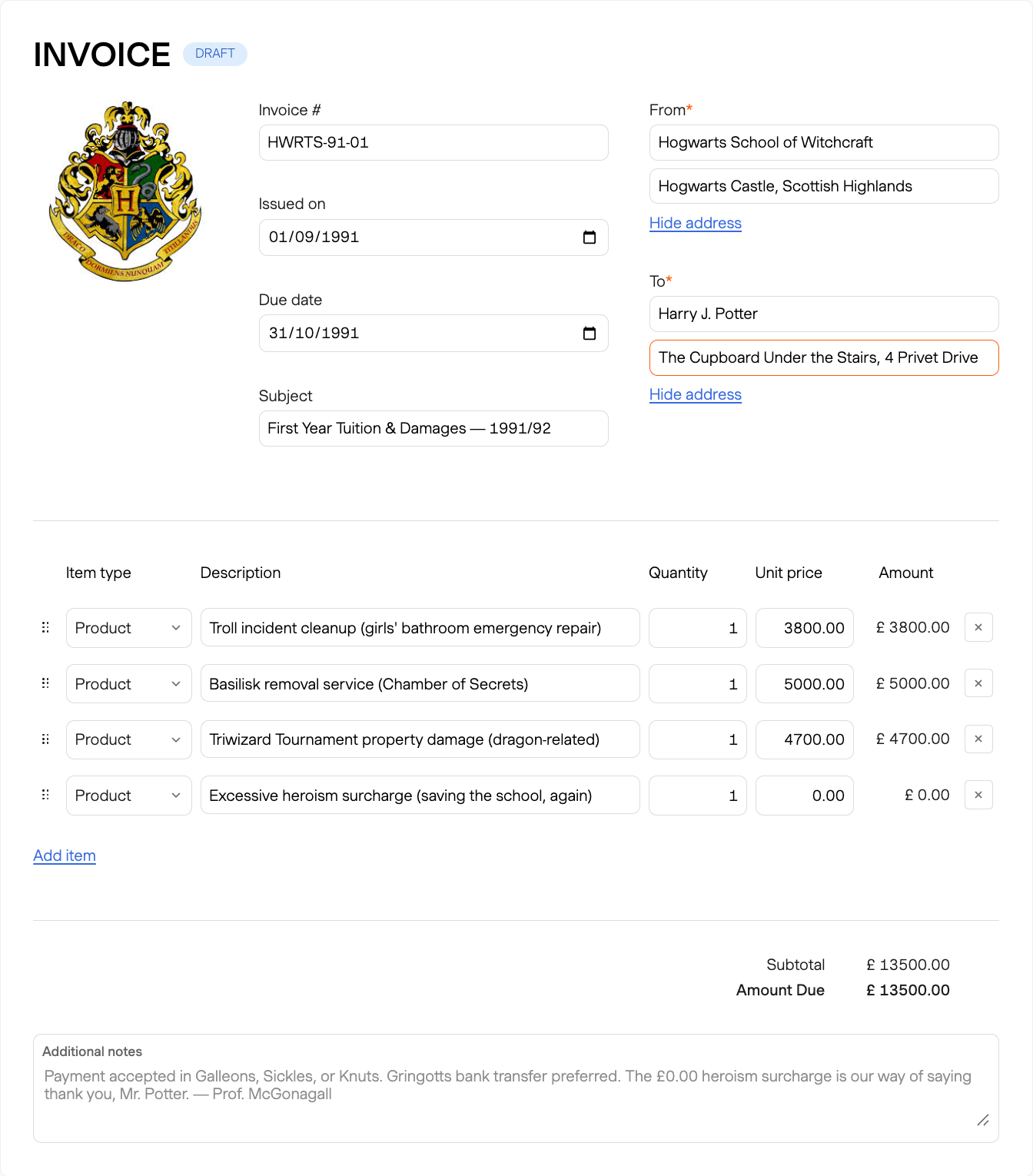
See how your invoice will appear with compliance-ready features like XML format and Hungarian VAT fields, ensuring adherence to local regulations.

Email Invoice for Hungary FAQs

  • Harvest provides flexibility in e-invoicing formats, supporting UBL and allowing for additional customization to meet specific needs.
  • Harvest is prepared for the ViDA roadmap, supporting UBL e-invoices for compliance with mandatory e-invoicing by 2030.
  • Yes, Harvest offers reporting features that allow users to analyze invoicing performance, track revenue trends, and assess time spent on projects. These insights can help businesses make informed decisions and improve overall efficiency.
  • In Hungary, electronic invoices must guarantee authenticity, integrity, and legibility. They must include all mandatory data as per the Hungarian VAT Act, such as tax numbers, invoice number, and VAT details. Consent from the recipient to receive invoices electronically is also required.
  • While email invoicing is increasingly popular, it may not completely replace traditional methods due to recipient preferences and legal requirements for certain transactions. Businesses must ensure both parties agree to electronic invoicing.