Harvest
Invoices
Sign up

Invoice Template for Hungary

Harvest offers customizable invoicing options that can be adapted for compliance with Hungarian regulations, including the addition of VAT numbers.

INVOICE DRAFT

Add your logo here
Item type
Description
Quantity
Unit price
Tax
Amount
Subtotal
$0.00
Discount
$0.00
Amount Due
$0.00
Get paid via:
Credit card / Debit card
ACH
Wire transfer

Customise invoice

Appearance

Add a logo
Show invoice title

Invoice settings

Tax Add up to 2 tax rates
%
Discount Apply a discount percentage
%

Download Your Free Hungarian Invoice Template

While numerous free invoice templates are available online in formats like Excel, Word, and PDF, it's crucial to understand their role in Hungarian invoicing compliance. You can find generic templates on various business resource websites. These can serve as a helpful starting point to understand the necessary structure and data fields. However, for official invoicing in Hungary, simply filling out a Word or Excel file is generally not sufficient due to strict regulations and mandatory real-time reporting to the National Tax and Customs Administration (NAV). Compliant invoicing typically requires using licensed Hungarian invoicing software or official invoice booklets. If you opt for a template, customize it by adding your company logo, full business details, and ensuring all mandatory fields are present, but be aware it won't fulfill the real-time reporting obligation on its own.
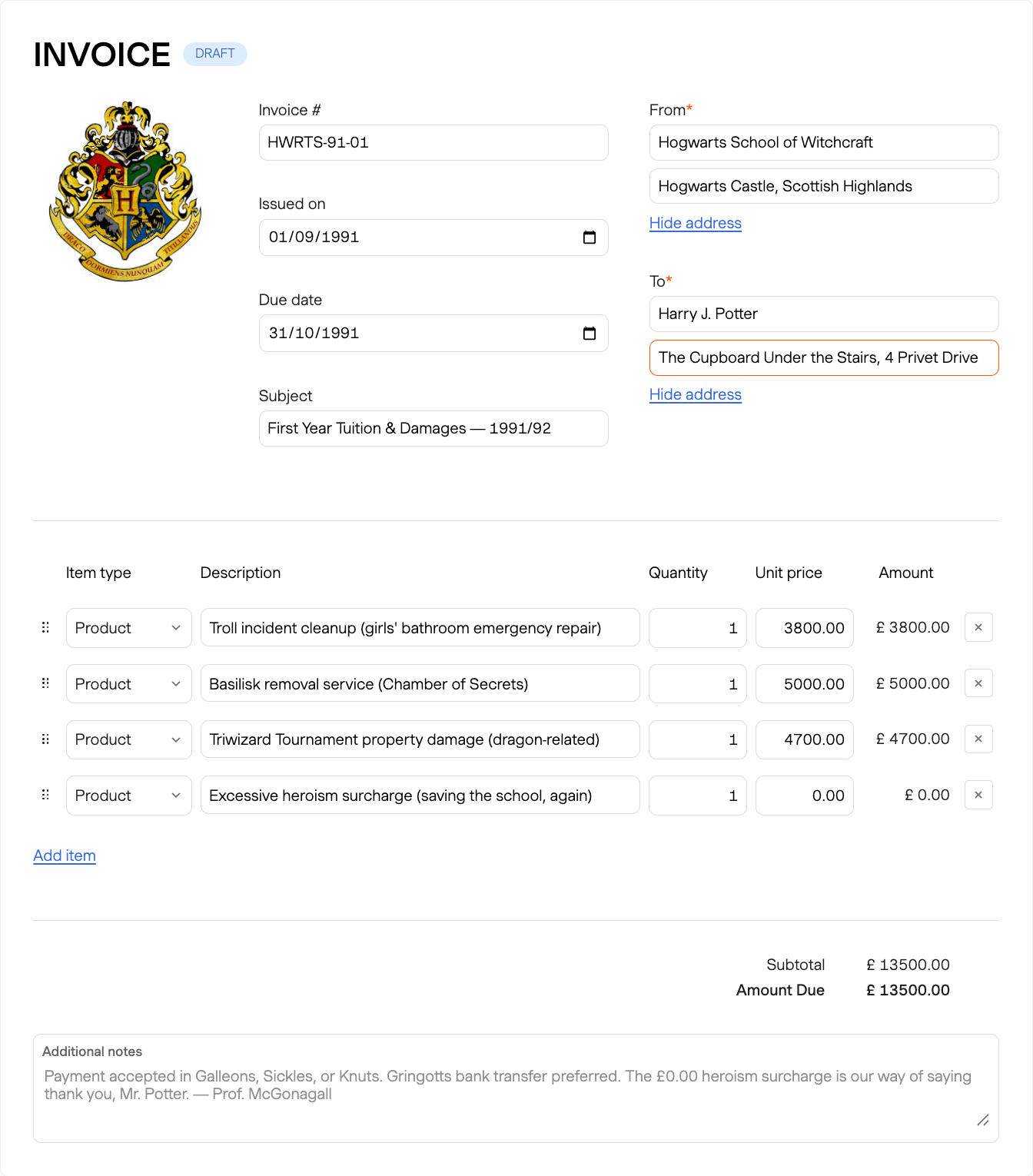
Ensure Your Invoice Meets Hungarian Legal Requirements

To ensure your invoice meets Hungarian legal requirements, include several mandatory elements. These include the date of issue, a unique sequential invoice number, and the date of supply if it differs from the issue date. You must also provide the full name, address, and VAT number of both the supplier and the customer. For financial details, clearly list the description and quantity of goods or services, the unit price (excluding VAT), the applicable VAT rate(s), the VAT amount, and the total gross amount. A critical detail: if the invoice is in a foreign currency, the VAT amount must also be shown in Hungarian Forints (HUF). Common compliance mistakes to avoid include incorrect dates, wrong VAT rate application (the general VAT rate is 27%), and failing to report invoices in real-time to NAV. Penalties for incorrect reporting can be substantial, up to HUF 500,000 per invoice.

Best Practices for Invoicing in Hungary

When invoicing in Hungary, especially for specific scenarios, adhere to best practices to maintain compliance.

  • Handling Reverse Charge VAT: The reverse charge mechanism ("fordított adózás" in Hungarian) applies in specific situations, such as certain domestic B2B transactions where both parties are taxable persons registered in Hungary and not tax-exempt.
  • Invoicing for Freelancers and Small Businesses: Ensure that your invoices meet the regulatory standards even if you operate on a smaller scale. It is crucial to maintain detailed records and report all invoices accurately to the tax authorities.
  • Issuing Invoices in Hungarian for Local Clients: Although English may be used for international clients, issuing invoices in Hungarian is advisable for local transactions to avoid misunderstandings and ensure compliance with local preferences.

See Your Hungarian Invoice Template in Action

Preview how your invoice will appear with mandatory VAT fields and Hungarian Forint currency compliance, ready for your local clients.

Invoice Template for Hungary FAQs

  • Harvest allows you to add mandatory elements like a VAT number to your invoices through the account settings, ensuring compliance with Hungarian regulations.
  • Harvest provides customizable invoicing options, including adding VAT numbers, which can be adapted for use in Hungary, helping ensure compliance with local tax regulations.
  • Harvest takes data security seriously and uses industry-standard encryption to protect your information. They also have secure data centers and conduct regular security audits to ensure compliance with best practices.
  • Common pitfalls include failing to include all mandatory information like VAT numbers, incorrect application of VAT rates, and not adhering to the unique sequential numbering of invoices. Additionally, not reporting invoices in real-time to the National Tax and Customs Administration (NAV) can result in penalties.
  • While invoicing tools can automate many processes, they may not fully handle every aspect of compliance with Hungarian tax regulations. Users must ensure that the tool is set up correctly to include all necessary invoice elements and stay updated on any regulatory changes.