Harvest
Invoices
Sign up

Email Invoice for United Kingdom

Harvest simplifies VAT compliance by allowing the inclusion of VAT numbers on invoices, ensuring businesses meet essential tax requirements.

INVOICE DRAFT

Add your logo here
Item type
Description
Quantity
Unit price
Tax
Amount
Subtotal
$0.00
Discount
$0.00
Amount Due
$0.00
Get paid via:
Credit card / Debit card
ACH
Wire transfer

Customise invoice

Appearance

Add a logo
Show invoice title

Invoice settings

Tax Add up to 2 tax rates
%
Discount Apply a discount percentage
%

Understanding UK Invoice Regulations

To ensure legal compliance in the UK, every invoice you issue must contain specific information, regardless of your business structure. These requirements are set out by His Majesty's Revenue and Customs (HMRC) to facilitate accurate record-keeping and tax reporting.

  • A unique identification number: Each invoice must have a sequential number that uniquely identifies the document.
  • The date of issue: The date the invoice was created.
  • Your business details: This includes your full company name (as registered with Companies House if applicable), business address, and contact information. Sole traders should include their name and any trading name used, along with a UK address.
  • Customer's details: The name and address of the person or business you are invoicing.
  • A clear description of goods/services: Detail what you are charging for, including quantities and unit prices.
  • The date of supply (or 'tax point'): This is when the goods or services were provided, which may differ from the invoice date.
  • The amount(s) being charged: Itemised costs and the total amount due.
  • Payment terms: Clearly state when payment is due, for example, "payment within 30 days."

If your business is a limited company, you must also include your full registered company name, company registration number, and registered office address. If you are VAT-registered, additional details are required, which will be covered in a later section.
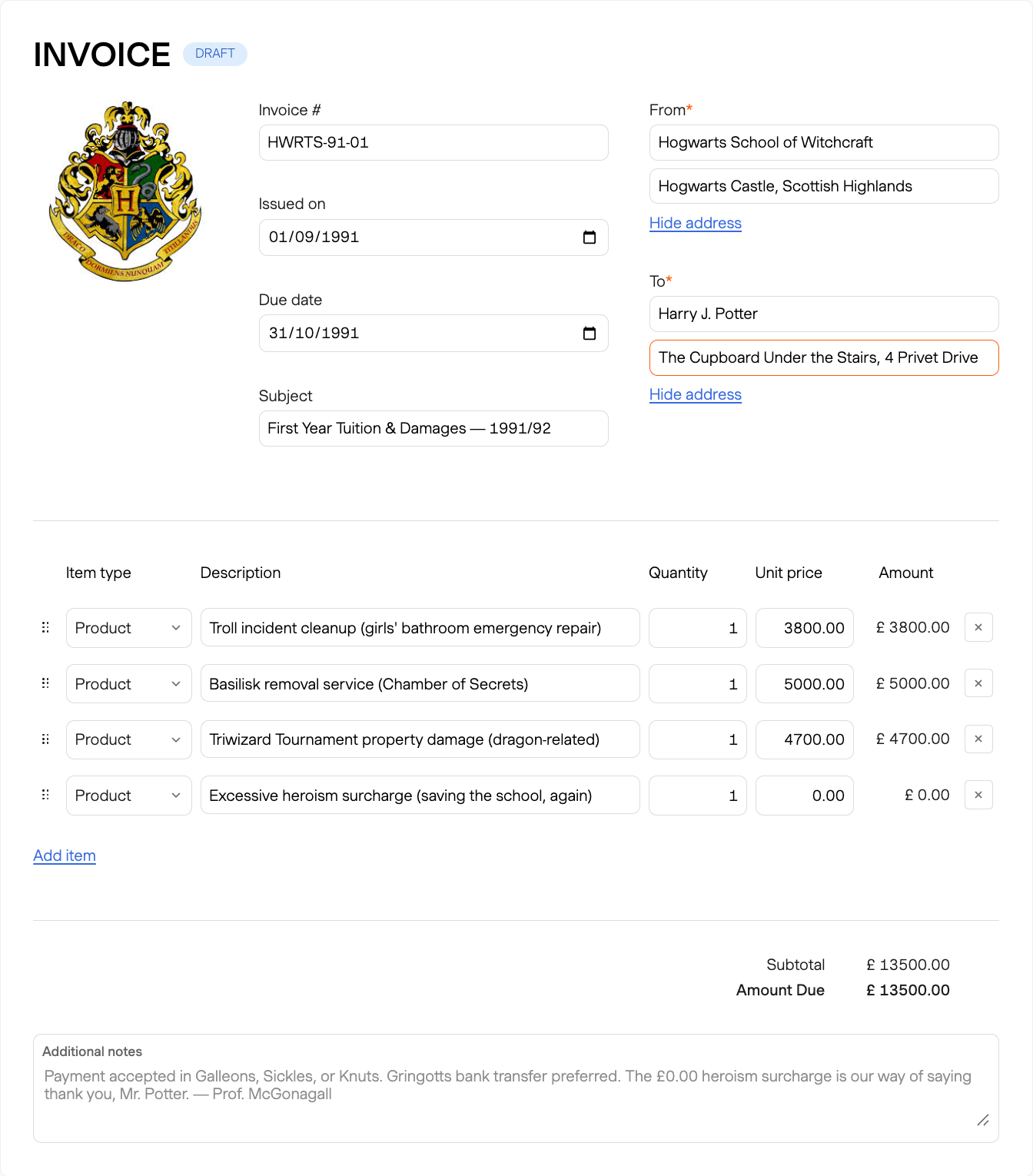
Structuring Your Invoice for Email Delivery

When sending invoices via email, the structure and formatting are crucial for clarity and professional presentation, ensuring the recipient can easily understand and process the payment request. While paper invoices are still acceptable, the UK is moving towards mandatory electronic invoicing for VAT invoices from April 2029.

  • Clear Header: Position your business name, logo (if applicable), address, and contact details prominently at the top.
  • Unique Invoice Number and Date: Ensure these are easily identifiable. A sequential numbering system is mandatory.
  • Customer Information: Clearly state the client's business name and address.
  • Itemised List of Goods/Services: Provide a detailed breakdown of each item, including:
    • Description of the item or service.
    • Quantity or hours.
    • Unit price.
    • Subtotal for each item.
  • Subtotals and Totals: Clearly show the subtotal before any taxes, the total VAT (if applicable), and the grand total amount due.
  • Payment Terms and Due Date: Explicitly state the payment deadline (e.g., "Payment due within 30 days") and accepted payment methods, including bank details.

Differences in invoice structure exist between sole traders and limited companies. Sole traders must include their name and any trading name, along with a UK address where legal documents can be delivered. Limited companies, however, must include their full company name as it appears on the Companies House register, their company registration number, and their registered office address. If directors' names are listed, all directors' names must be included.

Crafting the Perfect Invoice Email

The email accompanying your invoice is just as important as the invoice itself, serving as the primary communication for payment. A well-crafted email can significantly improve the chances of timely payment.

  • Clear and concise subject line: This is paramount for ensuring the email is opened and identified quickly. It should include the invoice number, your business name, and the due date. Examples include "Invoice #12345 from [Your Business Name] - Due [Due Date]" or "Invoice Attached: #INV-001 for [Service/Product]".
  • Professional and polite greeting: Address the recipient by name to maintain a courteous and professional tone.
  • Brief and direct email body: The opening paragraph should state the purpose of the email immediately, such as "Attached is Invoice #12345 for [specific service or product] completed on [date]."
  • Key invoice summary: Include essential details directly in the email body, such as the invoice number, total amount due, and the payment due date.
  • Payment instructions: Clearly outline how to pay, including bank details or a payment link if available.
  • Call to action and offer of assistance: Politely request payment and encourage the client to contact you with any questions or concerns.
  • Professional closing: Conclude with a polite closing, your full name, title, company name, and contact information.
  • Attachment: Always attach the invoice as a PDF file. This format is secure, widely accessible, and preserves the invoice's integrity.

Maintaining a professional tone throughout the email is crucial. Avoid informal language and proofread carefully for any typos or grammatical errors, as these can detract from your credibility.

VAT Considerations for UK Invoices

For VAT-registered businesses in the UK, specific Value Added Tax (VAT) requirements must be met on invoices to ensure compliance with HMRC regulations. The current VAT registration threshold is £90,000 for 2024/25.

  • Your VAT registration number: This nine-digit number, usually prefixed with "GB", confirms your registration and allows your customer to reclaim VAT.
  • The tax point (time of supply): The date when the goods or services were supplied.
  • A breakdown of the VAT charged: For each item, you must show the net amount (excluding VAT), the rate of VAT applied (e.g., 20% standard rate), and the amount of VAT charged.
  • Indication of zero-rated or exempt supplies: If any items are zero-rated or exempt from VAT, this must be clearly stated.
  • The total amount excluding VAT.
  • The total amount of VAT.
  • The grand total amount including VAT.

For certain transactions, particularly in business-to-business (B2B) scenarios involving specific goods or services, reverse charge VAT may apply. This means the customer, rather than the supplier, accounts for the VAT on the supply. For example, in the construction industry, the domestic reverse charge for building and construction services means the subcontractor does not charge VAT to the contractor. Instead, the contractor declares both the output VAT and input VAT on their VAT return. This typically applies to standard and reduced-rate VAT services reported under the Construction Industry Scheme (CIS).

HMRC requires businesses to keep all VAT records for at least six years after the end of the VAT period to which they relate. These records can be kept digitally or on paper, but they must be accurate, complete, and readily accessible for inspection.

Resources and Tools for UK Invoicing

Navigating UK invoicing requirements can be streamlined by utilising appropriate resources and tools. These can help ensure compliance, improve efficiency, and reduce the risk of errors.

For finding reliable invoice templates, the most authoritative source is generally HMRC guidance. While HMRC does not provide specific templates, their detailed requirements outline all necessary information, allowing you to create your own or verify third-party templates. Many accounting software providers also offer compliant templates as part of their services.

Tools for creating and managing invoices range from simple spreadsheet templates to comprehensive accounting software. When selecting a tool, consider its ability to:

  • Generate unique and sequential invoice numbers automatically.
  • Include all mandatory UK invoice details, including VAT information if you are registered.
  • Handle different invoice types, such as full VAT invoices, modified VAT invoices (for retail supplies over £250, showing VAT inclusive values), and simplified VAT invoices (for retail supplies under £250).
  • Integrate with Making Tax Digital (MTD) for VAT, which requires digital record-keeping and submission of VAT returns through compatible software.
  • Provide e-invoicing capabilities, especially as mandatory electronic invoicing for VAT invoices is expected from April 2029.

Additional resources for compliance include:

  • HMRC website: The official government website (GOV.UK) provides extensive guidance on all aspects of invoicing, VAT, and record-keeping.
  • Professional accounting advice: For complex scenarios or specific industry requirements, consulting with a qualified accountant or tax advisor is highly recommended.
  • Industry bodies: Organisations relevant to your sector may offer specific guidance or resources tailored to your business type.

See Your UK Email Invoice Template in Action

Preview how your email invoice will look with UK-specific fields, including VAT numbers and proper formatting for compliance.

Email Invoice for United Kingdom FAQs

  • Harvest allows you to add your VAT number to your invoices, ensuring compliance with VAT requirements.
  • An email invoice in the UK should include a unique identification number, invoice date, your business and customer details, a detailed description of goods/services, payment terms, and VAT information if applicable. Ensure the email body clearly states the invoice purpose and payment instructions.
  • Yes, Harvest provides various reporting features that allow you to analyze your time tracking and invoicing activities. You can generate reports on billable hours, project profitability, and client payments.
  • While email invoices are increasingly accepted, certain legal and business contexts might still require paper invoices. For instance, some clients or jurisdictions may request a physical copy for records or compliance reasons. Always verify with the recipient if digital invoices are acceptable.
  • Harvest supports the inclusion of unique identification numbers like VAT numbers on invoices.