Harvest
Invoices
Sign up

Invoice Software for Malaysia

Harvest offers robust multi-currency invoicing capabilities, making it an excellent choice for Malaysian businesses dealing with international clients.

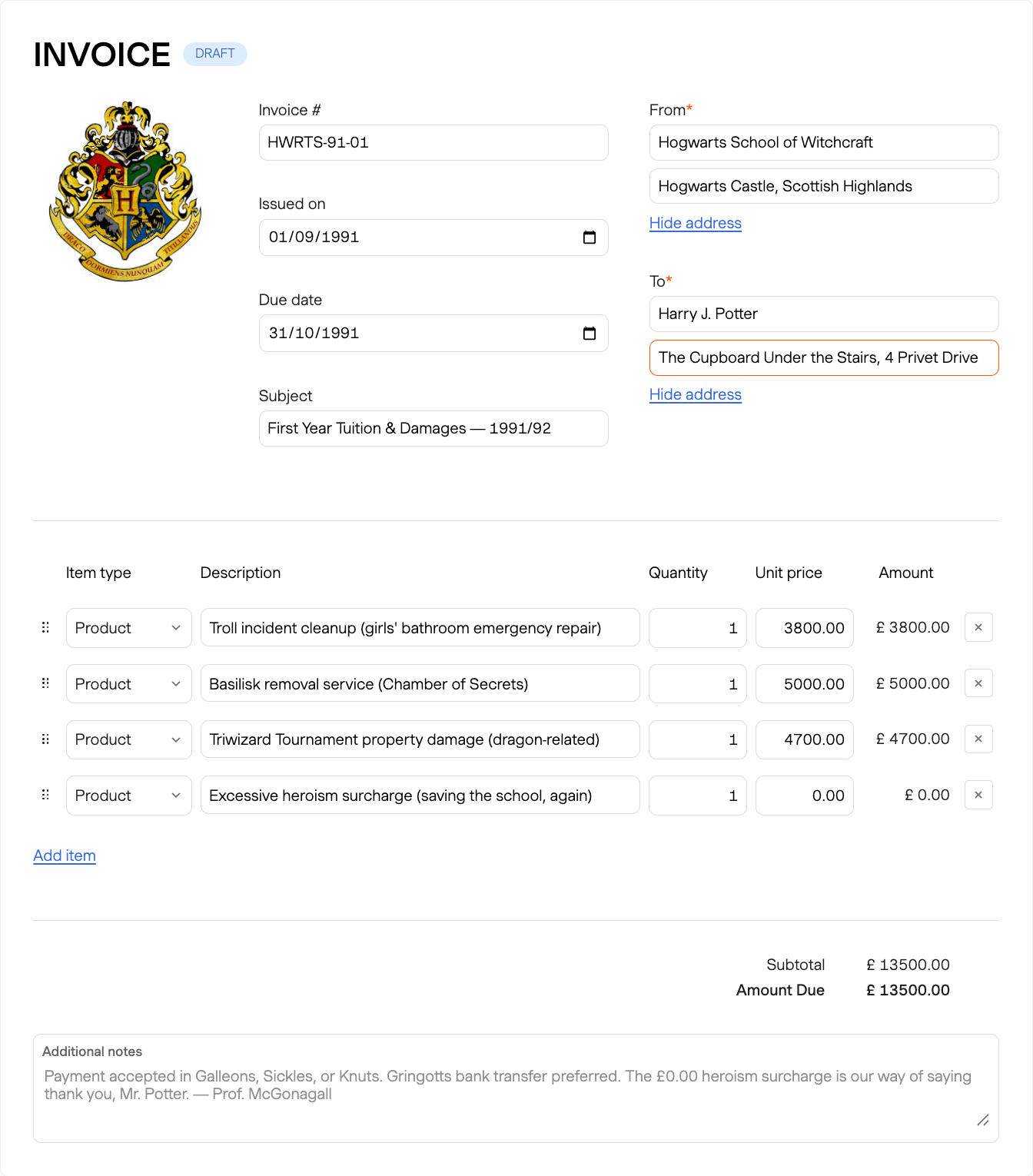
INVOICE DRAFT

Add your logo here
Item type
Description
Quantity
Unit price
Tax
Amount
Subtotal
$0.00
Discount
$0.00
Amount Due
$0.00
Get paid via:
Credit card / Debit card
ACH
Wire transfer

Customise invoice

Appearance

Add a logo
Show invoice title

Invoice settings

Tax Add up to 2 tax rates
%
Discount Apply a discount percentage
%

Key Features to Look for in Malaysian Invoice Software

When evaluating invoice software for your Malaysian business, prioritize features that ensure compliance and streamline transactions. First, LHDN e-invoicing compliance is paramount, as Malaysia has a phased rollout of mandatory e-invoicing, with full implementation targeted for July 2026. Your software should support the submission of e-invoices to the Inland Revenue Board of Malaysia (LHDN) via the MyInvois portal, either manually or through direct API integration, in the required XML or JSON format. These e-invoices must include 55 specific data fields and be digitally signed.

Second, look for automatic SST calculations. Malaysia operates under a Sales and Service Tax (SST) system, with sales tax rates typically at 5% or 10% and service tax rates at 6% or 8%, depending on the goods or services. The software should accurately apply these rates, calculate the SST amount, and display it separately on invoices to ensure transparency and compliance.

Finally, seamless integration with FPX and DuitNow is crucial for local payment processing. FPX (Financial Process Exchange) is a real-time online banking system for secure e-commerce checkouts and bill payments, while DuitNow facilitates instant, account-to-account transfers via QR codes or phone numbers. Native support or easy integration with these payment rails will significantly enhance your customers' payment experience and accelerate cash flow.
Avoiding Common Pitfalls in Choosing Invoice Software

Selecting invoice software without careful consideration can lead to significant operational hurdles and compliance issues. A common pitfall is overlooking local compliance, particularly Malaysia's LHDN e-invoicing mandate. Businesses with annual turnover exceeding RM1 million are generally required to comply, with different phases for implementation based on revenue thresholds. Failing to choose software that can generate and submit e-invoices in the prescribed XML or JSON format to the MyInvois system can result in non-compliance and potential penalties.

Another mistake is ignoring multi-currency needs. If your business deals with international clients or suppliers, software that lacks robust multi-currency support will complicate invoicing, payment processing, and financial reporting. Ensure the software can handle various currencies, apply appropriate exchange rates, and manage foreign currency transactions accurately.

Lastly, selecting software without local payment integration like FPX and DuitNow can create friction for your customers. While global platforms might offer broad payment options, native support for Malaysian payment methods is vital for local transactions. Without it, you might need complex third-party integrations or risk slower payment collection due to inconvenient payment options for your Malaysian clientele.

Selection Criteria for the Best Invoice Software

To choose the best invoice software, focus on criteria that enhance both user experience and operational efficiency.

  • User-friendly interfaces for SMEs: For small and medium-sized enterprises (SMEs), an intuitive interface is critical. The software should be easy to navigate, allowing quick invoice creation, management, and tracking without extensive training. This minimizes errors and speeds up daily tasks.
  • Real-time stock tracking: For businesses selling goods, integrated real-time stock tracking is invaluable. This feature automatically updates inventory levels as invoices are issued, preventing overselling and providing accurate stock visibility. It ensures that your invoicing directly reflects available products, improving order fulfillment and customer satisfaction.
  • Training and support resources: Even the most intuitive software requires occasional support. Look for providers offering comprehensive training materials, responsive customer support, and local assistance. This ensures your team can quickly resolve issues, understand new features, and maximize the software's capabilities, especially concerning evolving Malaysian tax regulations. Good support can be a key differentiator, helping you stay compliant and efficient in the long run.

See Your Malaysian Invoice Template in Action

Preview how your invoice will accommodate local tax rates, support FPX and DuitNow payments, and comply with Malaysian invoicing standards.

Invoice Software for Malaysia FAQs

  • Harvest offers multi-currency invoicing capabilities by allowing you to set up a default currency for your account and a preferred currency on a per-client basis. This feature simplifies handling invoices for international clients by applying the appropriate currency and exchange rate automatically.

  • Businesses in Malaysia must comply with LHDN e-invoicing requirements, which involve submitting invoices through the MyInvois portal in XML or JSON format. The e-invoices should include 55 specific data fields and be digitally signed, with full compliance required by July 2026.

  • Absolutely! Harvest is designed for freelancers and contractors who bill clients based on hourly rates, fixed-price projects, or retainer agreements. It allows easy tracking of billable hours and conversion into invoices.
  • While many invoicing software solutions offer features to manage local tax compliance, they may not cover every aspect automatically. It's essential to ensure that the software is regularly updated to align with the latest tax regulations, and some manual oversight may still be necessary to ensure complete compliance.

  • Common payment methods supported by invoice software in Malaysia include FPX for online banking transactions and DuitNow for instant transfers through QR codes or phone numbers. These local payment integrations help facilitate smooth and secure transactions for Malaysian businesses.