Harvest
Invoices
Sign up

Invoice Template for Video Production

Harvest offers comprehensive invoicing solutions tailored for the video production industry, ensuring detailed and customizable billing for all project phases and client types.

INVOICE DRAFT

Add your logo here
Item type
Description
Quantity
Unit price
Tax
Amount
Subtotal
$0.00
Discount
$0.00
Amount Due
$0.00
Get paid via:
Credit card / Debit card
ACH
Wire transfer

Customise invoice

Appearance

Add a logo
Show invoice title

Invoice settings

Tax Add up to 2 tax rates
%
Discount Apply a discount percentage
%

Key Features of an Effective Video Production Invoice Template

An effective video production invoice template should meticulously detail all project costs to ensure transparency and accurate client billing. Look for templates that allow for a detailed breakdown of production costs, separating expenses like equipment rental, crew salaries, location fees, and post-production services. It's crucial to have fields for itemized billing across production phases, such as pre-production (scripting, storyboarding), principal photography (shooting days), and post-production (editing, sound design, motion graphics). Additionally, ensure the template can clearly list and differentiate inclusion of licensing fees for music, stock footage, or specific usage rights, as these are often distinct from production services and can vary significantly based on usage terms.
Customizing Your Invoice Template for Different Video Projects

To effectively manage diverse client needs, your invoice template must offer robust customization options for various video projects. Ensure the template allows for customizable line items, enabling you to easily add or remove services specific to a corporate explainer video versus a commercial advertisement, for example. Consider templates that support specific invoicing needs for different client types; a large agency might require purchase order numbers and specific departmental billing, while a small business might prefer a simpler, all-inclusive breakdown. The ability to easily add and track additional costs like travel expenses, rush fees, or last-minute revisions is also paramount for accurate and comprehensive billing.

Best Practices for Invoicing in the Video Production Industry

Adopting best practices in invoicing helps maintain professionalism and financial health within the video production industry. Implement milestone-based payment structures, where a percentage (e.g., 25-50%) is paid upfront, with subsequent payments tied to project completion phases like script approval, principal photography wrap, and final delivery. A common pitfall to avoid is vague descriptions; always ensure clarity and professionalism by providing detailed service descriptions and transparent cost breakdowns. Clearly state payment terms, due dates, and any late payment policies (e.g., a 1.5% monthly late fee) to prevent misunderstandings and ensure timely compensation.

Preview Your Video Production Invoice Template

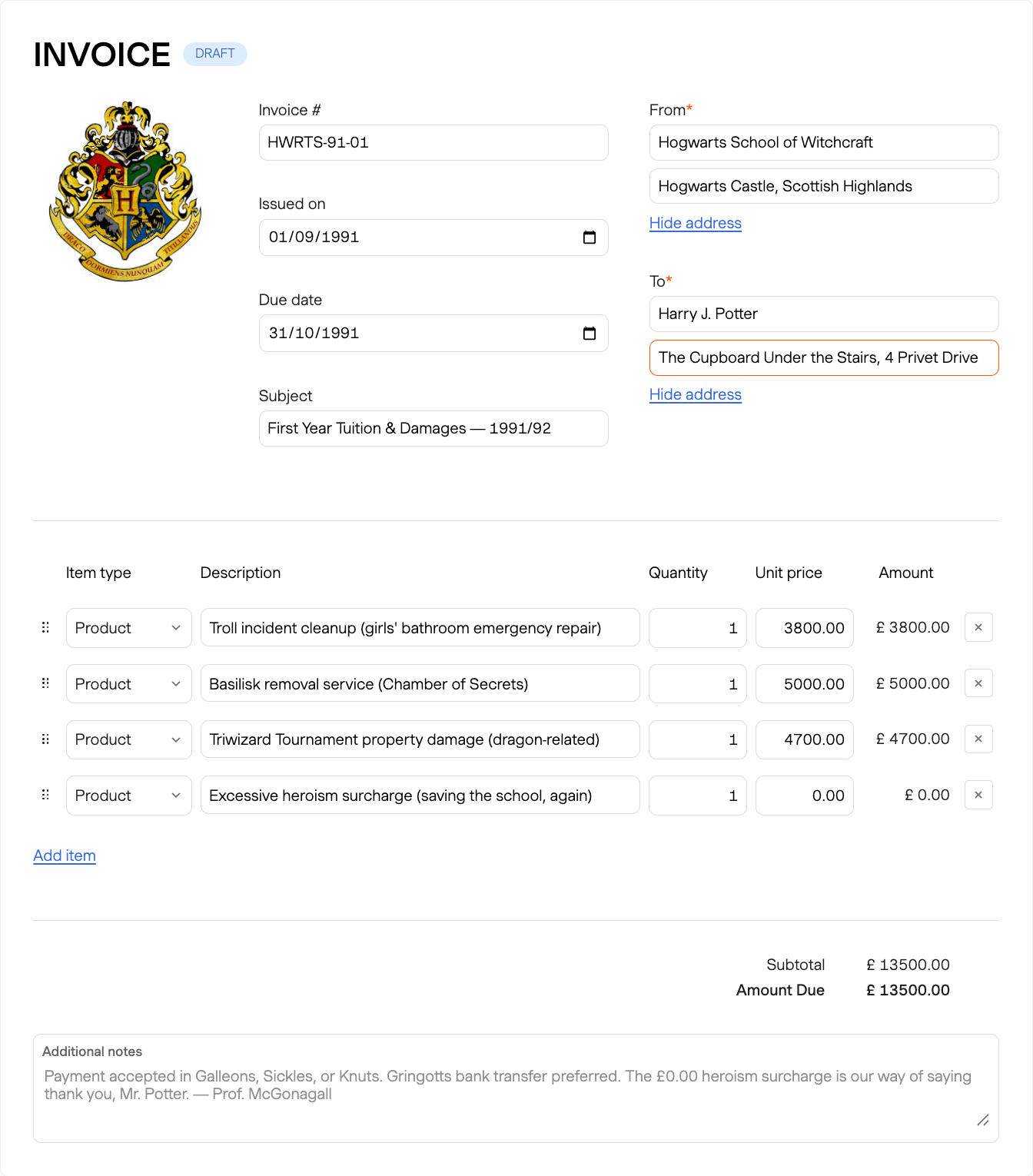
Get a glimpse of how your invoice will look with fields for production phases, licensing fees, and customizable line items — perfect for video projects.

Invoice Template for Video Production FAQs

  • Harvest can include a detailed breakdown of production costs by allowing you to invoice for tracked time, expenses, and fixed fees, with the option to display detailed time entry notes.
  • Best practices include using milestone-based payment structures, providing clear and detailed service descriptions, and stating payment terms explicitly to avoid misunderstandings. Always ensure invoices are professional, with comprehensive cost breakdowns.
  • Some limitations: no dynamic template variables, one logo/brand per account (separate accounts needed for multiple brands), no partial credit card payments, and UBL export is one invoice at a time.
  • Harvest can track additional costs such as travel expenses or equipment rentals by including them as expenses on invoices and attaching detailed expense reports.
  • Invoice templates are designed to be flexible yet standardized. They might not automatically handle all client-specific requirements due to the diverse and unique nature of each client's needs, such as specific formatting or unusual billing cycles, which often require manual adjustment.