Harvest
Invoices
Sign up

Invoice Template for Virtual Assistants

Harvest provides flexible invoicing solutions tailored for virtual assistants, supporting detailed billing and customization to meet diverse client needs.

INVOICE DRAFT

Add your logo here
Item type
Description
Quantity
Unit price
Tax
Amount
Subtotal
$0.00
Discount
$0.00
Amount Due
$0.00
Get paid via:
Credit card / Debit card
ACH
Wire transfer

Customise invoice

Appearance

Add a logo
Show invoice title

Invoice settings

Tax Add up to 2 tax rates
%
Discount Apply a discount percentage
%

Key Features of a Good Invoice Template for Virtual Assistants

A good invoice template for virtual assistants should clearly detail services rendered and payment due, ensuring professional presentation. Essential elements to include are your business name and contact information, the client's details, an invoice number, issue date, and a due date. Crucially, the template needs customizable fields to accurately describe your unique services, whether hourly tasks, project-based work, or retainer agreements, allowing for specific line items like "Social Media Management (10 hours)" or "Website Content Creation (3 articles)". To ensure a professional presentation, opt for a clean layout with adequate white space, legible fonts, and a logical flow of information, making it easy for clients to understand at a glance.
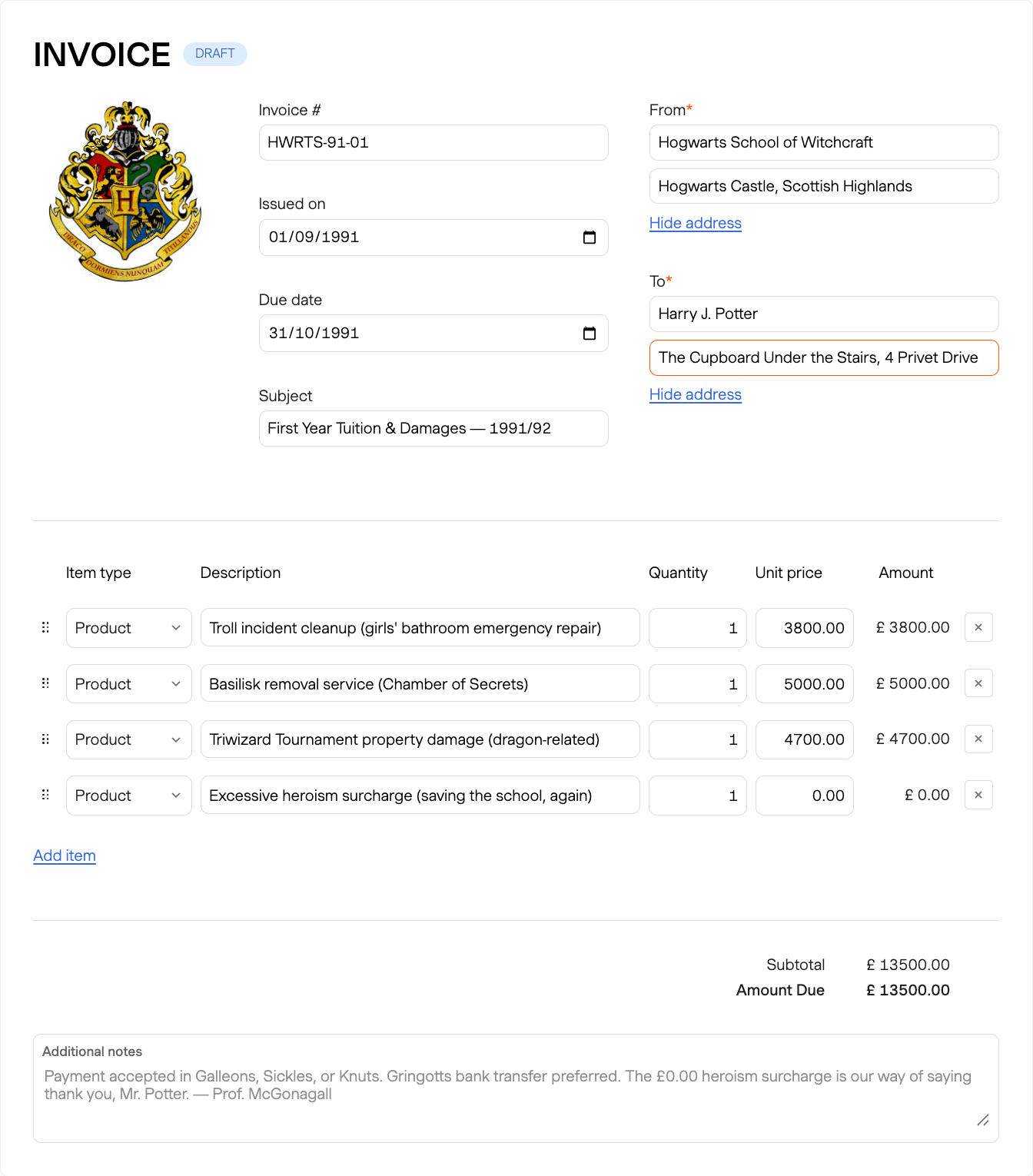
How to Customize Your Invoice Template

Personalizing your invoice template is straightforward and significantly enhances your professional image. Begin by incorporating your business logo prominently at the top of the invoice. Next, adapt the template for different client needs by adjusting the level of detail; some clients may require highly itemized breakdowns, while others prefer a simpler summary. You can also customize payment terms, such as "Net 30" or "Due Upon Receipt," to align with specific agreements. Incorporating branding elements like your consistent brand colors and fonts throughout the document further reinforces your business identity, making each invoice uniquely yours and memorable to clients.

Best Practices for Invoicing as a Virtual Assistant

To ensure effective invoicing and timely payments, virtual assistants should adopt several best practices and avoid common pitfalls. A frequent mistake is failing to clearly itemize services or not stating payment terms upfront, which can lead to client confusion and delayed payments. Always provide a detailed breakdown of services, hours worked, and agreed-upon rates. For clear communication, explicitly state your preferred payment methods (e.g., bank transfer, online payment gateway) and any late payment policies, such as a 5% late fee applied after 15 days past the due date. Establishing a consistent invoicing schedule, like sending invoices on the 1st and 15th of each month, and following up politely on overdue payments within 3-5 days of the due date, significantly improves your chances of receiving prompt payment.

Explore Your Virtual Assistant Invoice Template

See how your invoice template can be personalized with detailed service descriptions and branded elements, ready to present to clients.

Invoice Template for Virtual Assistants FAQs

  • Harvest allows you to set hourly billing rates for specific tasks, including those performed by virtual assistants, ensuring accurate invoicing.

  • Best practices for invoicing as a virtual assistant include clearly itemizing services, stating payment terms upfront, and ensuring clear communication about payment methods and policies. Setting up a consistent invoicing schedule and following up on overdue payments can also improve payment timeliness.

  • In Harvest, you can personalize invoice messages to clients by adding custom notes or terms on each invoice. This feature allows you to provide specific instructions or important information directly to your clients.
  • Harvest facilitates tracking billable hours across multiple clients, which can be consolidated into invoices.

  • While many invoice templates offer customization, limitations can include restrictions on layout changes or the extent of detail that can be included. Some templates may not support integration with other software for automated data tracking and billing.