Harvest
Invoices
Sign up

Invoicing Software for Philippines

Harvest provides robust invoicing features with multi-currency support, making it a versatile choice for Filipino SMEs dealing with international clients.

INVOICE DRAFT

Add your logo here
Item type
Description
Quantity
Unit price
Tax
Amount
Subtotal
$0.00
Discount
$0.00
Amount Due
$0.00
Get paid via:
Credit card / Debit card
ACH
Wire transfer

Customise invoice

Appearance

Add a logo
Show invoice title

Invoice settings

Tax Add up to 2 tax rates
%
Discount Apply a discount percentage
%

Key Features to Look for in Invoicing Software for the Philippines

To ensure your invoicing software effectively supports your business in the Philippines, look for features that align with local regulations and payment preferences. First, compliance with Philippine tax regulations is non-negotiable; the software must support the generation of official receipts and sales invoices that adhere to Bureau of Internal Revenue (BIR) requirements, including the upcoming mandatory e-invoicing for certain taxpayers by December 31, 2026. This includes handling the 12% Value-Added Tax (VAT) and Expanded Withholding Tax (EWT) calculations accurately. Second, integration with local payment platforms is crucial for smooth transactions. Ensure the software can connect with popular e-wallets like GCash and Maya, as well as local bank transfer options, to facilitate diverse payment methods for your clients. Finally, look for robust automated invoicing features such as recurring invoice generation, automated payment reminders, and comprehensive financial reporting to streamline your billing process and improve cash flow.
Common Pitfalls When Choosing Invoicing Software

Businesses often encounter several common pitfalls when selecting invoicing software, which can lead to inefficiencies and compliance issues.

  • Ignoring local compliance requirements: A significant mistake is choosing software not specifically designed or updated for Philippine tax laws, such as the BIR's e-invoicing mandate. This can result in non-compliant invoices, leading to penalties.
  • Overlooking integration capabilities: Failing to select software that integrates seamlessly with your existing accounting systems, CRM, or local payment gateways (like PayMongo or Maya Business) creates data silos and increases manual data entry, wasting time and raising the risk of errors.
  • Underestimating feature needs: Opting for overly simplistic software that lacks essential features like automated tax calculations, customizable invoice templates, or robust reporting can hinder scalability and operational efficiency as your business grows. Additionally, neglecting data security and timely software updates are critical errors that can expose sensitive financial information and lead to system vulnerabilities.

How to Ensure Compliance with Philippine Tax Regulations

Ensuring your invoicing software remains compliant with Philippine tax regulations requires proactive steps and continuous vigilance.

  • Understand BIR requirements: Familiarize yourself with current and upcoming mandates from the Bureau of Internal Revenue (BIR), such as Revenue Regulation No. 011-2025, which outlines the Electronic Invoicing/Receipting System (EIS) requiring structured data formats (e.g., JSON or XML) and digital signatures for certain taxpayers.
  • Set up tax rates accurately in software: Configure your software to correctly apply the 12% Value-Added Tax (VAT) for businesses with annual gross sales exceeding PHP 3 million, and appropriate Expanded Withholding Tax (EWT) rates (e.g., 5% or 10% for professionals, 2% for contractors) where applicable. The software should also be capable of generating BIR Form 2307 for EWT.
  • Ensure regular updates for compliance: Choose software that provides consistent updates to reflect changes in BIR regulations. This is vital for maintaining compliance, especially with evolving e-invoicing requirements, which mandate transmitting invoice data to the BIR's EIS within three days of the transaction. Furthermore, ensure your software is BIR-registered or accredited, as this is a prerequisite for issuing electronic invoices.

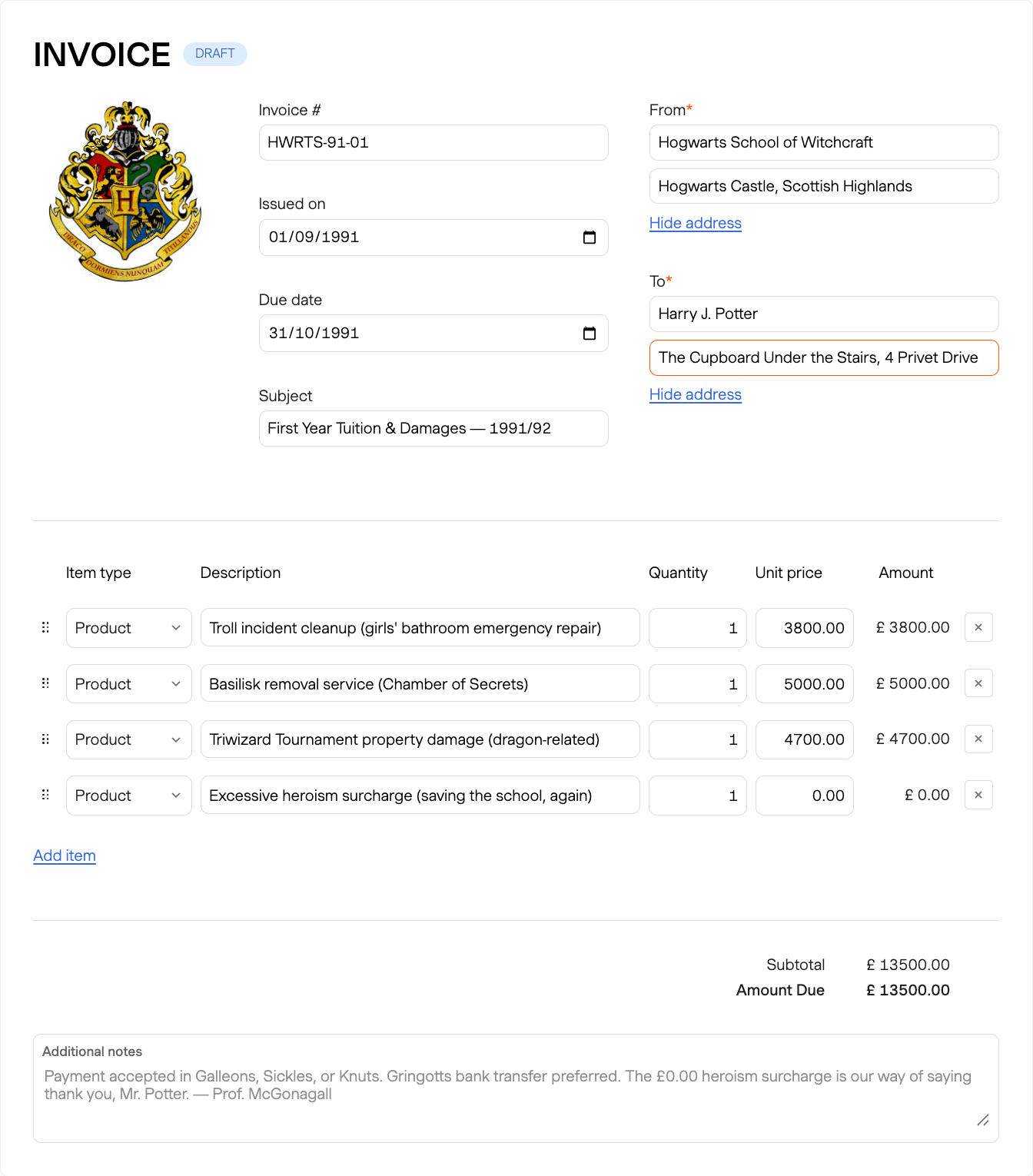
See Your Philippine Invoice Template in Action

Preview how your invoice will look with PHP currency, local tax rates, and integration with Philippine payment platforms — ready for your clients.

Invoicing Software for Philippines FAQs

  • Harvest offers customizable invoicing features that can be tailored to meet the needs of SMEs, including setting default tax rates and payment terms. This helps businesses automate repetitive tasks and maintain compliance with local tax regulations.

  • Harvest supports multi-currency transactions by letting you set a default currency and specific currencies for each client. This feature is particularly beneficial for Filipino businesses dealing with international clients, enabling seamless global transactions.

  • Harvest offers multiple support options, including a comprehensive help center, email support, and live chat during business hours, ensuring you get assistance when needed.
  • When selecting invoicing software, consider compliance with local tax laws, integration with existing systems and local payment gateways, and the software’s ability to scale and adapt to your business’s growing needs. Additionally, prioritize security features and regular updates to ensure ongoing compliance and data protection.

  • While invoicing software can greatly assist with compliance, it cannot fully automate the process. Businesses must stay informed about regulatory changes and ensure their software is updated accordingly. Regular manual checks and adjustments are recommended to maintain full compliance.