Harvest
Invoices
Sign up

Send Invoice in Romania

Harvest provides robust support for UBL 2.1 e-invoicing, ensuring compatibility with European standards. This enables businesses to meet Romanian compliance requirements effectively.

INVOICE DRAFT

Add your logo here
Item type
Description
Quantity
Unit price
Tax
Amount
Subtotal
$0.00
Discount
$0.00
Amount Due
$0.00
Get paid via:
Credit card / Debit card
ACH
Wire transfer

Customise invoice

Appearance

Add a logo
Show invoice title

Invoice settings

Tax Add up to 2 tax rates
%
Discount Apply a discount percentage
%

Understanding E-Invoicing Regulations in Romania

Romania's e-invoicing regulations have evolved significantly, moving towards a mandatory clearance model to combat tax fraud and enhance fiscal transparency. The journey began with the introduction of Business-to-Government (B2G) e-invoicing through the RO e-Factura system in September 2021, with a pilot program commencing on October 1, 2021, under Ordinance no. 120/2021. By July 1, 2022, B2G e-invoicing became mandatory for all transactions with Romanian public bodies, requiring invoices in UBL 2.1 format.

The scope expanded to Business-to-Business (B2B) transactions, initially targeting high tax risk products like fruits, vegetables, alcohol, construction materials, mineral products, clothing, and footwear, for which e-invoicing became mandatory from July 1, 2022. A broader B2B e-invoicing mandate for all Romanian-established businesses and non-established VAT-registered taxpayers supplying goods or services with a place of supply in Romania came into effect on January 1, 2024. From July 1, 2024, the system shifted to a full invoice clearance model, making RO e-Factura the only permissible channel for B2B invoices between established taxpayers. Looking ahead, B2C e-invoicing became mandatory for established suppliers from January 1, 2025, with a voluntary phase available since July 1, 2024.
Technical Specifications for E-Invoices

Adhering to the technical specifications for e-invoices in Romania is crucial for successful submission and validation within the RO e-Factura system. The standard format for e-invoices is RO_CIUS, which is a structured XML format compliant with the European e-invoicing standard EN 16931. Specifically, businesses must use either the UBL 2.1 or CII XML syntaxes. This ensures interoperability and streamlined processing through the national platform.

The RO e-Factura system performs structural, syntax, and semantic checks on submitted invoices. Businesses need to ensure their master data is accurate and aligned with the specific requirements of the Romanian Tax Authorities (ANAF) to avoid rejected invoices. Integration with existing systems can be achieved through web services or web loading, depending on whether a company has its own application for generating electronic invoices.

Compliance and Reporting Requirements

Compliance with Romania's e-invoicing regulations involves a clear process of registration and real-time reporting to the National Agency for Fiscal Administration (ANAF). To access the RO e-Factura system, economic operators must first register in the Virtual Private Space (SPV) either in their own name, through a legal representative, or by proxy.

Once SPV access is secured, businesses must register in the RO e-Factura system by completing and submitting Form 084 to ANAF. Individuals carrying out economic activities identified by their personal identification number (CNP) must register in the RO e-Factura registry before commencing activity and submit Form 082 by May 26, 2026, for effective registration on June 1, 2026. Invoices must be submitted to the RO e-Factura platform within a specific timeframe. As of January 1, 2026, the deadline for transmitting B2B and B2C invoices is five working days from the date of issuance.

Penalties and Consequences of Non-Compliance

Failing to comply with Romania's e-invoicing regulations can lead to significant financial penalties and operational disruptions for businesses. For non-compliance with the e-reporting obligation, fines vary based on the taxpayer's size. Large taxpayers may face fines ranging from 5,000 lei to 10,000 lei, medium taxpayers between 2,500 lei and 5,000 lei, and other legal entities and natural persons between 1,000 lei and 2,500 lei.

Beyond the reporting obligation, not complying with the e-invoicing mandate itself carries a substantial penalty. As of July 1, 2024, issuing invoices outside the RO e-Factura system or receiving and recording such invoices will result in a fine equal to 15% of the total invoice value for both the seller and the client. For B2C transactions, penalties for non-compliance began on July 1, 2025, with fines ranging from 1,000 to 10,000 lei based on taxpayer size.

Future Trends in E-Invoicing

The e-invoicing landscape in Romania is continuously evolving, with several upcoming changes designed to further streamline processes and enhance compliance. A significant amendment, effective January 1, 2026, is the shift in the invoice transmission deadline from five calendar days to five working days for both B2B and B2C transactions.

Furthermore, from January 2026, the RO e-Factura mandate will expand its scope to include supplies for non-resident VAT-registered customers, although suppliers will still need to provide these invoices via traditional channels in addition to the portal. For small and medium-sized enterprises (SMEs) with an annual turnover below EUR 500,000, the full enforcement deadline for RO e-Factura has been extended to July 1, 2026, offering additional time for adaptation.

See Your Romanian E-Invoice in Action

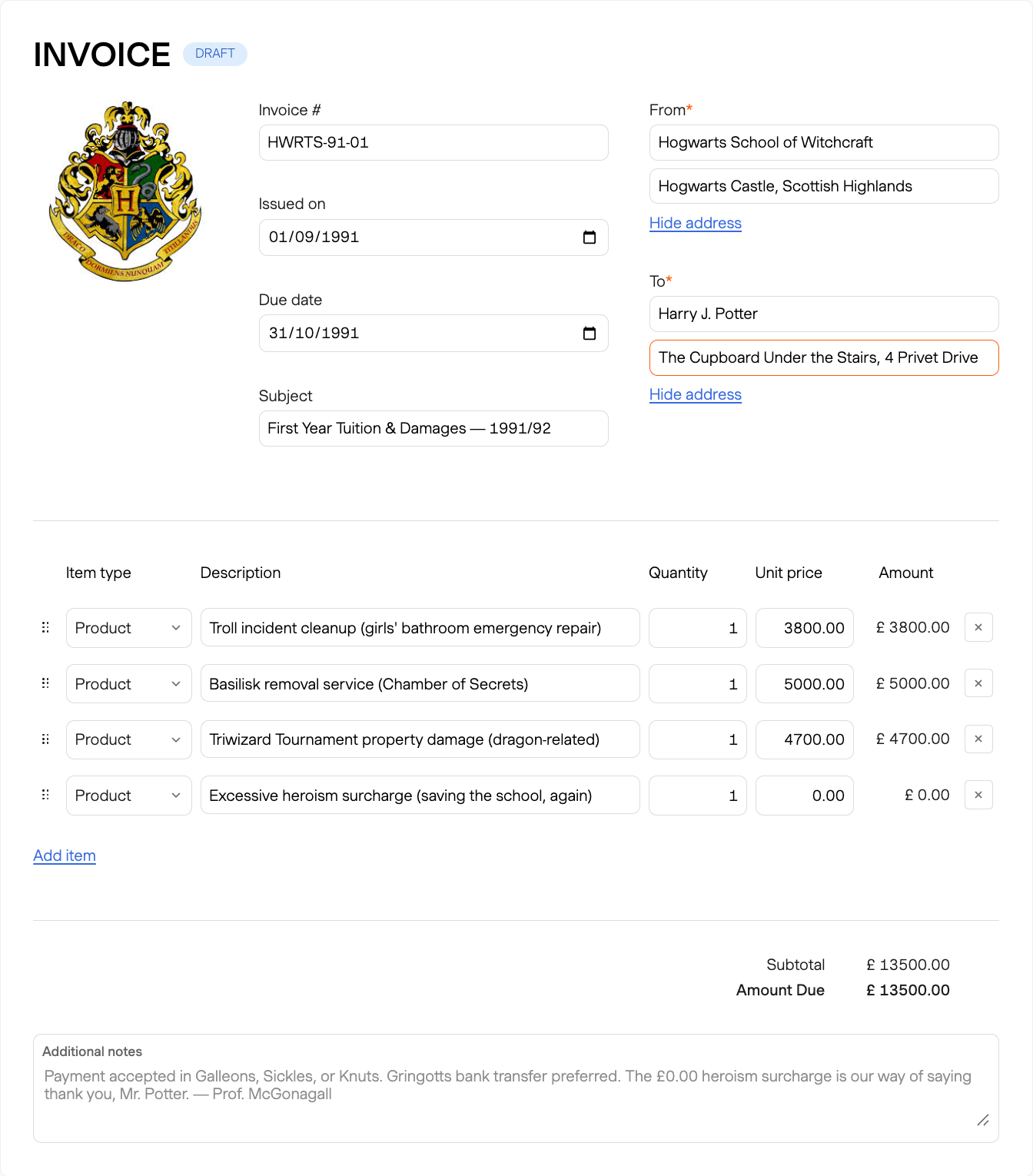
Preview how your e-invoice will appear with UBL 2.1 formatting and Romanian compliance — ready for submission via RO e-Factura.

Send Invoice in Romania FAQs

  • Harvest supports the UBL 2.1 format for e-invoices, allowing you to export invoices in this standardized XML format.

  • To register with ANAF for sending e-invoices, businesses must first access the Virtual Private Space (SPV) and obtain a qualified digital signature. Once registered in the SPV, businesses need to submit Form 084 to ANAF to register for the RO e-Factura system.

  • Harvest primarily operates as a cloud-based service, meaning you need an internet connection to access its features. However, you can track time offline on the mobile app, and your data will sync once you're back online.
  • Current e-invoicing systems may have limitations such as compatibility issues with different software platforms, strict compliance requirements that can vary by jurisdiction, and the need for constant updates to stay aligned with evolving regulatory standards.

  • Harvest allows you to include VAT codes in your invoices, ensuring compliance with tax regulations. This is crucial for meeting Romanian e-invoicing requirements and avoiding penalties.