Harvest
Invoices
Sign up

Send Invoice in United Kingdom

Harvest streamlines the invoicing process for UK businesses by allowing customization of tax information and payment terms, ensuring compliance and clarity.

INVOICE DRAFT

Add your logo here
Item type
Description
Quantity
Unit price
Tax
Amount
Subtotal
$0.00
Discount
$0.00
Amount Due
$0.00
Get paid via:
Credit card / Debit card
ACH
Wire transfer

Customise invoice

Appearance

Add a logo
Show invoice title

Invoice settings

Tax Add up to 2 tax rates
%
Discount Apply a discount percentage
%

Understanding UK Invoicing Regulations

Navigating UK invoicing regulations is crucial for any business, as compliance ensures smooth financial operations and avoids potential penalties from HMRC. All businesses in the UK, regardless of their VAT registration status, must adhere to basic invoicing rules. Every invoice issued needs to include a unique identification number, your business's name, address, and contact details, the customer's name and address, a clear description of the goods or services provided, the date of supply, the invoice date, the amount(s) being charged, and the total amount owed. These fundamental requirements help in tracking transactions and provide legal protection in case of disputes or audits.

For VAT-registered businesses, the invoicing requirements become more detailed. If you are VAT-registered and supply standard or reduced-rate goods or services to another VAT-registered person, you must issue a VAT invoice, typically within 30 days of the supply date. A VAT invoice must include your VAT registration number, the tax point (time of supply), a breakdown of the VAT charged per item (including the rate applied), the amount payable excluding VAT, the total VAT amount, and the grand total including VAT. For retail sales of £250 or less, a simplified VAT invoice can be used, requiring fewer details but still needing the business's VAT number, supply date, description, VAT rate, and total amount paid.

The specific information required also varies based on your business structure. Sole traders must include their full name (and any trading name used) and an address where legal documents can be delivered. Unlike limited companies, sole traders do not need to include a company registration number on their invoices. Limited companies, however, have additional obligations: their invoices must display the full registered company name exactly as it appears on the Companies House certificate of incorporation, along with the company registration number and the registered office address. If directors' names are voluntarily listed on the invoice, then all directors' names must be included. All businesses are legally required to retain their invoices for at least six years for VAT purposes.
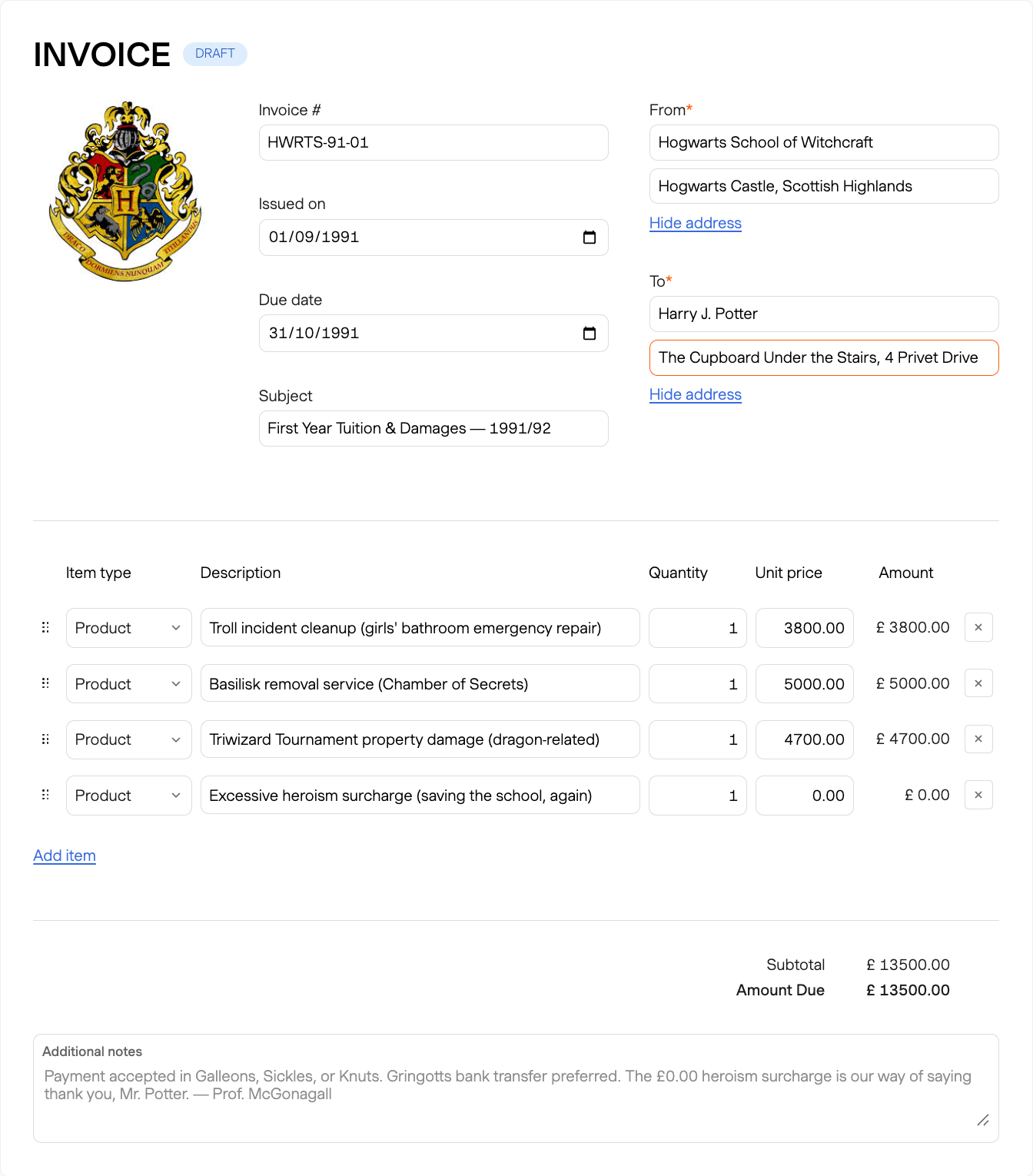
Essential Elements of a UK Invoice

A legally compliant UK invoice serves as a critical record and a formal request for payment, necessitating the inclusion of specific elements to be valid. Beyond simply requesting payment, these details ensure clarity for the customer and facilitate proper record-keeping for your business and HMRC.

Here's a detailed checklist of mandatory elements for all UK invoices:

  • Unique Identification Number: Each invoice must have a unique, sequential number to ensure no duplicates or gaps, which is vital for tracking and audit purposes.
  • Your Business Details: This includes your full business name, address, and contact information. Sole traders should list their own name and any trading name, along with an address for correspondence. Limited companies must use their full registered name, company registration number, and registered office address.
  • Customer's Details: The name and address of the person or business you are invoicing.
  • Clear Description of Goods/Services: A detailed breakdown of what you are charging for, including quantities and unit prices, helps the customer understand the value provided and minimises disputes.
  • Date of Supply: The date when the goods or services were actually provided.
  • Invoice Date: The date the invoice was issued.
  • Amount(s) Charged: Itemised costs for each good or service.
  • Total Amount Owed: The full sum the customer needs to pay.

For VAT invoices, which are mandatory when both you and your customer are VAT-registered for taxable supplies, additional information is required. These specific requirements include:

  • Your VAT registration number.
  • The tax point (time of supply), if different from the invoice date.
  • For each item, the net amount (excluding VAT), the VAT rate applied (e.g., 20%, 5%, 0%), and the VAT amount charged.
  • A clear statement if items are zero-rated or exempt from VAT.
  • The total amount of VAT for the entire invoice.
  • The grand total amount including VAT.

The consistent use of a unique invoice number is paramount for accurate record-keeping, allowing for easy tracking of payments and outstanding debts, and simplifying the process during any HMRC audit or compliance check.

Impact of Making Tax Digital on Invoicing

Making Tax Digital (MTD) has significantly reshaped invoicing and record-keeping practices for UK businesses, particularly those registered for VAT. MTD is a government initiative designed to make tax administration more efficient and to reduce errors by requiring businesses to keep digital records and use MTD-compatible software to submit their VAT returns.

The primary change introduced by MTD for VAT-registered businesses is the mandate for digital record-keeping. This means that businesses can no longer rely solely on paper records or manual spreadsheets for their VAT accounts. Instead, every sale must be digitally recorded, capturing essential details such as the date of supply (tax point), the net amount before VAT, and the applied VAT rate. While the software typically handles these fields automatically when creating an invoice, businesses making numerous low-value sales, such as in retail, are permitted to keep daily summaries at each VAT rate.

In practice, MTD affects invoicing by requiring businesses to use HMRC-compliant software that can digitally link to HMRC's systems. This software not only generates invoices that meet legal requirements but also stores them digitally, fulfilling the MTD obligation to keep VAT invoices in a digital format for at least six years. For example, if a business previously used a manual system for invoicing and then transferred totals to a spreadsheet for VAT returns, under MTD, the entire process from invoice creation to VAT return submission must be digitally linked. This ensures that the data flows seamlessly and accurately, reducing the potential for human error in transcribing figures. The shift towards digital invoicing under MTD aims to create a more transparent and efficient tax system, benefiting both businesses through streamlined processes and HMRC through improved data accuracy.

Best Practices for Effective Invoicing

Effective invoicing goes beyond mere compliance; it's about optimising your financial workflow to ensure prompt payments and maintain strong client relationships. One key best practice is creating clear and detailed invoice descriptions. Instead of vague entries, provide specific information about the goods or services rendered, including quantities, unit prices, and any other relevant details that explain the value provided. For instance, rather than "Consulting Services," specify "Website Design Consultation - 5 hours @ £X/hour." This clarity helps your customer understand exactly what they are paying for, significantly reducing queries and potential disputes.

Setting clear payment terms is another crucial strategy to ensure prompt payment. Your invoice should explicitly state the payment due date, which is commonly set at 30 days from the invoice issue date, though this is not a mandatory legal requirement. Clearly outline accepted payment methods and include your bank details (account number and sort code) to facilitate easy transactions. Furthermore, it's advisable to include any terms regarding late payments, such as interest charges or late payment fees, as this can incentivise timely settlement. For example, you might state: "Payment due within 30 days. Late payments may incur a statutory interest of 8% plus the Bank of England base rate."

To minimise disputes, a professional and accurate invoice is your best defence. Ensure all calculations are correct, and that the invoice reflects any prior agreements or quotes. Double-check customer details and ensure the description of work aligns with what was delivered. Providing a point of contact for invoicing queries can also help resolve issues quickly before they escalate into disputes. By adopting these practices, you not only comply with regulations but also foster trust with your clients and improve your cash flow management.

See Your UK Invoice Template in Action

Preview how your invoice will appear with GBP currency, VAT compliance, and detailed itemized billing — ready for UK clients.

Send Invoice in United Kingdom FAQs

  • Harvest allows you to add your VAT number to your invoices, ensuring compliance for VAT-registered businesses in the UK. Additionally, you can include detailed time entry notes to minimize disputes and ensure prompt payments, and set clear payment terms, which is crucial for ensuring timely payments.

  • A UK invoice must include a unique identification number, the business's name, address, and contact details, the customer's name and address, a clear description of the goods or services provided, the date of supply, the invoice date, itemized costs, and the total amount owed. For VAT invoices, additional details such as the VAT registration number and tax point are required.

  • Yes, Harvest allows you to include billable hours and expenses from multiple projects on a single invoice. This feature offers flexibility in billing clients for work completed across different projects in one consolidated invoice.
  • Invoicing tools can facilitate the invoicing process and help ensure that invoices are clear and compliant, but they cannot guarantee payment receipt. Ensuring prompt payment also depends on clear payment terms and effective communication with clients.

  • Making Tax Digital requires VAT-registered businesses in the UK to maintain digital records and use compatible software to submit VAT returns. This initiative is aimed at reducing errors and streamlining tax administration.