Harvest
Invoices
Sign up

Send Payment Reminder

Harvest streamlines the process of sending automatic payment reminders, helping businesses maintain consistent cash flow with minimal manual effort.

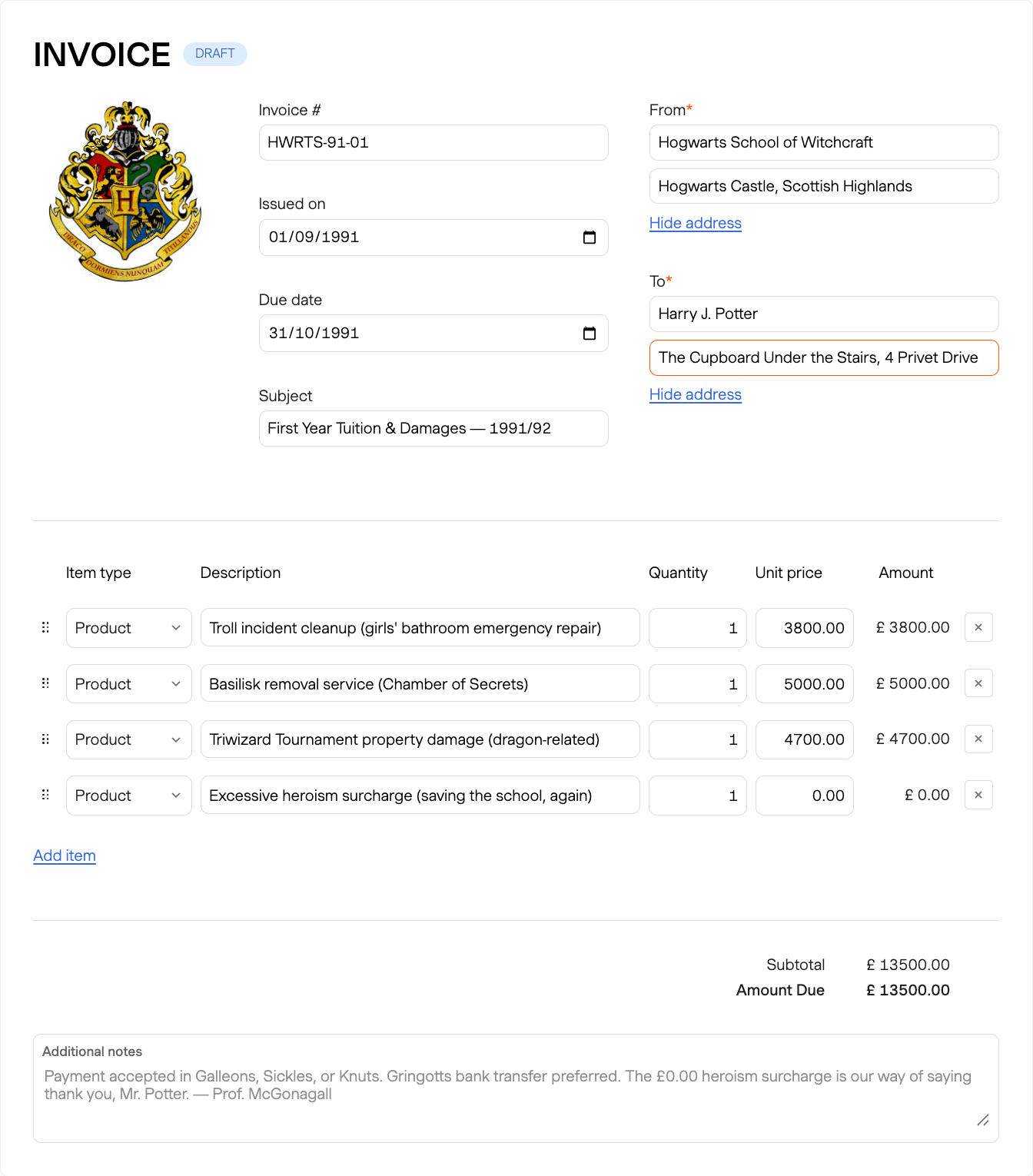
INVOICE DRAFT

Add your logo here
Item type
Description
Quantity
Unit price
Tax
Amount
Subtotal
$0.00
Discount
$0.00
Amount Due
$0.00
Get paid via:
Credit card / Debit card
ACH
Wire transfer

Customise invoice

Appearance

Add a logo
Show invoice title

Invoice settings

Tax Add up to 2 tax rates
%
Discount Apply a discount percentage
%

Understanding the Timing of Payment Reminders

The optimal timing for sending payment reminders significantly influences client payment behavior and preserves business relationships. Businesses often find success by implementing a multi-stage reminder strategy that includes pre-due, due-date, and post-due communications. Sending a reminder 7-10 days before the due date can reduce late payments by up to 20%. This "pre-due" reminder serves as a helpful nudge, allowing clients ample time to process the payment without feeling pressured.

On the actual due date, a concise, polite reminder can reinforce the payment obligation. This is particularly effective for clients who might have simply forgotten. Post-due reminders require a more structured approach, typically escalating in tone and urgency over time. A common frequency involves sending the first post-due reminder 1-3 days after the due date, followed by subsequent reminders at intervals of 7-14 days. For instance, a reminder sent 3 days past due might be a gentle follow-up, while one sent 15 days past due might include information about late fees. The psychological impact of these timings is crucial: too frequent, and you risk annoying clients; too infrequent, and you might be perceived as lax, potentially delaying payment further. Maintaining a consistent, predictable schedule helps manage client expectations and encourages timely payments without damaging goodwill.
Crafting the Perfect Payment Reminder Message

Crafting an effective payment reminder message involves a delicate balance between clarity, professionalism, and a friendly tone to encourage payment without alienating the client. Every reminder should clearly state the essential components: the invoice number, the original due date, the outstanding amount, and clear instructions on how to pay. For example, explicitly stating "Invoice #12345 for $500 was due on March 1, 2026" leaves no room for ambiguity.

The language and tone are paramount. Initially, messages should be polite and assume an oversight, using phrases like "Just a friendly reminder" or "We wanted to gently remind you." As the payment becomes more overdue, the tone can become firmer but should always remain professional. Avoid accusatory language such as "You haven't paid" and instead focus on the action required: "Your payment of [amount] for Invoice [number] is now overdue." Incorporating a call to action, such as "Please remit payment at your earliest convenience" or "Click here to pay now," streamlines the process for the client. Research suggests that a positive framing, emphasizing the benefits of timely payment (e.g., "to avoid service interruption"), can be more effective than focusing solely on penalties.

Innovative Strategies for Payment Reminders

Innovative strategies for payment reminders move beyond traditional emails, leveraging creative approaches and behavioral economics to engage clients and encourage timely payments. One unconventional method involves using multimedia reminders, such as short, personalized video messages. A quick video from an account manager, for example, can humanize the reminder process, making it feel less transactional and more personal. This can be particularly effective for high-value clients or larger outstanding invoices, as it demonstrates a higher level of care and attention.

Leveraging principles from behavioral economics can also significantly improve payment rates. For instance, the concept of social proof can be subtly integrated by mentioning that "most of our clients pay within 7 days," implying a desirable norm. Another strategy is to frame the payment in terms of a small, manageable action rather than a large sum, which can reduce psychological friction. Offering flexible payment options or breaking down larger invoices into smaller, more frequent payments can also make the process less daunting. Gamification, while less common, could involve a loyalty program where timely payments earn points towards future discounts, turning a chore into a rewarding experience. These creative approaches aim to shift the client's perception of payment from an obligation to a positive interaction.

Automating Payment Reminders for Efficiency

Automating payment reminders significantly boosts efficiency by ensuring timely and consistent communication without manual effort, yet maintaining personalization is key to its success. The primary benefit of automation is the ability to schedule and send reminders at optimal intervals, reducing the likelihood of human error and freeing up staff time for more complex tasks. For example, a system can be configured to automatically send a polite reminder email 10 days before an invoice is due, another on the due date, and a series of escalating reminders post-due. This systematic approach ensures no payment slips through the cracks.

Setting up automated workflows typically involves integrating accounting or invoicing software with a communication platform. Within these systems, you can define triggers (e.g., "invoice due in X days," "invoice X days overdue") and corresponding actions (e.g., "send email template A," "send SMS template B"). To maintain personalization, even in automated messages, use merge tags to dynamically insert client names, invoice numbers, and specific amounts. Segmenting your client base and tailoring message templates to different client types (e.g., new clients vs. long-term partners) can also enhance the personal touch. For instance, a small business might use a more informal tone for its regular clients, while a larger corporation might stick to a more formal approach, all managed through automated rules.

Handling Overdue Payments Professionally

Handling overdue payments professionally requires a structured escalation strategy, a clear understanding of legal considerations, and a commitment to preserving client relationships. When initial gentle reminders fail, the tone and urgency of communications should gradually increase. This might involve a series of reminders sent at 7, 15, and 30 days past due, each with a slightly firmer message. For instance, after 30 days, a phone call might be more effective than another email, offering a direct opportunity to discuss the issue and potential solutions.

Legal considerations, particularly regarding late fees, are crucial. Many jurisdictions allow businesses to charge late fees, often a percentage of the outstanding amount (e.g., 1.5% per month) or a flat fee, but these must typically be stipulated in the original contract or terms of service. It's vital to check local regulations concerning maximum allowable late fees and notice requirements. If payment remains outstanding after significant efforts, a formal demand letter may be necessary before considering external collections. Throughout this process, maintaining client relationships is paramount. Even when escalating, the communication should remain professional and solution-oriented. Offering payment plans or partial payments can often resolve issues without resorting to more drastic measures, demonstrating flexibility and a willingness to work with the client, which can be invaluable for future business.

Explore Your Payment Reminder Template

See how your payment reminders can be scheduled automatically, customized for each client, and include essential payment information, reducing late payments.

Send Payment Reminder FAQs

  • Harvest allows you to set up automatic payment reminders for overdue invoices, which can be customized and scheduled to improve cash flow.
  • A payment reminder message should include the invoice number, original due date, outstanding amount, and clear payment instructions. It's important to use a friendly yet professional tone, especially in initial reminders, and to provide a clear call to action to facilitate easy payment.
  • You can edit invoice details before sending — modify line items, quantities, rates, or apply discounts. Once sent, you'd need to create a new invoice or issue a credit.
  • Payment reminder tools can help improve the chances of timely payments, but they cannot guarantee them due to various factors such as client cash flow issues, administrative delays, or simple oversight. External circumstances beyond the control of such tools can impact payment timelines.
  • It's generally effective to send a pre-due reminder 7-10 days before the payment due date, followed by a reminder on the due date. If payment is not received, subsequent reminders can be sent at 7-14 day intervals, adjusting the tone as necessary to reflect the growing urgency.