
Harvest
Time Tracking
Sign up free

Billable Hours

Struggling to track billable hours accurately? Harvest offers precise time tracking and reporting tools to ensure no billable hour goes unnoticed.

Try Harvest Free

What should you charge per hour?

Most freelancers and consultants dramatically undercharge. This calculator accounts for what most people miss: non-billable time, taxes, and overhead.

$
Accounting for vacation, holidays, sick days
60%
Most freelancers can bill 50-70% of their time. The rest goes to admin, marketing, proposals, and learning.
$
Software, insurance, equipment, accounting, taxes beyond income tax, etc.
Your break-even rate $0
Recommended rate (+20% buffer) $0
Billable hours per week 0h
Equivalent daily rate $0

Start tracking your billable hours

Walk through the entire flow below. Start a timer, check your reports, and create a real invoice — all in three clicks.

Go ahead — start tracking!

One click and you're timing. Try it right here: start a timer, add an entry, edit the details. This is exactly how it feels in Harvest.

  • One-click timer from browser, desktop & mobile
  • Works inside Jira, Asana, Trello, GitHub & 50+ tools
  • Duration or start/end — your call
  • Day, week & calendar views to stay on top of it all
  • Friendly reminders so no hour gets left behind
Acme Corp
Website Redesign
Homepage layout revisions
1:24:09
Content Strategy
Blog calendar planning
1:30:00
SEO Audit
Technical audit report
0:45:00
Brand Guidelines
Color system documentation
2:15:00
Logo Concepts
Initial sketches round 1
1:00:00

Understanding Billable Hours: The Foundation of Professional Services

Billable hours are a cornerstone in professional services, particularly in law and consulting. They represent the time spent on client-related work that can be directly invoiced. Understanding how to calculate and manage billable hours effectively is crucial for maximizing profitability and maintaining client trust. Typically, billable time is recorded in small increments, with 0.1 hours (six minutes) being the most common standard. For instance, a 36-minute task would log as 0.6 hours. This precision ensures that every minute of work is accounted for, minimizing unbilled hours that could otherwise result in significant revenue loss.

Misclassifying or underreporting just a few hours per consultant each week can lead to staggering financial losses. For a 10-person firm, this misclassification could cost over $200,000 annually. Moreover, a survey highlighted that 77% of legal professionals often underreport their billable hours, primarily due to manual tracking deficiencies. Harvest addresses these challenges by providing tools that ensure accurate and efficient time tracking, ultimately enhancing the bottom line.
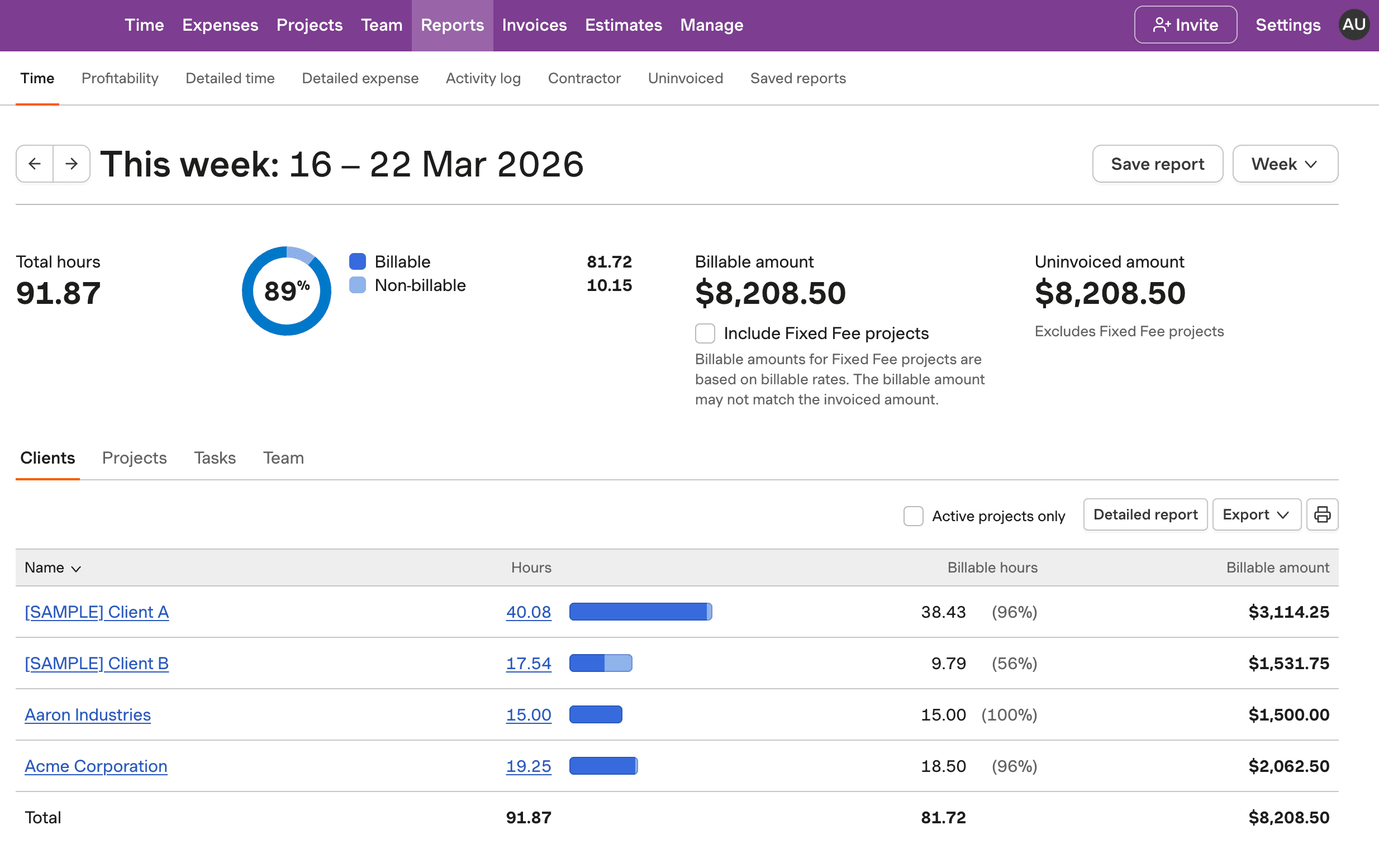
Billable vs. Non-Billable: Distinguishing Your Time

Understanding the difference between billable and non-billable hours is essential for accurate time management and financial health. Billable hours are directly tied to client projects and can be invoiced, while non-billable hours include tasks like administrative duties or internal meetings that don't generate direct revenue. Tracking both types of hours is vital to assess overall business performance and optimize resource allocation.

The billable utilization rate is a key metric, calculated by dividing total billable hours by total available hours, then multiplying by 100. This rate helps firms gauge the efficiency of their workforce. Industry benchmarks suggest that law firms achieve 60-80% depending on seniority, while consultancies aim for 75-85%. Harvest enables businesses to track both billable and non-billable hours, providing comprehensive insights into utilization rates and helping identify areas for improvement.

Strategies for Effective Billable Hour Tracking

Accurate tracking of billable hours is essential for maximizing revenue. Best practices include defining billable tasks clearly, using consistent time increments, and logging hours in real time. Delayed time entry can lead to substantial revenue loss, with up to 50% of potential income slipping away if entries are left till the end of the week. Real-time logging, supported by tools like Harvest's one-click timers, ensures that billable hours are captured as they occur.

In addition to real-time tracking, categorizing tasks accurately and reviewing entries daily are crucial. Harvest provides a streamlined solution with its ability to log time against specific tasks like client meetings or correspondence. This functionality not only aids in precise billing but also supports detailed reporting for financial analysis and forecasting. Utilizing integrated software like Harvest can automate these processes, reducing human error and increasing billing accuracy.

The Impact of Billable Hours on Professionals and Firms

Billable hours significantly influence both earnings and firm profitability. For many professionals, especially in law, meeting high billable hour targets is crucial for career advancement and financial success. However, achieving these targets often requires long hours, impacting work-life balance. On average, lawyers spend only 2.9 hours of an 8-hour workday on billable tasks, necessitating extended office hours to meet firm requirements.

Harvest's capabilities extend beyond simple time tracking, offering insights that help manage workloads and improve efficiency. By leveraging detailed reports on billable hours, firms can better forecast financial outcomes and make data-driven decisions on workforce management. This capability not only enhances profitability but also supports healthier work-life balance by highlighting areas where efficiency can be improved.

Optimizing Billable Hours: Future Trends and Ethical Considerations

As technology evolves, so do the methods for tracking billable hours. AI and automation tools are increasingly being adopted to capture more billable hours without extending workdays, potentially increasing billable time by 25-30%. Harvest's integration with various digital platforms facilitates seamless time tracking, reducing manual entry errors and improving accuracy.

Ethical billing practices, such as transparency and accuracy, remain paramount. Clients expect honesty in billing, and tools like Harvest help maintain these standards by providing clear, detailed invoices backed by precise time logs. As the industry shifts, alternative fee arrangements are also gaining traction, challenging the traditional billable hour model. However, until these become more widespread, optimizing billable hour tracking remains a critical component of professional services.

Track Billable Hours with Harvest

See how Harvest tracks billable hours in real-time, helping you manage tasks like client meetings and correspondence efficiently.

Harvest dashboard showing billable hours tracking

Billable Hours FAQs

  • Billable hours refer to the time spent on client-related work that can be invoiced. They are typically calculated in small increments, such as 0.1-hour blocks, to ensure all work is captured. For example, a 36-minute task would be logged as 0.6 hours. Accurate tracking is essential for maximizing revenue.

  • Billable hours directly affect a firm's revenue and a professional's earnings. Misclassifying just a few hours weekly can cost a 10-person firm over $200,000 annually. Efficient tracking ensures all work is billed correctly, enhancing profitability.

  • Billable hours are directly tied to client projects and can be invoiced, while non-billable hours include tasks like internal meetings that do not generate direct revenue. Tracking both is crucial for assessing business performance and optimizing resources.

  • Technology, such as time-tracking software, automates the logging of working hours, reducing errors and improving billing accuracy. Harvest offers real-time tracking and detailed reporting, ensuring precise billing and financial forecasting.

  • Law firms often require attorneys to achieve specific billable hour targets, typically between 1,700 and 2,000 hours annually. Time is usually recorded in 0.1-hour increments to maximize billing accuracy and revenue.

  • Harvest offers one-click start/stop timers and manual entry options to track billable hours accurately. It provides detailed reports to aid in financial forecasting and client billing, ensuring no hour goes unbilled.

  • The billable utilization rate measures the percentage of available working hours spent on revenue-generating tasks. Calculated by dividing total billable hours by total available hours and multiplying by 100, it helps gauge workforce efficiency.

  • Yes, Harvest can track both billable and non-billable hours, providing comprehensive insights into all aspects of time management. This functionality helps businesses optimize resource allocation and improve overall efficiency.

  • Harvest simplifies time tracking with its user-friendly interface and integration capabilities. It helps capture all billable hours accurately, generates detailed reports, and integrates with various platforms for seamless workflow management.