
Harvest
Time Tracking
Sign up free

Time Tracking Template

Harvest offers a comprehensive solution for accurate time tracking, addressing the challenge of manual errors and compliance with its automated features.

Try Harvest Free

How many hours did you work this week?

Enter your clock-in and clock-out times for each day. The calculator handles breaks, overtime, and weekly totals automatically.

Day Clock In Clock Out Break Hours
Total hours this week 0h
Regular hours (≤40) 0h
Overtime hours 0h
Average hours/day 0h
Total break time 0h

Track time automatically with Harvest

Walk through the entire flow below. Start a timer, check your reports, and create a real invoice — all in three clicks.

Go ahead — start tracking!

One click and you're timing. Try it right here: start a timer, add an entry, edit the details. This is exactly how it feels in Harvest.

  • One-click timer from browser, desktop & mobile
  • Works inside Jira, Asana, Trello, GitHub & 50+ tools
  • Duration or start/end — your call
  • Day, week & calendar views to stay on top of it all
  • Friendly reminders so no hour gets left behind
Acme Corp
Website Redesign
Homepage layout revisions
1:24:09
Content Strategy
Blog calendar planning
1:30:00
SEO Audit
Technical audit report
0:45:00
Brand Guidelines
Color system documentation
2:15:00
Logo Concepts
Initial sketches round 1
1:00:00

Understanding Time Tracking Templates: Your Foundation for Efficiency

Time tracking templates are essential tools designed to systematically capture and record work hours, tasks, and activities. They are invaluable for improving payroll accuracy, ensuring precise client billing, enhancing productivity, and maintaining regulatory compliance. These templates are available in various formats, including Excel, Google Sheets, PDF, and Word, catering to different preferences and needs. For organizations where labor represents 25-35% of total operating costs, effective time tracking becomes crucial for profitability.

Templates typically include fields for employee identification, date, clock-in/clock-out times, break periods, total hours worked, overtime indicators, and signature fields for verification. Many digital spreadsheet templates offer automated calculations of hours, overtime, and breaks, significantly reducing manual errors and improving efficiency. With nearly 32% of US workers being paid weekly, weekly time tracking templates are particularly popular.
Types of Templates and How to Choose the Right One

Choosing the right time tracking template depends on your specific needs and work structure. Options include daily, weekly, bi-weekly, and monthly templates, each suited to different use cases. Daily templates are ideal for variable schedules, while weekly versions align with standard payroll cycles. For project-based work, specialized templates can track billable hours and project progress, crucial for industries like marketing, construction, and IT services.

Freelancers and contractors benefit from project-based templates to simplify invoicing and improve accountability. Industry-specific templates, such as those for construction or legal professions, include additional fields for job classifications or client billing. When selecting a template, consider factors like pay periods, the level of detail required, and any industry-specific needs.

Step-by-Step Guide to Using and Customizing Your Template

To effectively use a time tracking template, begin by downloading or copying the template to your preferred format, such as Excel or Google Sheets. For Google Sheets, ensure you make a copy to your own account for editing. Enter personal details like employee name, supervisor, and company information. Record daily entries by logging clock-in/clock-out times, break periods, and specific tasks or projects.

Many templates come with built-in formulas to automatically calculate total regular hours, overtime, and pay, enhancing accuracy. Customize templates by adding or removing columns, incorporating project names, or adjusting formulas as needed. Regular and consistent logging, ideally daily, is recommended to ensure data precision, as recalling details later can be challenging.

Maximizing Benefits: Beyond Basic Time Tracking

Time tracking templates provide more than just basic time logging; they offer insights into project management, resource allocation, and profitability. By analyzing tracked data, organizations can make informed decisions on workload distribution and budget management. Templates also foster accountability and transparency within teams, promoting a culture of accuracy and reliability.

For remote teams and mobile workers, consider using mobile-optimized templates for ease of access and real-time updates. Training employees on the proper use of templates ensures consistent adoption and data accuracy. Ultimately, time tracking templates are not just about recording hours; they are tools for strategic management and operational efficiency.

Discover Harvest's Time Tracking Template

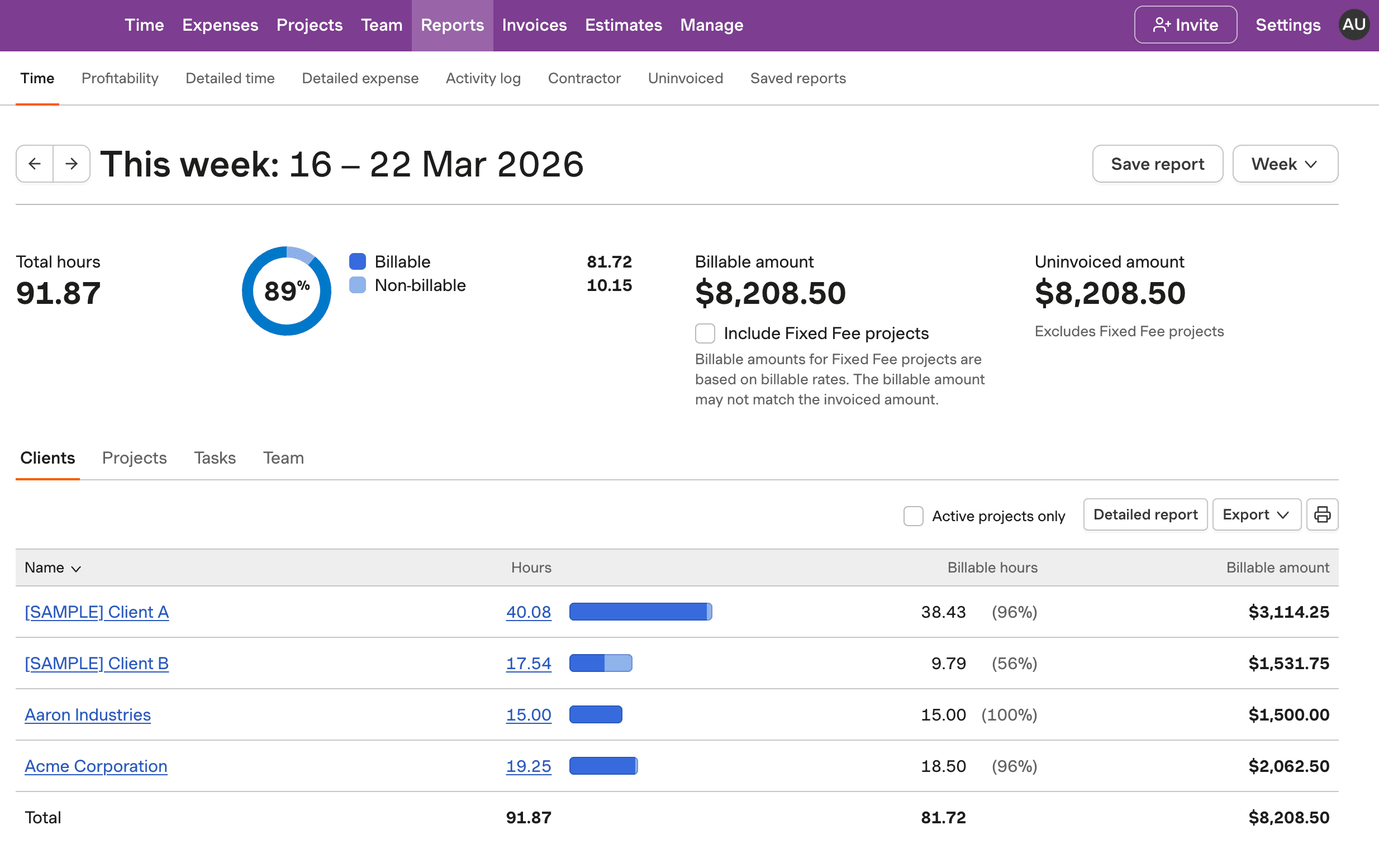
Explore how Harvest's time tracking template helps manage your time effectively, ensuring billing accuracy and productivity gains.

Screenshot of a Harvest time tracking template in use.

Time Tracking Template FAQs

  • Time tracking templates come in various formats, including daily, weekly, bi-weekly, monthly, and project-specific versions. Each is designed for different scheduling needs, such as daily templates for variable schedules and weekly ones for standard payroll cycles. Specialized templates also exist for industries like construction and legal professions.

  • To use a time tracking template, download it in your preferred format like Excel or Google Sheets. If using Google Sheets, make a copy to your account for editing. Enter necessary details, record clock-in and clock-out times, and let built-in formulas calculate total hours and pay. Regular and accurate logging ensures the best results.

  • Yes, time tracking templates can be customized to suit specific needs. You can add or remove columns, include project names, adjust formulas, or tailor fields for industry-specific requirements. Customization helps in aligning the template with your unique work structure and tracking needs.

  • Using a time tracking template improves payroll accuracy, billing precision, and productivity. It helps in ensuring compliance with labor laws and provides insights into project management and resource allocation. Templates also foster accountability and transparency within teams.

  • Yes, there are templates designed for specific industries such as construction, legal, and service sectors. These templates often include additional fields for job classifications, client billing, or project details, catering to the unique requirements of each industry.

  • Harvest offers automated time tracking solutions that enhance accuracy and compliance, reducing manual errors common with templates. Its features include one-click timers, detailed reporting, and seamless integration with popular tools, providing a comprehensive alternative to manual templates.

  • Yes, Harvest supports tracking billable hours by project with its detailed time tracking and reporting features. This allows for precise billing and makes it suitable for project-based work in industries like marketing and construction.