
Harvest
Time Tracking
Sign up free

Billable Hours Calculator for Entrepreneurs

Entrepreneurs often lose 10-25% of billable hours due to poor time tracking. Harvest offers a solution with one-click timers and detailed reports, ensuring no hour goes unbilled.

Try Harvest Free

What should you charge per hour?

Most freelancers and consultants dramatically undercharge. This calculator accounts for what most people miss: non-billable time, taxes, and overhead.

$
Accounting for vacation, holidays, sick days
60%
Most freelancers can bill 50-70% of their time. The rest goes to admin, marketing, proposals, and learning.
$
Software, insurance, equipment, accounting, taxes beyond income tax, etc.
Your break-even rate $0
Recommended rate (+20% buffer) $0
Billable hours per week 0h
Equivalent daily rate $0

Start tracking your billable hours

Walk through the entire flow below. Start a timer, check your reports, and create a real invoice — all in three clicks.

Go ahead — start tracking!

One click and you're timing. Try it right here: start a timer, add an entry, edit the details. This is exactly how it feels in Harvest.

  • One-click timer from browser, desktop & mobile
  • Works inside Jira, Asana, Trello, GitHub & 50+ tools
  • Duration or start/end — your call
  • Day, week & calendar views to stay on top of it all
  • Friendly reminders so no hour gets left behind
Acme Corp
Website Redesign
Homepage layout revisions
1:24:09
Content Strategy
Blog calendar planning
1:30:00
SEO Audit
Technical audit report
0:45:00
Brand Guidelines
Color system documentation
2:15:00
Logo Concepts
Initial sketches round 1
1:00:00

Understanding Billable Hours: The Foundation of Entrepreneurial Profitability

Billable hours are the cornerstone of revenue generation for entrepreneurs. These are the hours directly devoted to client projects that can be invoiced, unlike non-billable hours spent on internal operations such as meetings, training, or marketing. Accurate tracking of billable hours is crucial to avoid losing up to 25% of potential revenue due to unrecorded work activities. In the U.S., this can equate to a staggering 50 million hours of lost productivity daily. To maximize profitability, entrepreneurs must clearly distinguish between billable and non-billable tasks and ensure precise time tracking.

Utilizing tools like Harvest can significantly enhance this process. Harvest allows entrepreneurs to track both billable and non-billable hours, providing detailed insights into their impact on overall profitability. By leveraging Harvest, entrepreneurs can avoid common pitfalls such as forgetting to log hours or relying on memory, which often results in misremembering 40-50% of worktime. Implementing a reliable time tracking system is essential for maintaining accurate invoicing, improving project management, and building client trust.
Calculating Your Worth: Setting Competitive Billable Rates

Determining the right billable rate is essential for solo entrepreneurs aiming to cover costs and achieve desired profit margins. This involves a comprehensive calculation that accounts for total annual costs, including salaries and operating expenses, realistic annual billable hours, and a set profit margin. For example, if the average freelancer in the U.S. charges $48/hour, understanding the factors that influence this rate is crucial. These factors include the cost of work, experience, industry, and geographic location.

Harvest aids in this calculation by allowing entrepreneurs to apply flexible rates per project or person, helping set competitive prices. By incorporating overhead costs—such as office rent, software licenses, and marketing expenses—entrepreneurs can ensure their rates reflect the true cost of doing business. This strategic rate setting can align with industry norms, such as service firms using a multiplier of 2.5 to 3.5 times base compensation, ensuring sustainability and competitiveness.

Mastering Time Management: Best Practices for Maximizing Billable Hours

Effective time management is vital for maximizing billable hours. Entrepreneurs often face challenges like delayed time entries and manual tracking inefficiencies, which can lead to significant revenue loss. Implementing best practices such as real-time tracking of all activities—both billable and non-billable—can mitigate these issues. Automated tools like Harvest simplify this process, enabling entrepreneurs to capture every minute worked accurately.

Harvest's one-click timers and detailed reporting capabilities provide entrepreneurs with real-time insights into their work patterns. These tools not only assist in avoiding the common mistake of delayed entry but also improve task prioritization by highlighting high-value activities. Regularly reviewing time data can help identify overlooked billable hours, ensure data accuracy, and ultimately drive profitability. By creating a structured policy for time tracking, entrepreneurs can foster consistency and accountability within their business operations.

Using Billable Hours Data to Enhance Business Profitability

Entrepreneurs can leverage billable hours data to enhance business profitability significantly. This data provides insights into project costs, helping entrepreneurs estimate expenses more accurately and negotiate better rates with clients. For instance, Harvest offers detailed tracking of billable hours and flexible rate management, essential for evaluating project profitability and client negotiations.

By analyzing billable hours data, entrepreneurs can identify trends and areas for improvement, such as optimizing utilization rates, which ideally range from 70% to 85%. This data-driven approach not only aids in setting realistic utilization goals but also enhances decision-making regarding resource allocation and project planning. Ultimately, using Harvest to analyze billable hours data can lead to improved financial outcomes and sustainable business growth.

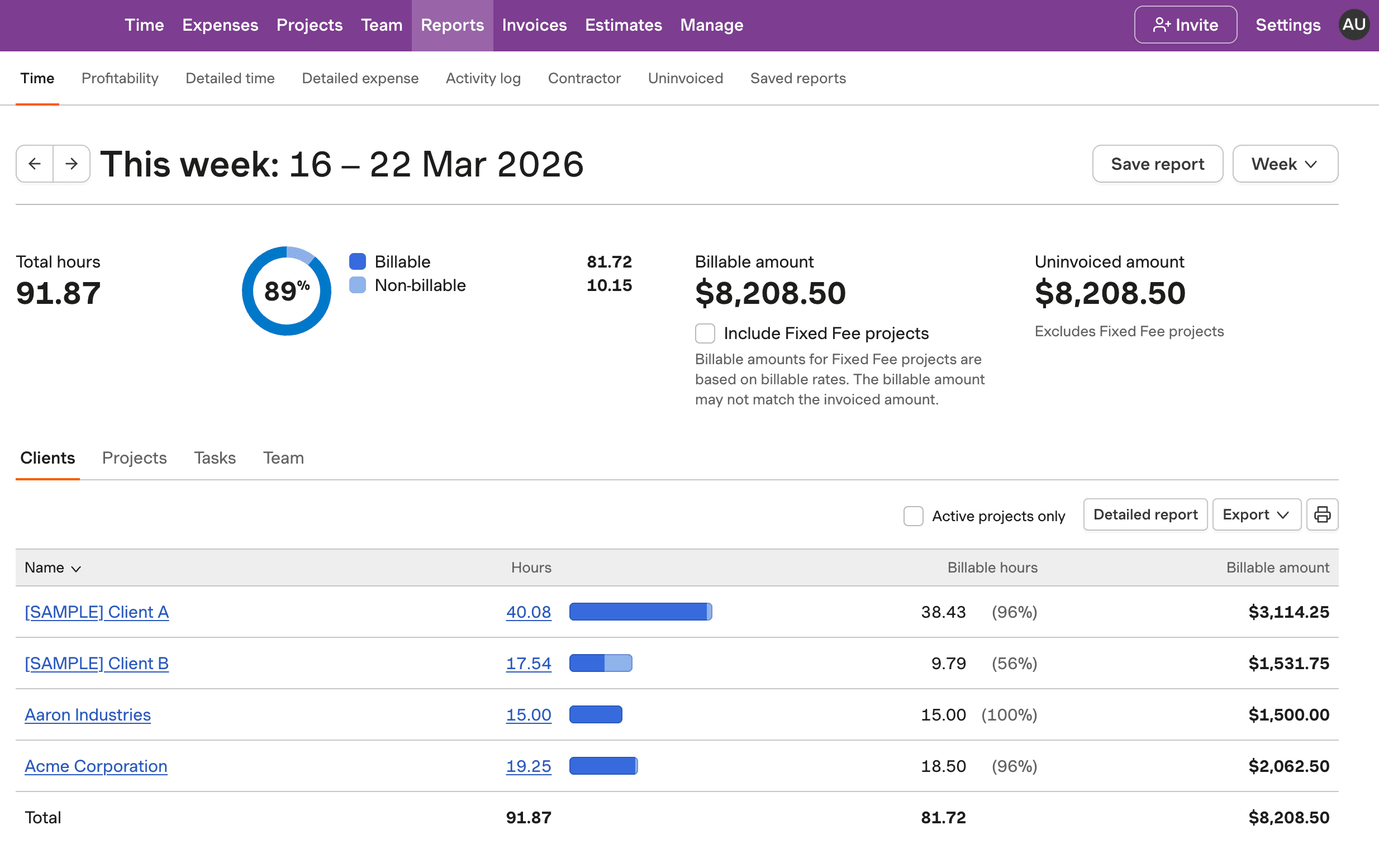
Billable Hours Tracking with Harvest

See how Harvest tracks billable hours with one-click timers and detailed reports, helping entrepreneurs boost profitability.

Screenshot of Harvest showing billable hours tracking for entrepreneurs.

Billable Hours Calculator for Entrepreneurs FAQs

  • A billable hours calculator helps entrepreneurs determine the time spent on client projects that can be invoiced. By inputting data such as total hours worked and hourly rates, it calculates the total billable amount. This tool ensures accurate invoicing and helps in setting competitive rates.

  • To calculate your optimal hourly rate, consider your total annual costs, including salary and overhead, realistic billable hours, and desired profit margin. Use the formula: (Total costs / Billable hours) x Profit margin. Tools like Harvest can assist by providing flexible rate management features.

  • When determining billable hours, consider factors like client project requirements, your industry, experience, and geographic location. Ensure you differentiate between billable and non-billable tasks, as non-billable time impacts your overall profitability.

  • Harvest aids in tracking billable hours through one-click timers and detailed reporting features. It allows entrepreneurs to log hours as they work, minimizing errors and ensuring all billable time is accurately captured and invoiced.

  • Tracking non-billable hours is important because it provides insights into how much time is spent on operational tasks that don't directly generate revenue. Harvest helps by offering separate tracking and analysis of non-billable hours, aiding in better resource allocation and profitability analysis.

  • A typical utilization rate for entrepreneurs ranges from 70% to 85%, meaning this percentage of their time is spent on billable work. Harvest helps track and analyze utilization rates, providing data to optimize workload and improve profitability.

  • Yes, Harvest can help entrepreneurs negotiate better rates with clients by providing detailed tracking of billable hours and rate management. This data can be used to demonstrate the value of work performed and justify rate adjustments.