
Harvest
Expenses
Sign up

Expense Report Policy Example

Manual expense reporting costs businesses significantly, while Harvest offers a simplified way to track and manage expenses efficiently.

EXPENSE REPORT DRAFT

Drop your receipts here or click to upload

Images and PDFs (max 10 MB each)

Date
Category
Merchant
Description
Amount
Total
$0.00

Customise report

Appearance

Show report title

Report settings

Essential Components of an Expense Report Policy

Creating a comprehensive expense report policy is crucial for businesses to manage their finances effectively. A well-structured policy should include specific guidelines on allowable expenses, reimbursement procedures, and documentation requirements. For instance, defining allowable expenses such as travel, meals, and entertainment with clear budget thresholds can prevent misinterpretations and ensure compliance. Additionally, outlining the submission and approval workflows is essential, as 19% of expense reports contain errors that cost around $52 each to correct.

Including detailed documentation requirements is another critical aspect. The law mandates immediate documentation for certain expenses like travel and mileage, and missing receipts can result in a 20% negligence penalty from the IRS. Businesses should also establish clear reimbursement timelines, typically within 30 days, to maintain employee satisfaction and compliance. By integrating these elements, companies can reduce the risk of fraud, which accounts for 5% of annual revenue losses due to fraudulent reporting.
The Role of Automation in Expense Management

Automation in expense management is increasingly vital for businesses seeking efficiency and accuracy. Traditional manual processes are not only time-consuming but costly, with the average manual expense report costing $58 to process. In contrast, automated systems can reduce this to $10.30 per report and cut processing times by 67%. This shift is reflected in the growing trend, with 87% of CFOs prioritizing expense automation by 2025.

Harvest simplifies expense tracking by allowing the creation of specific categories for expenses like travel and meals, enhancing the organization of financial data. While Harvest does not automate policy enforcement, it offers a platform for manual entry and management of expenses, making it easier for teams to categorize and track their spending. This approach can significantly reduce the time finance teams spend on expense reconciliation, which in some cases can take up to 40 hours monthly.

Legal Considerations for Expense Reporting

Understanding the legal requirements for expense reporting is critical to avoid penalties and ensure compliance. In the U.S., both federal and state laws, such as those in California and Illinois, require employers to reimburse necessary business expenses. For instance, Illinois mandates that reimbursement requests be submitted within 30 days with appropriate documentation, highlighting the need for clear policies.

Harvest helps businesses tackle these compliance challenges by allowing manual expense entry and receipt attachment, facilitating the documentation process. Although it doesn't automate compliance checks, it supports businesses in managing receipts and expenses in one place, which is crucial given that 75% of businesses report increased fraud risk with manual tracking.

Practical Steps to Develop an Expense Policy

Developing an effective expense report policy involves a structured approach. Start by defining policy goals and involving departments like finance and HR to ensure all perspectives are considered. Assign clear roles and responsibilities for policy management and define both allowable and non-allowable expenses with specific budget thresholds.

Implement a clear workflow for expense submission and approval, specifying documentation requirements such as itemized receipts. Regular policy reviews and updates are necessary to keep the policy relevant and effective. Harvest assists in this process by offering tools to track and categorize expenses, though businesses will need to manually enforce policy guidelines.

Expense Report Policy with Harvest

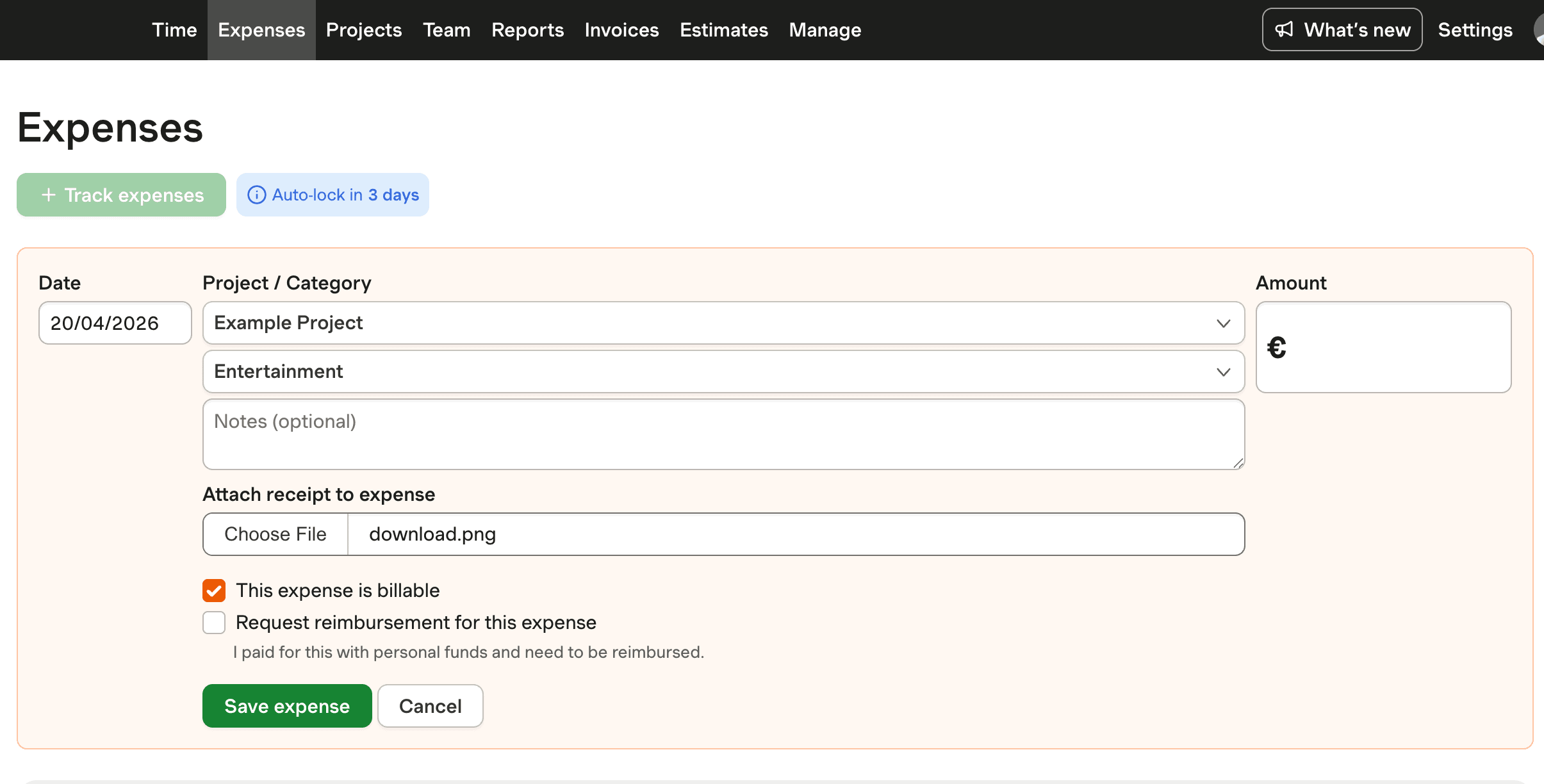
Harvest shows how to track and categorize expenses like travel and meals, aiding in policy compliance and management.

Screenshot of Harvest categorizing travel and meal expenses

Expense Report Policy Example FAQs

  • An effective expense report policy should include guidelines for allowable expenses, submission and approval workflows, and documentation requirements. Defining clear budget thresholds and reimbursement timelines is also crucial.

  • Start by involving key departments like finance and HR, define policy goals, outline allowable expenses, and set specific documentation requirements. Regularly review and update the policy to ensure ongoing compliance.

  • Common reimbursable expenses include travel, meals, and entertainment. Policies should clearly define these categories and set specific budget limits to avoid misinterpretations.

  • U.S. federal law requires reimbursement if expenses lower an employee's pay below minimum wage. Some states have more comprehensive laws, requiring reimbursement for all necessary business expenses.

  • Harvest helps by allowing the creation and management of specific expense categories, such as travel and meals, simplifying the tracking and organization of financial data.

  • Automation reduces processing costs from $58 to $10.30 per report and cuts processing times by 67%. It minimizes errors and fraud risk while enhancing efficiency and accuracy.

  • Integration with systems like QuickBooks or SAP Concur streamlines operations, reduces manual data entry, and provides real-time financial insights, improving accuracy and control over expenses.