Harvest
Invoices
Sign up

Contractors Invoice Template

Harvest excels at linking invoices to projects and managing detailed line items, making it ideal for tracking project-based billing.

INVOICE DRAFT

Add your logo here
Item type
Description
Quantity
Unit price
Tax
Amount
Subtotal
$0.00
Discount
$0.00
Amount Due
$0.00
Get paid via:
Credit card / Debit card
ACH
Wire transfer

Customise invoice

Appearance

Add a logo
Show invoice title

Invoice settings

Tax Add up to 2 tax rates
%
Discount Apply a discount percentage
%

Essential Features of a Construction Invoice Template

A robust construction invoice template must include specific features to handle the complexities of project billing, ensuring you get paid accurately and on time. Look for templates that facilitate progress billing, allowing you to invoice clients at predefined milestones or percentages of completion for long-term projects.

Your template should offer detailed line items for labor, materials, and equipment, providing a transparent breakdown of costs. This includes specific labor hours with rates, quantities and costs of materials used, and equipment rental or usage fees. For larger commercial projects, compliance with standardized formats like AIA G702/G703 is often a requirement, so ensure your chosen template can accommodate these. Effective change order tracking is also crucial; the template must clearly link additions or deductions to the original contract scope to approved change orders. Finally, the template needs to correctly calculate and track retainage—the 5-10% of each payment held until final project completion and inspection—which is standard in construction billingsource domain.
How to Customize Your Contractor Invoice Template

Customizing your contractor invoice template ensures it aligns perfectly with your business operations and project specifics, enhancing professionalism and clarity. Tailoring your template is a straightforward process that can significantly improve your billing efficiency.

Here are key steps to effectively customize your template:

  1. Add your branding: Incorporate your company logo, name, address, and contact information prominently to establish a professional identity.
  2. Tailor line item descriptions: Adjust categories to reflect your specific services (e.g., "Rough Carpentry," "Electrical Rough-in") rather than generic terms, providing greater clarity for your clients.
  3. Integrate project-specific fields: Include spaces for the project name, project number, client purchase order (PO) numbers, and specific contract terms relevant to each job.
  4. Ensure compliance with industry standards: Verify the template meets local and industry-specific invoicing regulations, especially regarding sales tax, lien waiver language, or other mandatory disclosures.
  5. Set up default rates: Pre-fill common labor rates or frequently used material costs to save time and reduce manual entry errors on each invoicesource domain.

Common Pitfalls to Avoid When Using Invoice Templates

Avoiding common mistakes in invoicing is critical for maintaining healthy cash flow and strong client relationships. Even with a good template, errors can occur, leading to payment delays or disputes.

Be vigilant about these common pitfalls:

  • Mistakes in progress billing: Incorrectly calculating completion percentages or billing for unapproved work can lead to significant payment delays and client disputes. Always cross-reference your invoices with approved project schedules and actual work completed.
  • Incorrect line item categorization: Mislabeling labor as materials, or vice-versa, can cause confusion, audit issues, and inaccurate cost tracking. Ensure each item is clearly and correctly assigned to its appropriate categorysource domain.
  • Failure to track change orders: Not formally documenting and invoicing for approved change orders means you're leaving money on the table. Every change, no matter how small, should be reflected on the invoice and linked to an approved change order to prevent a 10-20% loss on project profitability.
  • Overlooking retainage calculations: Incorrectly applying or releasing retainage can result in significant financial discrepancies at project closeout. Double-check retainage percentages and release conditions as specified in your contract.

See Your Contractors Invoice Template in Action

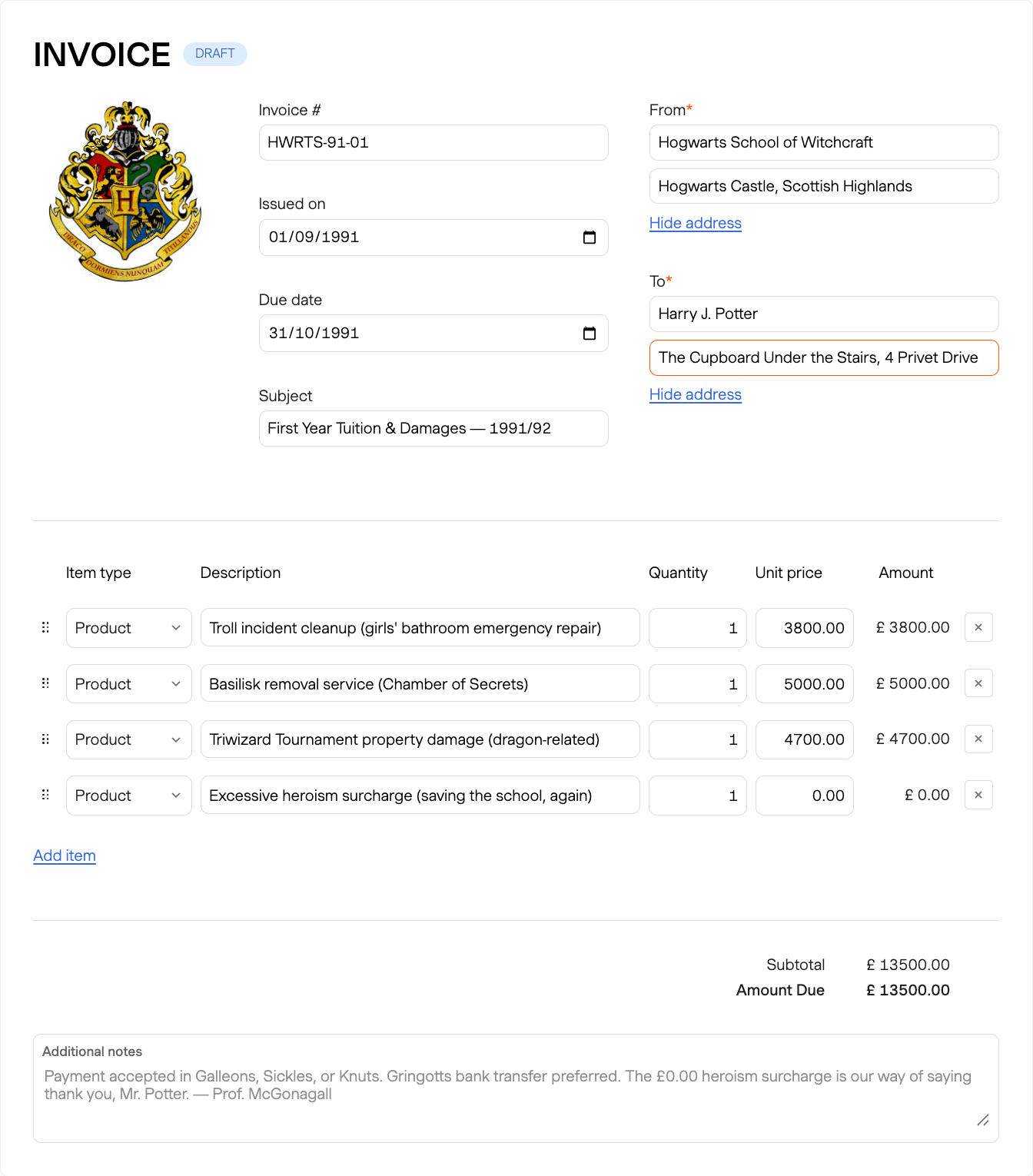
Preview your invoice with detailed line items for labor, materials, and equipment, tailored to construction project needs.

Contractors Invoice Template FAQs

  • A contractor invoice template should include the contractor's contact details, client's information, unique invoice number, date of issue, detailed description of services provided, labor and material costs, applicable taxes, total amount due, and payment terms and conditions.
  • Yes, several software tools and apps are designed to help generate construction invoices easily. These tools often feature customizable templates, automatic tax calculations, and integration with accounting software for seamless financial management.
  • Yes, Harvest allows users to set up recurring invoices on a weekly, monthly, or custom schedule to automate regular billing.
  • Free contractor invoice templates may lack customization options, advanced features, and integration capabilities with other business tools. They might also not be updated regularly to comply with the latest industry standards, potentially leading to compliance issues.
  • To ensure your contractor invoice meets industry standards, include all necessary information such as contractor and client details, project specifics, and accurate line items. Verify compliance with local regulations, such as sales tax requirements and lien waiver language, and use standardized formats when necessary for larger projects.