
Harvest
Contracts
Sign up

Contract Template in Korean

Harvest supports contractors by providing tools for time tracking, expense management, and invoicing, crucial for managing workflows efficiently.

Start from a template

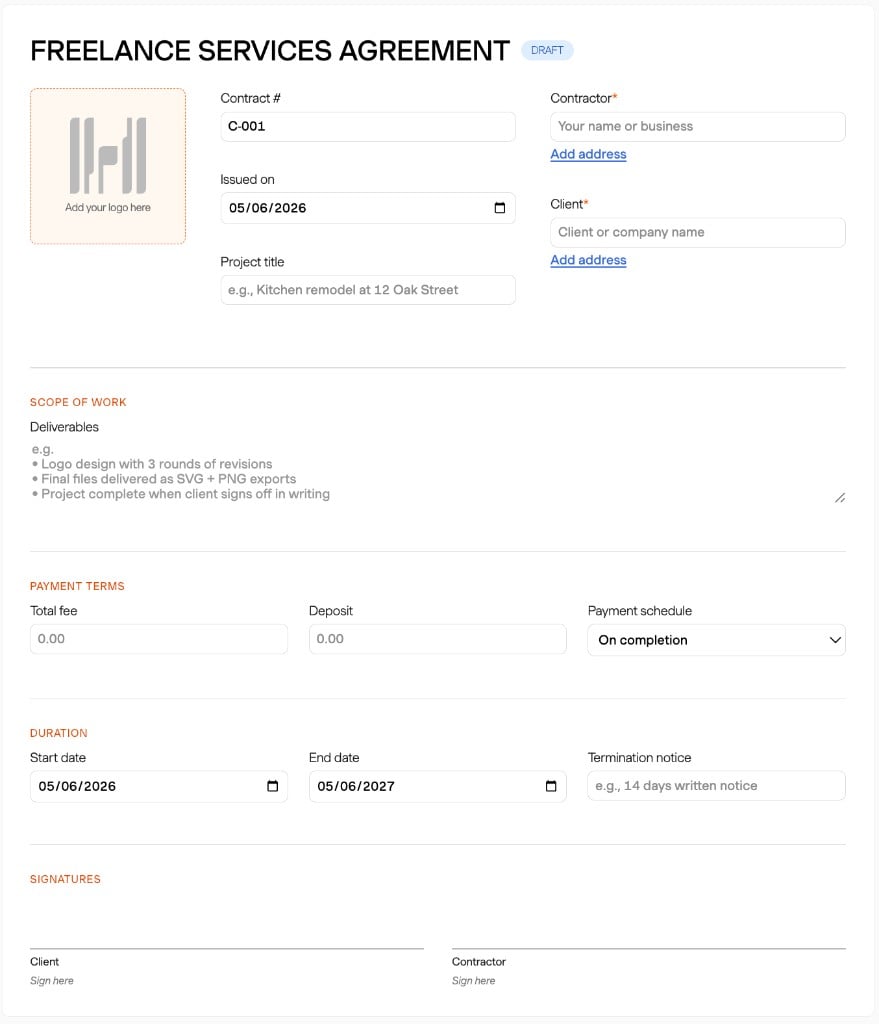
AGREEMENT DRAFT

Add your logo here

Scope of work

Payment terms

Duration

Signatures

Client

Sign here

Contractor

Sign here

Get paid via:
Credit card / Debit card
ACH
Wire transfer

Customize contract

Appearance

Add a logo
Show contract title

Contract settings

Include payment terms Total fee, deposit, and schedule
Include termination clause Notice required to end the contract
Include signature blocks Both parties sign at the bottom

Understanding Contract Templates in Korean

Finding a reliable contract template in Korean involves understanding the essential elements and legal requirements specific to the region. In South Korea, contracts are primarily governed by civil law, which does not require consideration as a prerequisite for enforceability. However, mutual consent, legal capacity, and a specific lawful objective are essential for a contract to be binding. Most contracts are drafted in Korean, with a governing language clause ensuring the Korean version prevails, making professional translation and legal review critical for non-Korean speakers.

Customization is key when using a contract template. Industry-specific terms, such as those for IT, construction, or education, should be carefully integrated to meet specific legal and practical needs. For example, employment contracts in educational institutions must comply with the Labor Standards Act, clearly outlining wages, work hours, and holidays. Missteps in this area can lead to legal actions and fines, underscoring the importance of comprehensive and clear documentation.

Legal Considerations for Korean Contracts

In South Korea, written contracts are mandatory for employment agreements as per the Labor Standards Act, ensuring clarity on wages and working conditions. This legal requirement highlights the importance of having a well-drafted template that can be customized for specific needs. For other contract types, while written forms aren’t legally required, they are crucial for enforcing terms and preventing disputes.

Beyond legal requirements, it's vital to consider cultural nuances and industry standards when drafting contracts. For instance, the "Yellow Envelope" bill allows subcontractors to negotiate directly with contractors, reflecting evolving labor practices. Additionally, legal experts recommend using templates as a starting point, emphasizing the need for thorough customization and legal review to avoid costly litigation and ensure the contract is enforceable.

Customizing Templates for Specific Needs

An effective contract template should serve as a practical starting point that can be tailored to fit various industry requirements. For independent contractors, essential elements include the scope of work, payment terms, and confidentiality obligations. Industries like IT often focus on intellectual property and data security, while construction contracts might emphasize project management and liability clauses.

Customizing a contract template involves more than just filling in blanks; it requires a strategic approach to address specific business needs and legal requirements. Professional legal review is advisable to ensure that all necessary elements are included and that the contract aligns with current regulations. This is especially true in Korea, where the legal landscape is influenced by both civil code and evolving business practices.

The Role of Harvest in Contractor Workflows

While Harvest does not provide legal templates or advice specific to Korean contracts, it plays a crucial role in managing contractor workflows. Harvest supports contractors by offering tools for time tracking, expense management, and invoicing, which are integral to maintaining organized and efficient operations. This functionality allows contractors to focus on their core work without getting bogged down by administrative tasks.

Harvest’s features help streamline the billing process, ensuring timely and accurate invoicing, which is essential for maintaining cash flow and contractor relationships. By integrating expense tracking and time management, Harvest provides a comprehensive solution to manage the financial aspect of contractor agreements effectively, though it is not a substitute for legal guidance on contract specifics.

Practical Tips for Using Contract Templates

When using a contract template in Korea, it's essential to ensure it includes all legally required elements and is tailored to the specific industry. Key elements such as party identification, scope of work, payment terms, and confidentiality provisions must be clearly defined. Customization should reflect the unique needs and legal requirements of the industry, such as addressing intellectual property in IT contracts or liability in construction agreements.

Professionally translating and reviewing contracts with the assistance of a Korean lawyer is highly recommended, especially for foreigners. This ensures that all terms are understood and that the contract complies with local laws. Additionally, including dispute resolution mechanisms like arbitration clauses can help prevent conflicts and provide a clear path for resolving disagreements should they arise.

Harvest for Korean Contracts

Explore how Harvest helps manage contractor workflows with tools for time tracking, expenses, and invoicing.

Harvest interface showing contract management tools in Korean context.

Contract Template in Korean FAQs

  • You can find reliable contract templates in Korean through legal service providers or online legal platforms that offer downloadable versions. It's crucial to review the template with a legal expert to ensure it meets your specific needs and complies with local laws.

  • Essential elements of a Korean contract include mutual consent, legal capacity, and a specific lawful objective. For employment contracts, written documentation is mandatory, detailing wages, work hours, and other conditions as per the Labor Standards Act.

  • To customize a contract template for your industry, incorporate specific terms related to the scope of work, payment schedules, and confidentiality. Consulting with industry experts and legal professionals can ensure the contract meets both legal and practical requirements.

  • Yes, contracts in Korea require mutual consent, legal capacity, and a specific lawful objective. Employment contracts must be in writing according to the Labor Standards Act, outlining wages and working conditions.

  • Harvest supports contractor workflows by providing tools for time tracking, expense management, and invoicing, helping manage the financial aspects of projects effectively. It simplifies administrative tasks, allowing contractors to focus on their core work.

  • An independent contractor agreement should include the scope of work, payment terms, confidentiality clauses, and any industry-specific obligations. Legal advice is recommended to ensure comprehensive coverage and compliance with local laws.

  • Professional legal review ensures that contract terms are legally sound and tailored to specific needs. This minimizes the risk of disputes and ensures compliance with local laws, especially in complex legal landscapes like South Korea.