Harvest
Invoices
Sign up

Download Invoice for Sweden

Harvest provides robust invoicing capabilities that ensure compliance with EU and Swedish VAT regulations, making it a reliable choice for businesses operating in Sweden.

INVOICE DRAFT

Add your logo here
Item type
Description
Quantity
Unit price
Tax
Amount
Subtotal
$0.00
Discount
$0.00
Amount Due
$0.00
Get paid via:
Credit card / Debit card
ACH
Wire transfer

Customise invoice

Appearance

Add a logo
Show invoice title

Invoice settings

Tax Add up to 2 tax rates
%
Discount Apply a discount percentage
%

Key Features of a Compliant Swedish Invoice Template

A compliant Swedish invoice, or "faktura," must include specific details to meet legal and VAT (Moms) requirements, ensuring smooth transactions and avoiding issues with the Swedish Tax Agency (Skatteverket). Essential elements include the invoice issue date, a unique sequential invoice number, and both the supplier's and customer's legal names and addresses. For VAT-registered businesses, the supplier's VAT registration number (typically starting with "SE" followed by 12 digits) is mandatory, and the customer's VAT number is required for intra-community supplies or reverse charge mechanisms. It's also crucial to state the supplier's corporate identity number (organisationsnummer) and whether the supplier is approved for F-tax ("Godkänd för F-skatt"). The invoice must clearly describe the goods or services, quantity, unit price, applicable VAT rate (standard 25%, reduced 12% or 6%), the VAT amount in Swedish Kronor (SEK), and the total price including VAT. For added convenience, many templates support mobile payment QR codes, particularly for Swish, which allows customers to scan and pay securely with pre-filled payment details.
Customizing Your Swedish Invoice Template

Personalizing your Swedish invoice template is straightforward and helps reinforce your brand identity while ensuring clarity for your clients.

1. Incorporate Branding Elements: Start by adding your company logo, preferred fonts, and brand colors. Ensure your business name, address, and contact information are prominently displayed.

2. Choose Appropriate Formats: While there's no single mandatory format for all invoices, PDF is widely accepted for general business-to-business (B2B) transactions. However, for business-to-government (B2G) transactions, electronic invoicing in structured formats like PEPPOL BIS Billing 3.0 is mandatory. Consider offering multiple formats (e.g., PDF, Word, or Excel) if your clients have varying preferences, but be aware that PDFs are not considered true e-invoices for B2G purposes.

3. Tailor Payment Information: Customize payment terms, due dates, and bank details. Including a Swish QR code can significantly streamline the payment process for customers, as it pre-fills payment information upon scanning.

4. Add Specific Disclaimers or Notes: Depending on your industry or specific agreements, you might need to include additional legal disclaimers, warranty information, or project-specific notes.

Common Pitfalls in Swedish Invoicing

Navigating Swedish invoicing requires attention to detail to avoid common mistakes that can lead to compliance issues or payment delays.

1. Missing Mandatory Information: A frequent pitfall is omitting crucial details such as the unique invoice number, correct VAT registration numbers, or the supplier's F-tax approval status. Without F-tax approval clearly stated, clients may be legally required to withhold 30% tax from your payment, creating administrative burdens for both parties.

2. Incorrect VAT Application: Applying the wrong VAT rate (e.g., using the standard 25% for a service that qualifies for 12% or 6%) or miscalculating the VAT amount can lead to discrepancies with the Swedish Tax Agency. Always verify the correct VAT rate for your specific goods or services.

3. Inadequate Archiving: Swedish law mandates that all accounting information, including invoices, must be archived for a minimum of seven years after the end of the calendar year to which they relate. Failing to retain these records, either in paper or electronic form, can result in penalties.

4. Not Using Electronic Invoices for B2G: For transactions with Swedish public sector entities, electronic invoicing in specific structured formats (like PEPPOL BIS Billing 3.0) is mandatory. Submitting paper or PDF invoices in these cases is generally not accepted and can lead to non-compliance penalties.

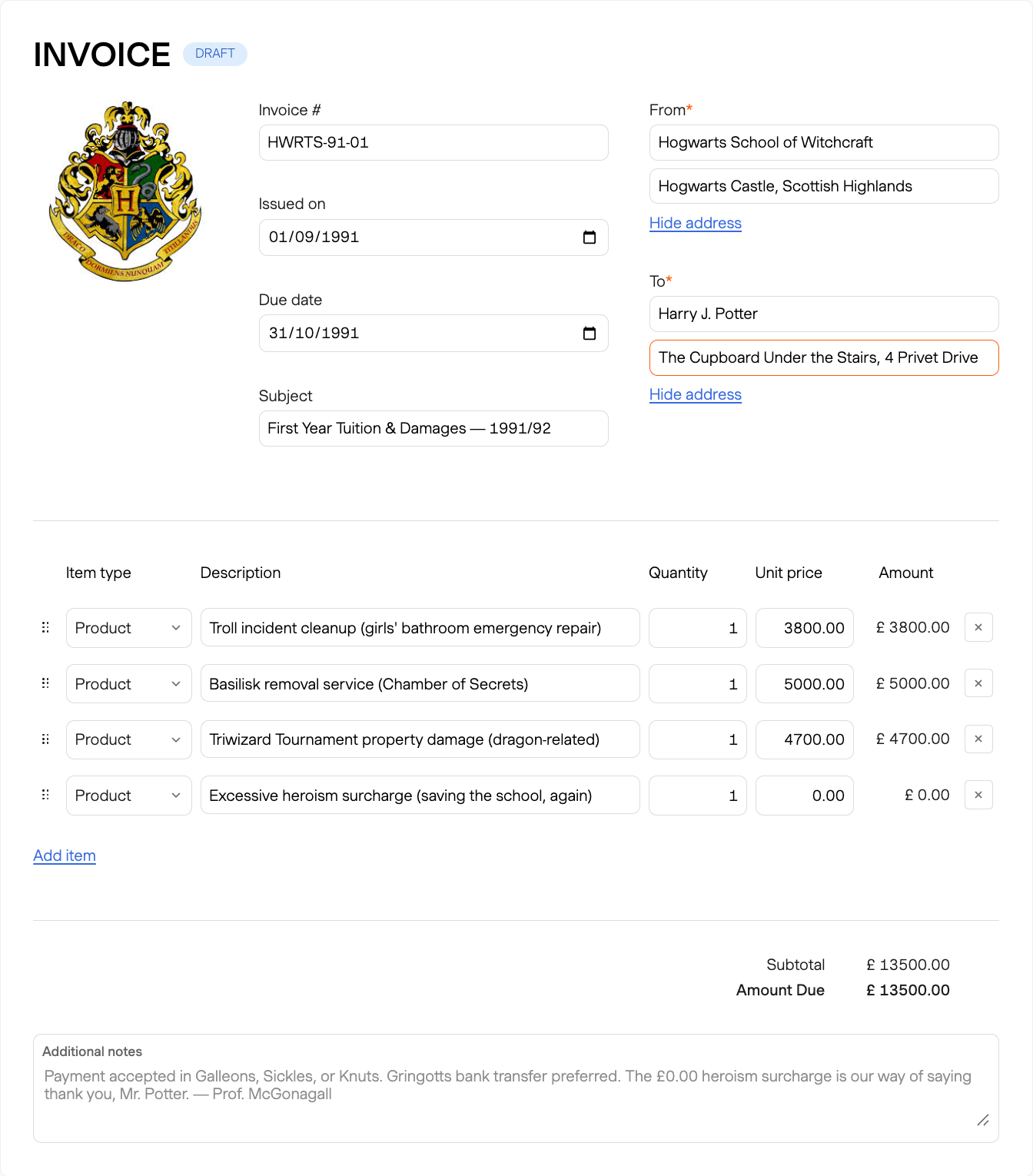
See Your Swedish Invoice Template in Action

Preview your invoice with Swedish VAT fields, QR code payments, and compliance details — all ready for your business needs in Sweden.

Download Invoice for Sweden FAQs

  • Harvest allows you to add your company's VAT number to your invoices, ensuring compliance with Swedish VAT regulations. Additionally, you can include VAT and other line items, ensuring all necessary details are present. Harvest also supports UBL e-invoices, which comply with EU regulations, making it suitable for businesses operating in Sweden.
  • In Sweden, invoices must include essential details such as the invoice issue date, unique invoice number, supplier's and customer's legal names and addresses, and VAT registration numbers. For VAT-registered businesses, it's mandatory to state the supplier's corporate identity number, VAT rates, and the total price including VAT.
  • Yes, Harvest allows you to include billable hours and expenses from multiple projects on a single invoice. This feature offers flexibility in billing clients for work completed across different projects in one consolidated invoice.
  • Yes, invoicing tools can automate the creation of credit notes by using predefined templates and rules. This helps to ensure that credit notes are issued promptly and accurately, reflecting adjustments to previous invoices.
  • While invoice templates are useful, they may not cover complex scenarios like industry-specific requirements or multi-currency conversions. Templates may also need manual adjustments to ensure compliance with local laws, especially for cross-border transactions.