Harvest
Invoices
Sign up

Email Invoice for Portugal

Harvest offers flexible invoicing solutions that can be customized to meet international e-invoicing standards, including those in Portugal. Easily manage your invoicing needs while staying compliant with local regulations.

INVOICE DRAFT

Add your logo here
Item type
Description
Quantity
Unit price
Tax
Amount
Subtotal
$0.00
Discount
$0.00
Amount Due
$0.00
Get paid via:
Credit card / Debit card
ACH
Wire transfer

Customise invoice

Appearance

Add a logo
Show invoice title

Invoice settings

Tax Add up to 2 tax rates
%
Discount Apply a discount percentage
%

Understanding Legal Requirements for Email Invoices in Portugal

Navigating the legal landscape for email invoices in Portugal requires a clear understanding of key regulations, particularly Decree Law No. 28/2019. This foundational law integrates rules for invoice processing, promoting the use of paperless invoices and electronic document archiving systems for VAT, corporate income tax (IRC), and personal income tax (IRS) purposes. A critical aspect is the mandatory use of certified invoicing software for businesses exceeding certain turnover thresholds, which was lowered to €50,000 from 2020.

A significant upcoming requirement is the Qualified Electronic Signature (QES) mandate. While previously postponed multiple times, PDF invoices will only be considered valid electronic invoices for tax purposes from January 1, 2027, if they include a QES or a qualified electronic seal. Until this date, PDF invoices without a QES are still acceptable, provided they meet other compliance criteria, such as being generated by certified software and including the ATCUD and QR codes.

For Business-to-Business (B2B) transactions, structured e-invoicing is not yet generally mandatory in Portugal. However, an organization may voluntarily issue an e-invoice to a buyer upon the buyer's prior acceptance. This emphasis on buyer acceptance in B2B scenarios is a crucial nuance often overlooked, highlighting that while the technical infrastructure for e-invoicing is robust, the mandate for B2B adoption is still based on mutual agreement, unlike the mandatory Business-to-Government (B2G) e-invoicing.
Best Practices for Composing Email Invoices

Crafting professional and clear email invoices is essential for efficient financial operations and maintaining good client relationships in Portugal. While the legal framework focuses on the invoice content and transmission, effective email composition ensures your invoices are promptly recognized and processed.

  • Professional Email Subject Lines: Use clear and concise subject lines that immediately convey the email's purpose. Examples include:
    • "Invoice [Invoice Number] from [Your Company Name]"
    • "Payment Due: Invoice [Invoice Number] for [Service/Product]"
    • "Fatura [Número da Fatura] de [Nome da Sua Empresa]" (Portuguese example)
  • Essential Elements of an Invoice Email: The body of your email should be professional and contain key information. Always attach the actual invoice as a PDF, ensuring it includes all legally required elements. These include:
    • Supplier and customer tax identification numbers (NIF/VAT number).
    • Invoice date and a unique sequential number.
    • A clear description of goods or services, quantity, unit price, taxable amount, applicable VAT rate, and the VAT amount for each rate, along with the total due.
    • The ATCUD code (Código Único do Documento), an 8-character unique document code, and a QR code. These are mandatory on all invoices, whether paper or PDF, and must be generated by AT-certified software. The QR code, with a minimum size of 30mm x 30mm, encodes key invoice data for verification.
  • Effective Payment Instructions: Clearly state payment terms, due dates, and accepted payment methods. Provide all necessary bank details (IBAN, SWIFT/BIC) and any specific reference numbers required for reconciliation. Consider including a direct link to a secure payment portal if available. Prompt and clear payment instructions reduce delays and queries, streamlining your cash flow.

Compliance and Storage of Electronic Invoices

Ensuring compliance and proper storage of electronic invoices in Portugal is paramount for avoiding legal and tax issues. The Portuguese Tax and Customs Authority (AT) has implemented robust measures to enhance traceability and ensure the integrity of financial documents.

Traceability Requirements:

  • ATCUD and QR Codes: All invoices issued from certified software must include a unique ATCUD code and a QR code. The ATCUD, a unique sequential validation number, helps link invoices to tax authority data, while the QR code encodes essential invoice details for verification. These elements are crucial for improving transparency and combating tax fraud.
  • SAF-T Reporting: All VAT-registered businesses, including non-residents with Portuguese VAT registration, are obliged to transmit their invoice data electronically to the AT. This is primarily done through monthly SAF-T (Standard Audit File for Tax) files, which contain detailed invoice data. These reports are typically due by the 5th day of the month following the issuance of the documents.

Legal Storage Mandates:

  • Electronic invoices must be retained for a minimum of 10 years.
  • During this period, the integrity, authenticity, and readability of the invoices must be ensured.
  • Digital archiving is permitted within Portugal or any other EU Member State, provided that access through terminals located in Portugal is guaranteed. Archiving outside the EU requires prior authorization from the AT.

VAT Compliance Specifics: Portugal adheres to the EU VAT Directive's standard invoice content requirements, supplemented by its national specifics like the mandatory ATCUD and QR codes. The monthly SAF-T reporting plays a central role in VAT compliance, providing the tax authority with near-real-time access to transaction data.

Upcoming Changes and Deadlines in Portuguese E-Invoicing

Portugal's e-invoicing landscape is continuously evolving, with several key changes and deadlines on the horizon that businesses need to anticipate to maintain compliance.

One of the most significant upcoming changes is the mandatory requirement for a Qualified Electronic Signature (QES) on PDF invoices. This requirement, which has seen several postponements, is now set to take effect on January 1, 2027. From this date forward, PDF invoices without a QES will no longer be considered valid electronic invoices for fiscal purposes, emphasizing the need for businesses to integrate qualified signing into their billing workflows. Until then, PDF invoices remain acceptable without a QES, provided they comply with other existing regulations, such as the inclusion of ATCUD and QR codes and being generated by certified software.

Looking further ahead, the mandatory submission of the annual SAF-T accounting file for transactions conducted in 2026 has been postponed and will now be due in 2028. This extension provides businesses with additional time to adapt their accounting systems and processes for this comprehensive reporting requirement. Furthermore, the mandatory use of e-invoicing for Business-to-Government (B2G) transactions was extended to small and medium-sized enterprises (SMEs) and micro-enterprises from January 1, 2026.

These regulatory changes are part of Portugal's broader digital transformation strategy, aligning with initiatives like the EU's VAT in the Digital Age (ViDA), which aims to standardize structured e-invoicing and near-real-time digital reporting for intra-EU B2B transactions by 2028-2030. Businesses must remain vigilant, monitoring official updates from the Autoridade Tributária e Aduaneira (AT) to ensure their systems and practices are prepared for future compliance.

See Your Portuguese Invoice in Action

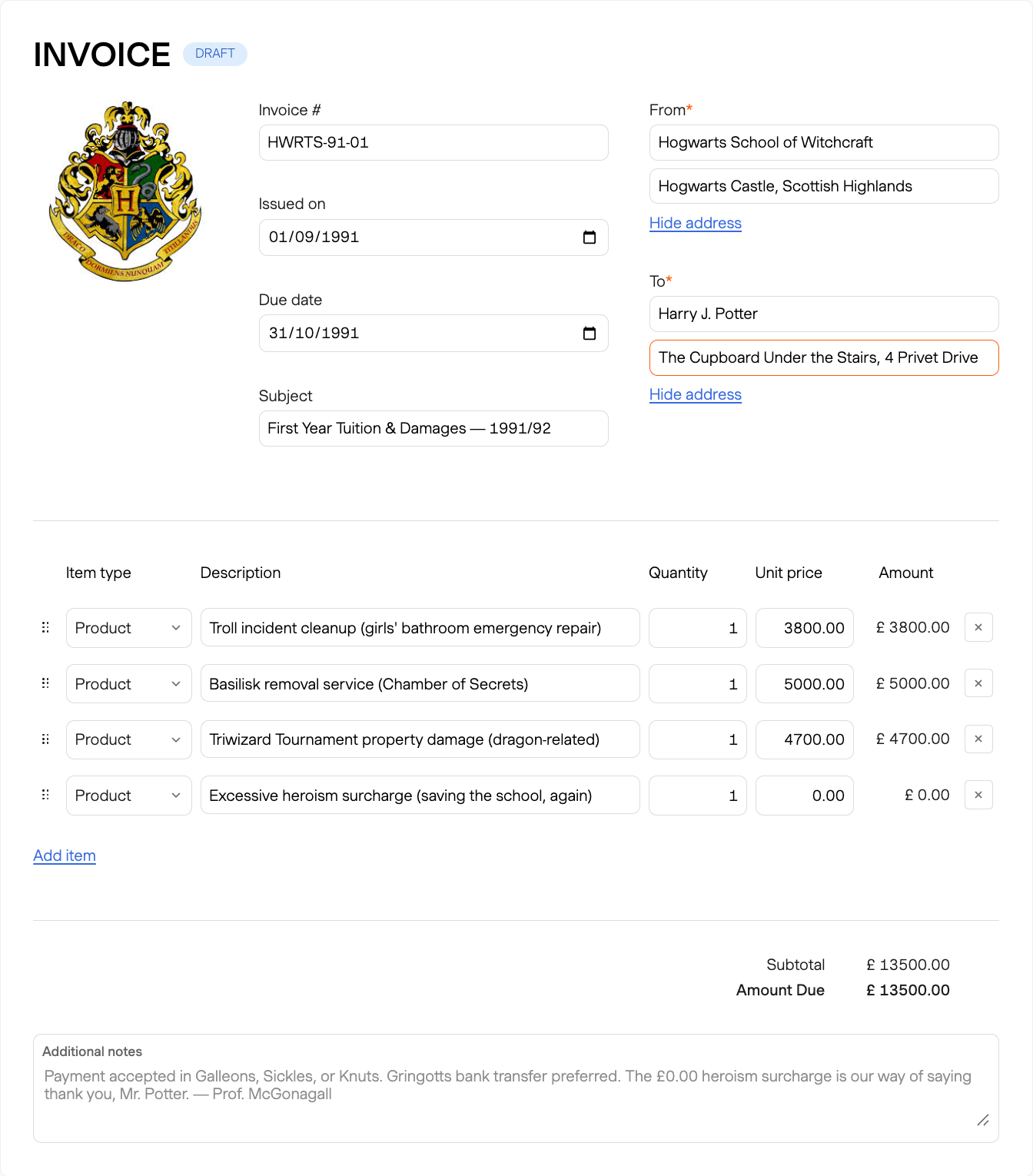
Preview your invoice with mandatory ATCUD and QR codes, formatted for Portuguese regulations — ready for email delivery.

Email Invoice for Portugal FAQs

  • Email invoices in Portugal must comply with Decree Law No. 28/2019, which requires the use of certified invoicing software for most businesses. They must include essential details such as the supplier's and customer's tax ID, invoice number, and a detailed description of goods or services. Additionally, invoices must feature the ATCUD and QR codes, and adhere to specific storage and traceability standards to ensure compliance with Portuguese tax law.

  • Currently, an electronic signature is not mandatory for PDF invoices in Portugal. However, from January 1, 2027, a Qualified Electronic Signature (QES) will be required for PDF invoices to be considered valid for tax purposes. Until this mandate takes effect, PDF invoices without a QES are still acceptable provided they comply with other regulations.

  • No, there's no limit on the number of invoices you can create in Harvest.
  • Electronic invoicing tools may face limitations such as needing to integrate with certified software to generate invoices with mandatory ATCUD and QR codes. Additionally, they must ensure compliance with specific storage and traceability requirements, which can involve complex local regulatory knowledge. These tools also require updates to align with evolving regulatory changes and deadlines.

  • To ensure compliance with VAT regulations in Portugal, invoices must include detailed information such as the VAT number, invoice number, date, and a breakdown of goods or services with applicable VAT rates. They must also feature the ATCUD and QR codes and be generated using certified software. Regularly submitting SAF-T files to the Portuguese tax authorities is also crucial for compliance.