Harvest
Invoices
Sign up

Final Invoice Template

Harvest offers robust invoicing capabilities, including customization and detailed tracking, making it ideal for managing complex billing needs.

INVOICE DRAFT

Add your logo here
Item type
Description
Quantity
Unit price
Tax
Amount
Subtotal
$0.00
Discount
$0.00
Amount Due
$0.00
Get paid via:
Credit card / Debit card
ACH
Wire transfer

Customise invoice

Appearance

Add a logo
Show invoice title

Invoice settings

Tax Add up to 2 tax rates
%
Discount Apply a discount percentage
%

Key Features of an Effective Final Invoice Template

An effective final invoice template should include essential elements to ensure clarity and compliance. Look for templates that clearly display your business and client contact information, a unique invoice number, issue date, and a specific due date, typically 15-30 days from issuance.

  • Essential fields include an itemized list of services or products, quantities, unit prices, and subtotal.
  • Customizable fields are crucial for project-specific needs, allowing you to add project names, phase numbers, or specific task descriptions.
  • Ensure the template supports various tax rates (e.g., sales tax, VAT, GST) and provides sections for discounts, shipping costs, and the final amount due.

Compliance with invoicing regulations often requires including tax identification numbers and any legal disclaimers.
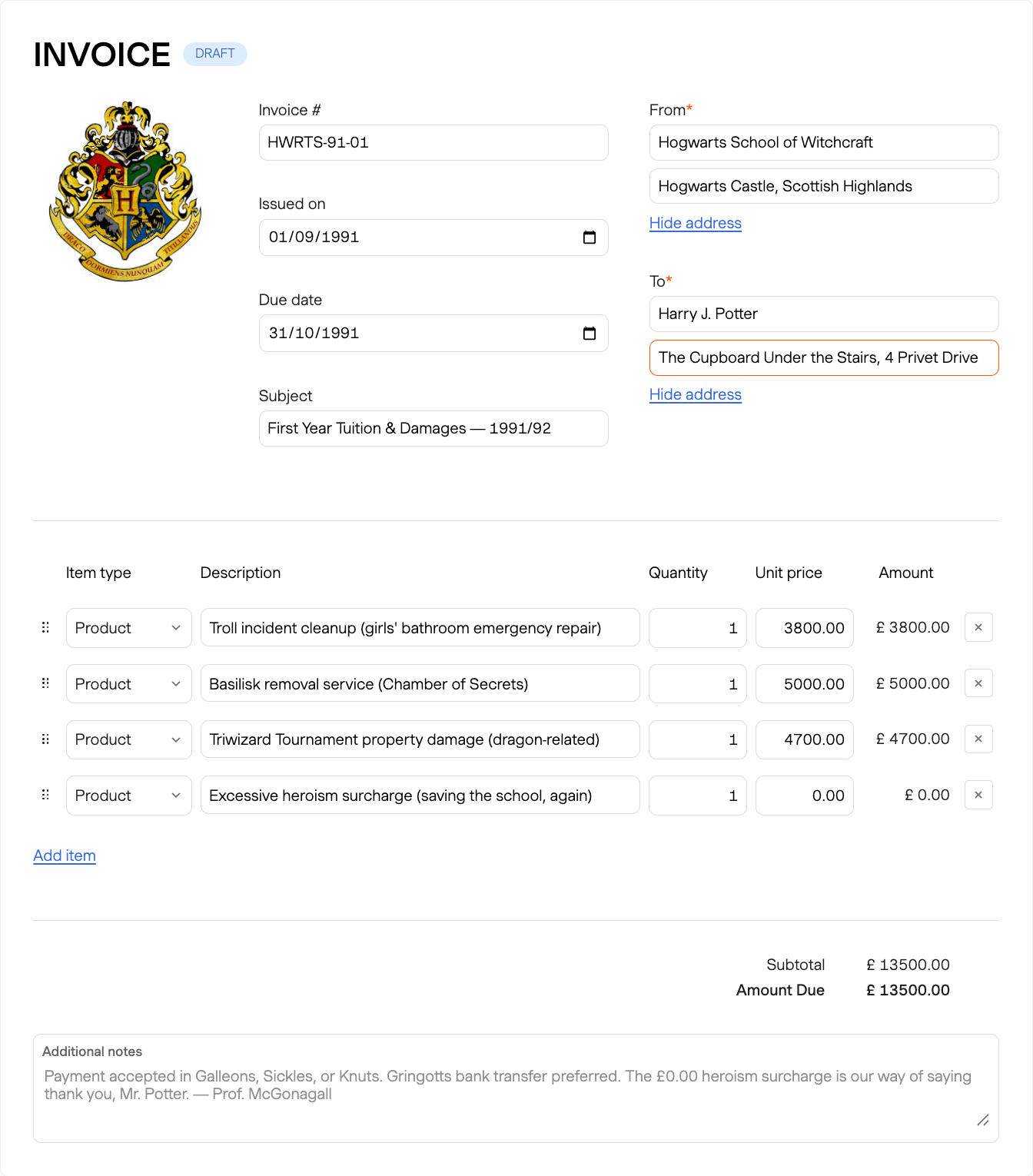
How to Customize Your Final Invoice Template

To effectively customize your final invoice template, begin by selecting a base design that aligns with your brand aesthetics. The step-by-step customization process involves:

  1. Adding your company logo and branding elements for a professional look.
  2. Modifying line items to accurately reflect project milestones, such as "Phase 1 Completion" or "Software Development - Module A."
  3. Incorporating all reimbursable expenses, clearly itemized with dates and descriptions.
  4. Adjusting tax rates to comply with local or national requirements, ensuring calculations are accurate.
  5. Applying any retainer balances or upfront payments to the final amount due, clearly showing the deduction.

For projects involving retainage — the 5-10% of each payment often held until final inspection or project completion — ensure your template can clearly account for this release.

Common Pitfalls When Using Final Invoice Templates

When using final invoice templates, common pitfalls often stem from a lack of attention to detail, leading to potential payment delays or disputes. A significant mistake is failing to fully customize the template, leaving generic placeholders or irrelevant fields.

  • Avoid vague descriptions for services or products; instead, use clear, specific language that aligns with your contract.
  • Ensure all calculations, including subtotals, taxes, and final amounts, are accurate to the cent. Incorrect tax rates or misapplied retainer balances are frequent errors.
  • Another pitfall is neglecting to include clear payment terms and methods, which can confuse clients.
  • For complex billing scenarios, such as multi-currency transactions or progress payments, ensure the template can handle these nuances without manual workarounds that introduce errors.

Always proofread thoroughly before sending to maintain professionalism and avoid rework.

Explore Your Final Invoice Template in Detail

See how your final invoice can include project-specific details, customized tax rates, and retainer balances — ready for any project type.

Final Invoice Template FAQs

  • Harvest allows you to view project context for Fixed Fee projects, helping you manage invoice schedules and remaining uninvoiced amounts.

  • Harvest allows you to track and include project expenses on invoices, with options to attach detailed expense reports.

  • Yes, Harvest allows you to set budgets for individual projects, so you can track your spending against those budgets. You'll receive notifications as you approach your budget limits, helping you manage resources effectively.
  • A final invoice template should include essential elements such as your business and client contact information, invoice number, issue and due dates, an itemized list of products or services, quantities, unit prices, and subtotals. It should also support various tax rates and include sections for discounts, shipping costs, and the final amount due.

  • Many invoice templates require manual input to adjust tax rates, as automatic adjustments can be limited depending on the software or template used. It's essential to verify the capabilities of your chosen template to ensure it meets your specific tax requirements.