Harvest
Invoices
Sign up

Scalable Invoice Template

Harvest offers flexible and customizable invoicing solutions, making it ideal for businesses looking to scale their financial operations efficiently.

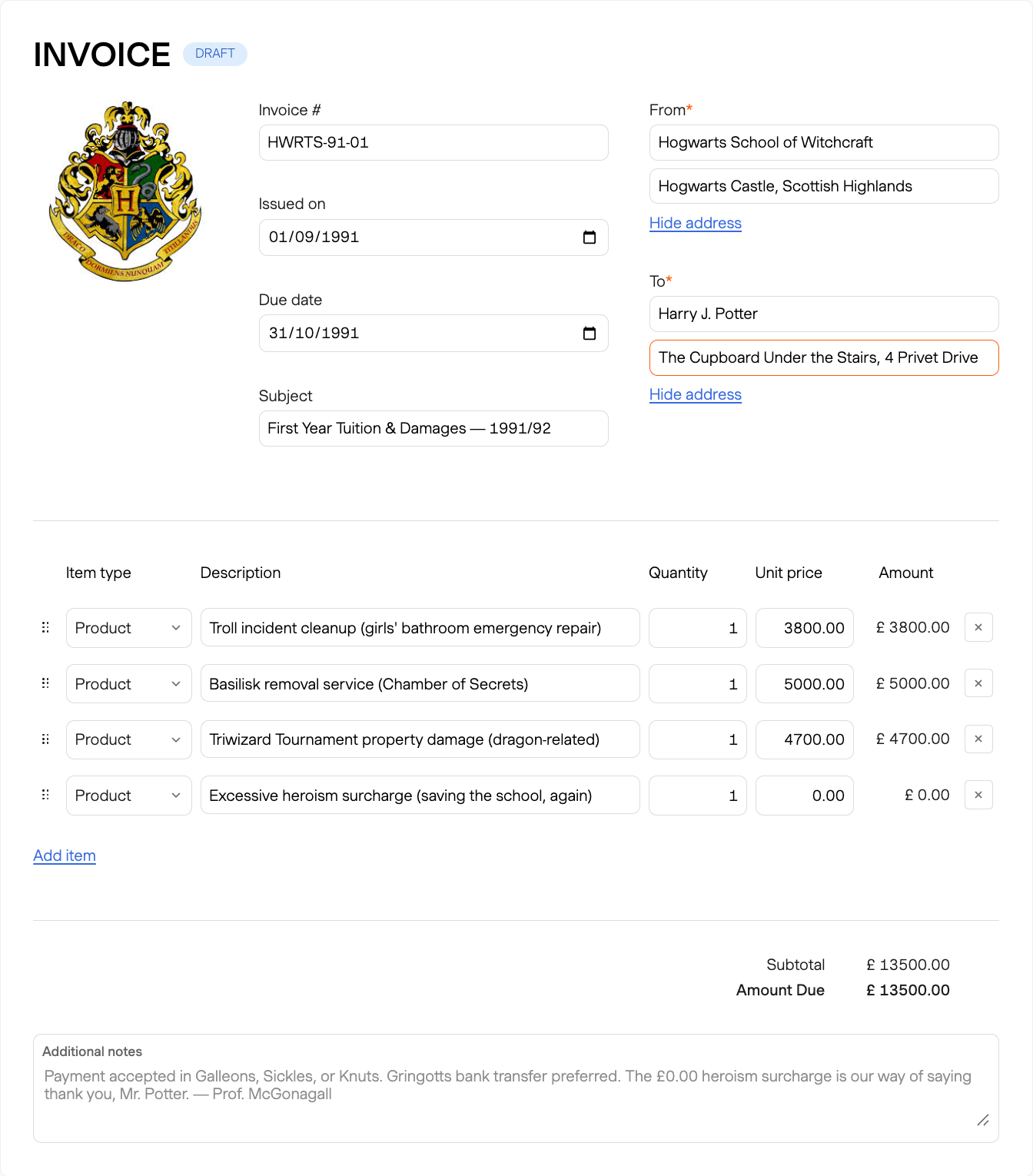
INVOICE DRAFT

Add your logo here
Item type
Description
Quantity
Unit price
Tax
Amount
Subtotal
$0.00
Discount
$0.00
Amount Due
$0.00
Get paid via:
Credit card / Debit card
ACH
Wire transfer

Customise invoice

Appearance

Add a logo
Show invoice title

Invoice settings

Tax Add up to 2 tax rates
%
Discount Apply a discount percentage
%

Key Features of a Scalable Invoice Template

A scalable invoice template offers robust customization, automation, and integration capabilities essential for efficient high-volume invoicing. Look for templates that allow extensive customization, enabling you to tailor branding, payment terms, and line item details for diverse client needs or industry-specific requirements, such as including "retainage" — the 5-10% of each payment held until final inspection — common in construction billing. Automation capabilities are paramount; these include auto-populating client information, sequential invoice numbering, and tax calculations, significantly reducing manual data entry and potential errors. Furthermore, seamless integration with existing accounting software, CRM systems, or payment gateways ensures data consistency and streamlines your entire financial workflow, preventing data silos and improving reporting accuracy.
Selecting the Right Template for High-Volume Invoicing

Choosing the right scalable invoice template requires evaluating its flexibility, compliance, and reporting features to support high-volume operations effectively.

  1. Assess Customization Depth: Ensure the template allows for extensive modifications to suit various client contracts, currencies, and regional tax requirements. A good template should support multiple tax rates and custom fields.
  2. Evaluate Automation Potential: Prioritize templates that offer features like recurring invoice generation, automated tax calculations, and client data pre-filling to minimize manual effort.
  3. Check Integration Capabilities: Confirm compatibility with your current accounting software (e.g., for syncing accounts receivable) and payment processors to avoid data entry duplication and ensure smooth financial reconciliation.
  4. Consider Reporting and Analytics: A scalable template should provide clear dashboards and reporting tools to track payment statuses, outstanding balances, and revenue trends, which is crucial for financial oversight.

A common pitfall is selecting a template that lacks the flexibility to adapt to evolving business needs or regulatory changes, leading to costly manual workarounds later.

Automating Your Invoicing Process

Automating your invoicing process significantly enhances efficiency, reduces errors, and improves cash flow for businesses managing large transaction volumes. To set up automated invoicing, begin by configuring client profiles with standard billing rates, payment terms, and preferred delivery methods (e.g., email). For subscription services or ongoing contracts, implement recurring billing features that automatically generate and send invoices at predefined intervals, such as monthly or quarterly, ensuring consistent revenue streams. Additionally, leverage automated payment reminders, which can be scheduled to dispatch polite follow-ups before or after the due date, potentially reducing late payments by 20-30% and freeing up valuable administrative time. This proactive approach helps maintain healthy accounts receivable without manual intervention.

Explore Your Scalable Invoice Template

Preview a scalable invoice template with customizable fields and integration-ready design, perfect for handling a large number of transactions efficiently.

Scalable Invoice Template FAQs

  • Customizable invoice templates enhance high-volume invoicing by allowing businesses to set up default values, translations, and messages. This adaptability supports different client types and project phases, making the invoicing process more efficient and tailored to specific needs.

  • To manage invoices at scale, it's important to use a system that integrates with your accounting software to reduce manual data entry. Regularly review and update invoice templates to ensure they meet current business and compliance needs. Implementing automated processes for invoice generation and payment reminders can also significantly enhance efficiency and accuracy.

  • Harvest shows each invoice's status — draft, sent, viewed, or paid — so you always know where things stand without chasing clients for updates.
  • Yes, invoice templates can handle multiple currencies by allowing you to set a default currency for your account and a preferred currency for each client. However, they do not perform currency conversions. For tax calculations, templates should support multiple tax rates and custom fields to accommodate different regional requirements.

  • One limitation is that invoice templates may not automatically update for new regulatory requirements, necessitating manual updates. Additionally, templates might not support complex financial transactions without customization, potentially requiring manual adjustments or workarounds.