
Harvest
Time Tracking
Sign up free

Biometric Time Clock

Harvest is a time tracking and invoicing tool that integrates seamlessly with QuickBooks for payroll, offering a practical solution for precise time management. While not featuring biometric capabilities, Harvest provides robust tools for detailed time and expense tracking.

Try Harvest Free

How much revenue is your team leaving on the table?

Most agencies run at 55-60% utilization. Even a small improvement means significant revenue. See what closing the gap looks like for your team.

Number of people who track billable time
$
Blended rate across roles (junior, senior, lead)
55%
Percentage of total hours that are billable. Industry average is 55-60%.
75%
A realistic target for service businesses is 70-80%.
Monthly revenue gap $0
Revenue at current utilization $0/mo
Revenue at target utilization $0/mo
Extra billable hours needed per person/day 0h
Annual revenue opportunity $0

Start tracking team utilization

Walk through the entire flow below. Start a timer, check your reports, and create a real invoice — all in three clicks.

Go ahead — start tracking!

One click and you're timing. Try it right here: start a timer, add an entry, edit the details. This is exactly how it feels in Harvest.

  • One-click timer from browser, desktop & mobile
  • Works inside Jira, Asana, Trello, GitHub & 50+ tools
  • Duration or start/end — your call
  • Day, week & calendar views to stay on top of it all
  • Friendly reminders so no hour gets left behind
Acme Corp
Website Redesign
Homepage layout revisions
1:24:09
Content Strategy
Blog calendar planning
1:30:00
SEO Audit
Technical audit report
0:45:00
Brand Guidelines
Color system documentation
2:15:00
Logo Concepts
Initial sketches round 1
1:00:00

Understanding Biometric Time Clocks: An Overview

Biometric time clocks are advanced systems that identify employees using unique physical traits, such as fingerprints or facial features, providing a modern alternative to traditional punch cards. These systems have gained traction due to their accuracy and ability to prevent time theft. With a grand market valuation projected to reach USD 6954.57 million by 2035, biometric clocks are revolutionizing workforce management.

Common types of biometric clocks include fingerprint scanners, facial recognition systems, and hand geometry devices. Each type functions by capturing a biometric trait, converting it into a mathematical template, and storing it securely for future matching. This transformation ensures that personal data remains private, as actual images are not stored. By leveraging these unique identifiers, businesses can enhance security and streamline attendance tracking.
Key Advantages and Operational Benefits of Biometric Time Clocks

Biometric time clocks offer significant advantages, particularly in eliminating "buddy punching," a practice where one employee clocks in for another. This form of time theft affects 75% of U.S. businesses and costs over $400 billion annually. By using biometric identifiers, these systems ensure that only the correct employee can clock in or out, thereby enhancing accuracy and reducing unauthorized entries.

Moreover, biometric systems improve payroll accuracy by eliminating errors, which can cost businesses up to $705 per error to rectify. One retailer observed a 20% reduction in payroll discrepancies after implementing a biometric time clock. The result is a streamlined payroll process that reduces administrative burdens and enhances overall efficiency, allowing businesses to save significantly on labor costs.

Implementation Considerations and Potential Challenges

When implementing biometric time clocks, several factors must be considered, including workplace environment, team size, and budget. While these systems offer remarkable accuracy, privacy concerns must be addressed to build trust among employees. Clear communication about data handling and obtaining consent is vital, especially in states with stringent regulations like Illinois and Texas.

Another consideration is the hygiene of touch-based systems, which can be mitigated by opting for contactless solutions like facial recognition. Additionally, ensuring the accessibility of these systems for employees with disabilities is crucial. Integration with existing HR and payroll software is essential for seamless operations, and businesses should adhere to best practices for data management and security.

The Legal Landscape of Biometric Data

The legal requirements surrounding biometric data vary significantly across states. Illinois, with its Biometric Information Privacy Act (BIPA), mandates strict consent and notification protocols to protect employee privacy. Texas and Washington also have laws requiring consent and regulating data storage and destruction.

Non-compliance with these laws can lead to statutory damages and lawsuits, highlighting the importance of robust data privacy policies and legal counsel. Businesses must stay informed about regional regulations and ensure their biometric systems are compliant, thereby preventing legal issues and safeguarding employee trust.

Biometric Time Clocks in Action: Industry Applications and Future Trends

Biometric time clocks are particularly beneficial in industries with high turnover rates, such as retail and hospitality, where precise labor cost control is essential. In manufacturing, these systems ensure accurate overtime calculations, while healthcare facilities benefit from their hygiene standards and security features.

Emerging trends in biometric technology, including AI and cloud-based solutions, are poised to further enhance these systems' capabilities. As businesses seek to optimize workforce management, biometric time clocks will continue to be an integral part of the future landscape, offering security, efficiency, and compliance benefits across various sectors.

Biometric Time Clock with Harvest

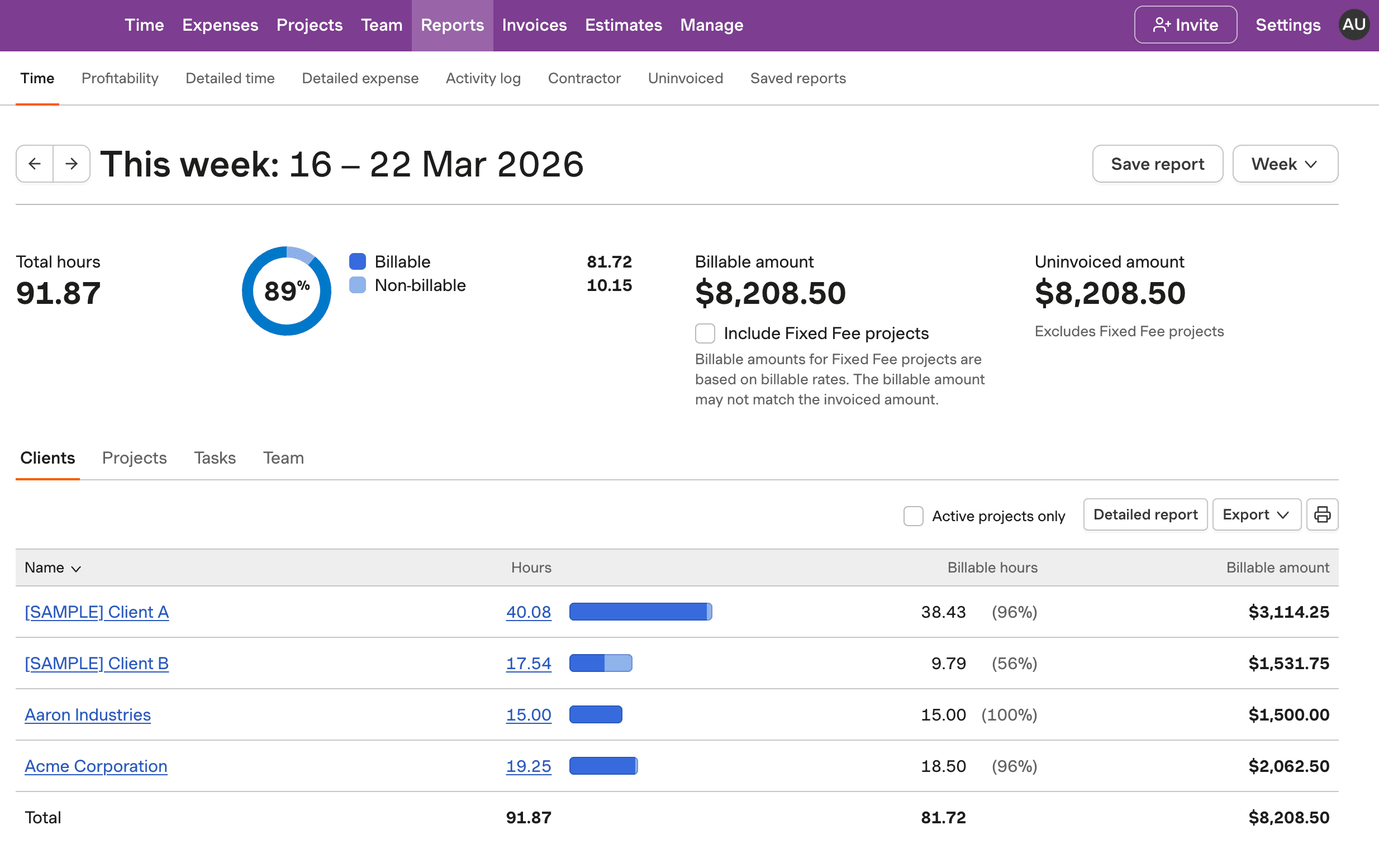
See how Harvest integrates with QuickBooks for seamless time tracking and invoicing, ensuring precise payroll management.

Biometric time clock system demo with Harvest integration interface.

Biometric Time Clock FAQs

  • Biometric time clocks prevent time theft by using unique physical traits like fingerprints or facial recognition to verify employee identities. This eliminates "buddy punching," where one employee clocks in for another, a practice impacting 75% of businesses and costing $400 billion annually in the U.S.

  • When selecting a biometric time clock, consider features such as accuracy in identification, ease of integration with payroll systems, data privacy compliance, and employee accessibility. Systems should offer secure data handling and storage, following state regulations for biometric data.

  • Biometric time clocks integrate with payroll systems by automatically transferring clock-in/out data, including hours worked and breaks, directly into payroll software. This reduces manual entry errors and ensures timely and accurate payroll processing.

  • Legal considerations include compliance with state laws, such as Illinois's BIPA, which require consent and notification for biometric data collection. Companies must ensure secure data storage and adhere to privacy regulations to avoid legal penalties.

  • Yes, biometric time clocks are ideal for high-security environments as they can integrate with access control systems to ensure only authorized personnel enter sensitive areas. This enhances security and protects valuable assets.

  • Privacy concerns with biometric time clocks are addressed by ensuring data is stored securely and employees provide informed consent. Systems convert biometric data into mathematical representations, preventing unauthorized access and safeguarding privacy.

  • Biometric time clocks are highly accurate, with fingerprint scanning offering 99.9% accuracy. This precision in employee identification helps minimize errors in attendance tracking and payroll processing.

  • Industries with high turnover rates, such as retail and hospitality, benefit significantly from biometric time clocks. They also suit manufacturing, healthcare, and high-security environments, where accurate attendance and secure access are crucial.

  • Biometric time clocks handle data security by encrypting biometric data and storing it as mathematical representations. This prevents unauthorized access and ensures compliance with data protection regulations.