
Harvest
Time Tracking
Sign up free

Billable Hours Report Template

Harvest simplifies tracking and invoicing for teams and freelancers, preventing up to 50% revenue loss from unlogged billable hours with real-time tracking.

Try Harvest Free

What should you charge per hour?

Most freelancers and consultants dramatically undercharge. This calculator accounts for what most people miss: non-billable time, taxes, and overhead.

$
Accounting for vacation, holidays, sick days
60%
Most freelancers can bill 50-70% of their time. The rest goes to admin, marketing, proposals, and learning.
$
Software, insurance, equipment, accounting, taxes beyond income tax, etc.
Your break-even rate $0
Recommended rate (+20% buffer) $0
Billable hours per week 0h
Equivalent daily rate $0

Start tracking your billable hours

Walk through the entire flow below. Start a timer, check your reports, and create a real invoice — all in three clicks.

Go ahead — start tracking!

One click and you're timing. Try it right here: start a timer, add an entry, edit the details. This is exactly how it feels in Harvest.

  • One-click timer from browser, desktop & mobile
  • Works inside Jira, Asana, Trello, GitHub & 50+ tools
  • Duration or start/end — your call
  • Day, week & calendar views to stay on top of it all
  • Friendly reminders so no hour gets left behind
Acme Corp
Website Redesign
Homepage layout revisions
1:24:09
Content Strategy
Blog calendar planning
1:30:00
SEO Audit
Technical audit report
0:45:00
Brand Guidelines
Color system documentation
2:15:00
Logo Concepts
Initial sketches round 1
1:00:00

Understanding Billable Hours: The Foundation of Professional Services

Billable hours are crucial for service-based industries, serving as a direct link between effort and income. They represent the time spent on client-related tasks that can be invoiced at a predetermined rate. Conversely, non-billable hours include internal activities such as administrative work and training. Accurate tracking of billable hours is vital, as delays can lead to significant revenue loss. For instance, lawyers may lose up to 10% of potential billable time if they postpone logging until the end of the day, increasing to 50% if delayed by a week. This highlights the importance of real-time tracking to maintain profitability and client trust.
Crafting an Effective Billable Hours Report Template

Creating a comprehensive billable hours report template is essential for accurate invoicing and client transparency. Key components of an effective template include fields for date, client or project name, task description, start and end times, duration, hourly rate, and billable status. Customization is vital, as requirements vary across professions; legal templates, for example, often include fields for case numbers and billing codes. Consistency in time increments, such as the legal industry's standard six-minute rule, ensures precision and compliance with industry norms.

Best Practices for Maximizing Billable Time and Accuracy

Maximizing billable time requires meticulous time-tracking practices. Real-time logging is crucial, as it prevents the loss of billable hours due to forgotten tasks. Detailed task descriptions help avoid block billing and ensure transparency. Regular reviews of time entries, ideally on a weekly basis, are necessary to catch errors and confirm completeness before invoicing. Separating billable from non-billable tasks further aids in analyzing profitability and managing resources effectively. By adhering to these practices, professionals can enhance their billing accuracy and client satisfaction.

Industry-Specific Considerations and Compliance

Different industries have specific requirements and compliance needs concerning billable hours. In the legal sector, adhering to American Bar Association rules ensures ethical billing practices. Lawyers are often required to meet annual billable targets ranging from 1,700 to 2,200 hours. Additionally, legal professionals may charge in 0.1-hour increments, maintaining precision in billing. Geographic location also influences hourly rates; for instance, New York partners average $1,562 per hour. Understanding these nuances is critical for professionals to align their billing practices with industry standards and expectations.

Analyzing Billable Hour Reports for Business Growth

Regular analysis of billable hour reports can drive business growth by identifying inefficiencies and optimization opportunities. Calculating utilization rates reveals how much of the workday is dedicated to billable tasks, with a benchmark of 75% being ideal in many service industries. Additionally, realization and collection rates, averaging 85% and 90% respectively, indicate how much of the billed time is actually invoiced and collected. Leveraging historical data for forecasting can refine project pricing strategies, ultimately enhancing profitability and resource management.

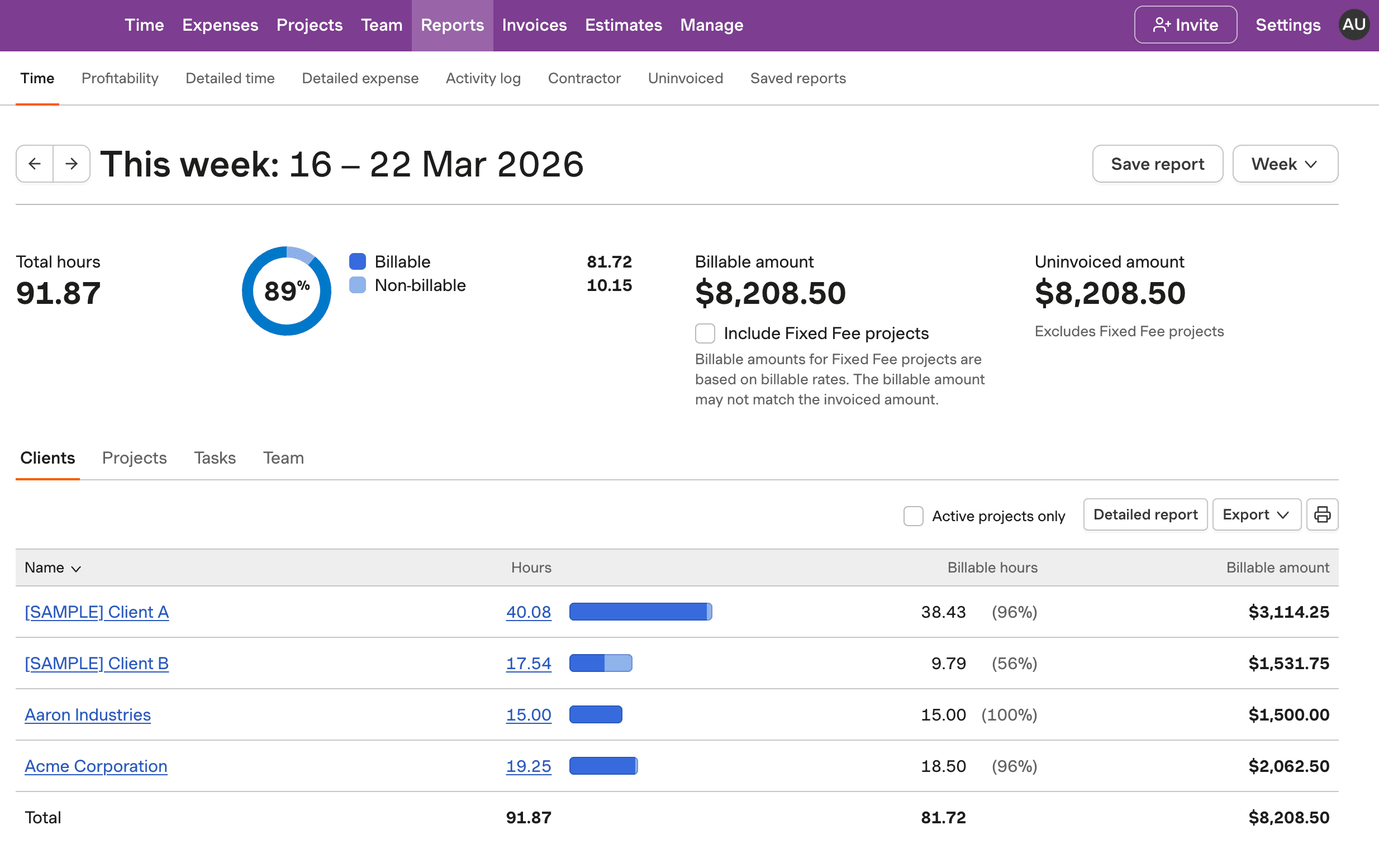
Billable Hours Report Template with Harvest

See how Harvest tracks billable hours accurately, ensuring no revenue is lost. Customize templates for precise invoicing.

Harvest Billable Hours Report Template screenshot for precise time tracking

Billable Hours Report Template FAQs

  • A billable hours report template should include fields for the date, client or project name, task description, start and end times, duration, hourly rate, and billable status. These elements ensure all necessary details are captured for accurate invoicing and client communication.

  • To track billable hours accurately, it's essential to log time in real-time. Harvest's one-click timers facilitate this, ensuring no billable hours are lost. Regularly review time entries to verify accuracy before invoicing.

  • Best practices include real-time tracking, detailed task descriptions, and regular reviews of time entries. It's also vital to distinguish between billable and non-billable tasks to optimize resource allocation and profitability.

  • The target for annual billable hours varies by profession. Lawyers typically aim for 1,700 to 2,200 hours, while other industries may have different benchmarks. Setting realistic targets based on industry standards is crucial for planning and evaluation.

  • Harvest provides tools for real-time time tracking and detailed reporting, ensuring accurate billing and maximizing revenue. It separates billable and non-billable hours, aiding in profitability analysis and efficient resource management.

  • Avoid inaccurate entries and inconsistent formats in your billable hours templates. Ensure all non-billable time is also accounted for and conduct regular reviews to maintain accuracy and reliability in your billing process.

  • Yes, timesheets are often required for compliance, payroll, and audits. They serve as legal documents to verify hours worked, especially in professions like law where precise billing is crucial.

  • Customize a billable hours template by adding fields specific to your business needs, such as client details, case numbers, or billing codes. Tailoring templates ensures they align with your operational and billing requirements.