
Harvest
Time Tracking
Sign up free

Billable Hours Template

Harvest simplifies time tracking and invoicing with one-click timers and detailed reporting, helping prevent up to 50% revenue loss from delayed tracking.

Try Harvest Free

What should you charge per hour?

Most freelancers and consultants dramatically undercharge. This calculator accounts for what most people miss: non-billable time, taxes, and overhead.

$
Accounting for vacation, holidays, sick days
60%
Most freelancers can bill 50-70% of their time. The rest goes to admin, marketing, proposals, and learning.
$
Software, insurance, equipment, accounting, taxes beyond income tax, etc.
Your break-even rate $0
Recommended rate (+20% buffer) $0
Billable hours per week 0h
Equivalent daily rate $0

Start tracking your billable hours

Walk through the entire flow below. Start a timer, check your reports, and create a real invoice — all in three clicks.

Go ahead — start tracking!

One click and you're timing. Try it right here: start a timer, add an entry, edit the details. This is exactly how it feels in Harvest.

  • One-click timer from browser, desktop & mobile
  • Works inside Jira, Asana, Trello, GitHub & 50+ tools
  • Duration or start/end — your call
  • Day, week & calendar views to stay on top of it all
  • Friendly reminders so no hour gets left behind
Acme Corp
Website Redesign
Homepage layout revisions
1:24:09
Content Strategy
Blog calendar planning
1:30:00
SEO Audit
Technical audit report
0:45:00
Brand Guidelines
Color system documentation
2:15:00
Logo Concepts
Initial sketches round 1
1:00:00

Understanding Billable Hours for Professional Services

Billable hours are the backbone of revenue generation for service-based businesses, such as law firms and consulting agencies. These hours represent the time spent directly on client projects, including client meetings, project work, and specialized research, that can be invoiced at an agreed hourly rate. Notably, in the legal industry, time is meticulously tracked in 6-minute increments to ensure precision and compliance. This practice helps avoid rounding errors and ensures clients are billed accurately.

Non-billable hours, on the other hand, include essential but non-revenue-generating tasks like administrative duties, internal meetings, and training. It's crucial for firms to differentiate between these two types of hours to maintain clear financial records and optimize profitability. For instance, while lawyers at large firms may have annual billable hour targets as high as 2,300 hours, small firms typically aim for around 1,700 hours. Understanding these distinctions helps set realistic targets and streamline operations.
Best Practices for Accurate and Ethical Time Tracking

Accurate time tracking is essential to avoid significant revenue loss and ensure compliance with ethical standards. Studies show that delaying time entry until the end of the day can result in a 10% loss of billable hours, escalating to 50% if postponed until the week's end. To combat this, logging time in real-time as tasks occur is recommended. This practice not only improves accuracy but also reduces the risk of client disputes over billing.

Another key practice is using consistent billing increments, such as 0.1-hour units, particularly in the legal field. Detailed descriptions of each task performed should accompany these entries, enhancing transparency and justifying charges. Implementing firm-wide guidelines and training staff on these protocols can standardize time tracking and reduce errors, ensuring ethical billing and compliance with regulations like the ABA Model Rule 1.5.

Leveraging Templates and Technology for Efficient Tracking

Templates offer a straightforward solution for organizing and tracking billable hours. An effective billable hours template should include fields for client/project name, task descriptions, start and end times, hourly rates, and automatic calculations to streamline the invoicing process. These templates are particularly useful for freelancers and small firms who may not require complex software solutions.

However, transitioning to automated time tracking solutions like Harvest can further enhance efficiency. Harvest allows users to track time with one-click start/stop timers, differentiate between billable and non-billable hours, and generate detailed reports. Its integrations with tools like Asana, Trello, and QuickBooks further simplify project management and billing. By adopting such technology, firms can reduce manual entry errors, improve accuracy, and ensure compliance with billing standards.

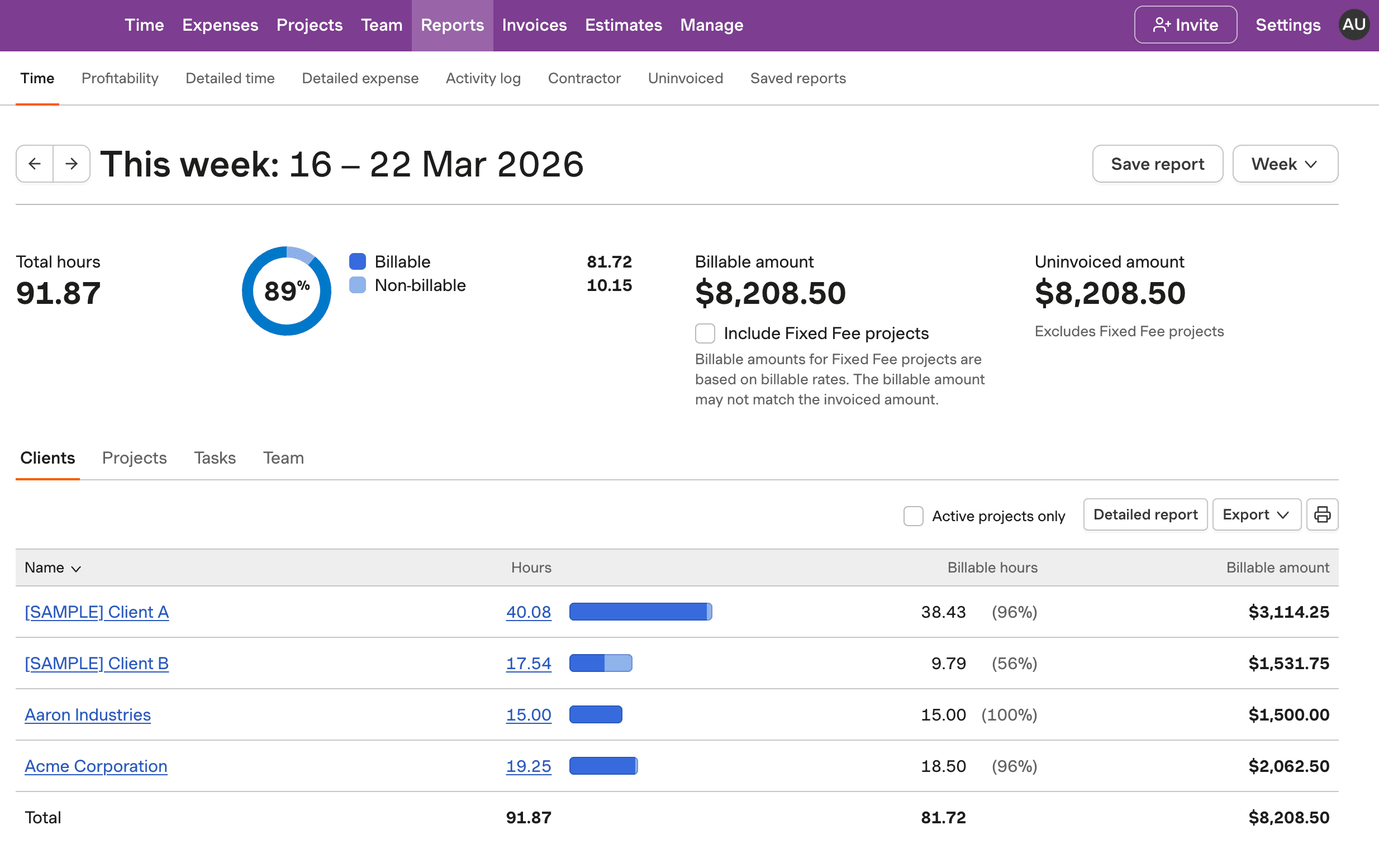
Track Billable Hours with Harvest

See how Harvest tracks and invoices billable hours with one-click timers and detailed reports, enhancing productivity and accuracy.

Harvest interface showing billable hours tracking features.

Billable Hours Template FAQs

  • Billable hours are the time spent on tasks that can be charged to a client, such as project work and client meetings. They are crucial for revenue generation in service-based industries.

  • Accurate tracking involves logging time in real-time, using consistent increments like 6-minute units, and providing detailed task descriptions. Tools like Harvest can automate this process.

  • Targets vary by industry and firm size. For instance, lawyers may aim for 1,700 to 2,300 hours annually. The goal is to balance profitability with workload management.

  • Harvest allows users to categorize each time entry, making it easy to distinguish between billable and non-billable hours, which is essential for accurate billing and profitability analysis.

  • A comprehensive template should include fields for client details, task descriptions, start and end times, hourly rates, and automatic calculation of totals to streamline invoicing.

  • Harvest integrates with popular tools like Asana, Trello, and QuickBooks, allowing seamless time tracking and invoicing alongside existing project management and accounting systems.

  • Yes, especially in regulated industries like law. Accurate timekeeping is crucial for compliance with rules such as the ABA Model Rule 1.5, which ensures reasonable billing practices.