
Harvest
Time Tracking
Sign up free

Calculate Billable vs Non Billable Hours

Harvest simplifies the process of calculating billable vs. non-billable hours, empowering teams to maximize profitability through precise time tracking and invoicing.

Try Harvest Free

How much revenue is your team leaving on the table?

Most agencies run at 55-60% utilization. Even a small improvement means significant revenue. See what closing the gap looks like for your team.

Number of people who track billable time
$
Blended rate across roles (junior, senior, lead)
55%
Percentage of total hours that are billable. Industry average is 55-60%.
75%
A realistic target for service businesses is 70-80%.
Monthly revenue gap $0
Revenue at current utilization $0/mo
Revenue at target utilization $0/mo
Extra billable hours needed per person/day 0h
Annual revenue opportunity $0

Start tracking team utilization

Walk through the entire flow below. Start a timer, check your reports, and create a real invoice — all in three clicks.

Go ahead — start tracking!

One click and you're timing. Try it right here: start a timer, add an entry, edit the details. This is exactly how it feels in Harvest.

  • One-click timer from browser, desktop & mobile
  • Works inside Jira, Asana, Trello, GitHub & 50+ tools
  • Duration or start/end — your call
  • Day, week & calendar views to stay on top of it all
  • Friendly reminders so no hour gets left behind
Acme Corp
Website Redesign
Homepage layout revisions
1:24:09
Content Strategy
Blog calendar planning
1:30:00
SEO Audit
Technical audit report
0:45:00
Brand Guidelines
Color system documentation
2:15:00
Logo Concepts
Initial sketches round 1
1:00:00

Understanding Billable vs. Non-Billable Hours

Billable hours are the cornerstone of revenue generation for businesses, particularly in professional services. These are the hours directly worked on client projects or tasks, such as meetings, planning, and creating deliverables, that can be invoiced to clients. On the other hand, non-billable hours are essential for business operations but cannot be directly charged to clients. They encompass activities like internal meetings, administrative tasks, and business development efforts. Accurately distinguishing these two types of hours is crucial for financial health and operational clarity, as excessive non-billable hours can erode profit margins.

In industries like law firms and consultancies, maintaining a high billable utilization rate is vital. For instance, law firms often target a utilization rate between 65% and 75%, while consulting firms aim for 75-85%. The difference between these and lower rates can significantly impact profitability. For example, improving a consultant's utilization from 65% to 75% at a $100/hour rate could add $20,800 in annual revenue per person. Therefore, understanding and managing these hours effectively is key to maximizing revenue.
Calculating Billable Utilization Rate Effectively

The Billable Utilization Rate is a critical metric for gauging efficiency and profitability in service-based industries. It is calculated by dividing billable hours by total available hours and multiplying by 100. For example, an employee working 40 hours a week with 28 billable hours achieves a 70% utilization rate. This rate not only reflects how much of the available time is revenue-generating but also highlights potential areas for efficiency improvements.

Industry benchmarks vary: top firms in professional services often hit 75-85%, while average firms might reach 60-70%. For law firms, a strong utilization rate can fall between 65% and 75%. Consistently monitoring these rates can help identify inefficiencies and improve resource allocation. Harvest provides the tools necessary for accurate time tracking, allowing businesses to calculate and optimize their utilization rates effectively.

Strategies to Track and Maximize Billable Hours

Effective time tracking is essential for maximizing billable hours and minimizing the impact of non-billable tasks. One strategy is to implement robust time tracking systems like Harvest, which allow for real-time entry and categorization of hours. This helps avoid the common pitfall of delayed time entry, which can lead to significant revenue loss – up to 50% if recorded at week's end.

Another approach is to regularly review time data to identify patterns and inefficiencies. For instance, analyzing non-billable hours can reveal profit drains and opportunities for optimization. Automating repetitive tasks and minimizing unnecessary meetings are practical steps to reduce non-billable time. Using Harvest, businesses can set clear expectations and targets, such as "no more than 1 hour per day on non-billable work" for client-facing roles, thereby focusing efforts on revenue-generating activities.

Leveraging Harvest for Accurate Time Tracking and Invoicing

Accurate time tracking and invoicing are pivotal for maintaining profitability and client trust. Harvest excels in this area by offering one-click timers and manual entries to accurately log both billable and non-billable hours. This ensures transparency in client invoicing and minimizes disputes. By setting project types, organizations can easily distinguish between billable and non-billable tasks, enhancing operational efficiency.

Detailed reporting features in Harvest enable businesses to leverage time tracking data for improved efficiency and billing accuracy. For example, law firms can track specific tasks like legal research and client meetings with defined billable rates, ensuring every hour is accounted for correctly. This detailed insight not only aids in accurate invoicing but also helps in making informed decisions about pricing, staffing, and workflow optimization.

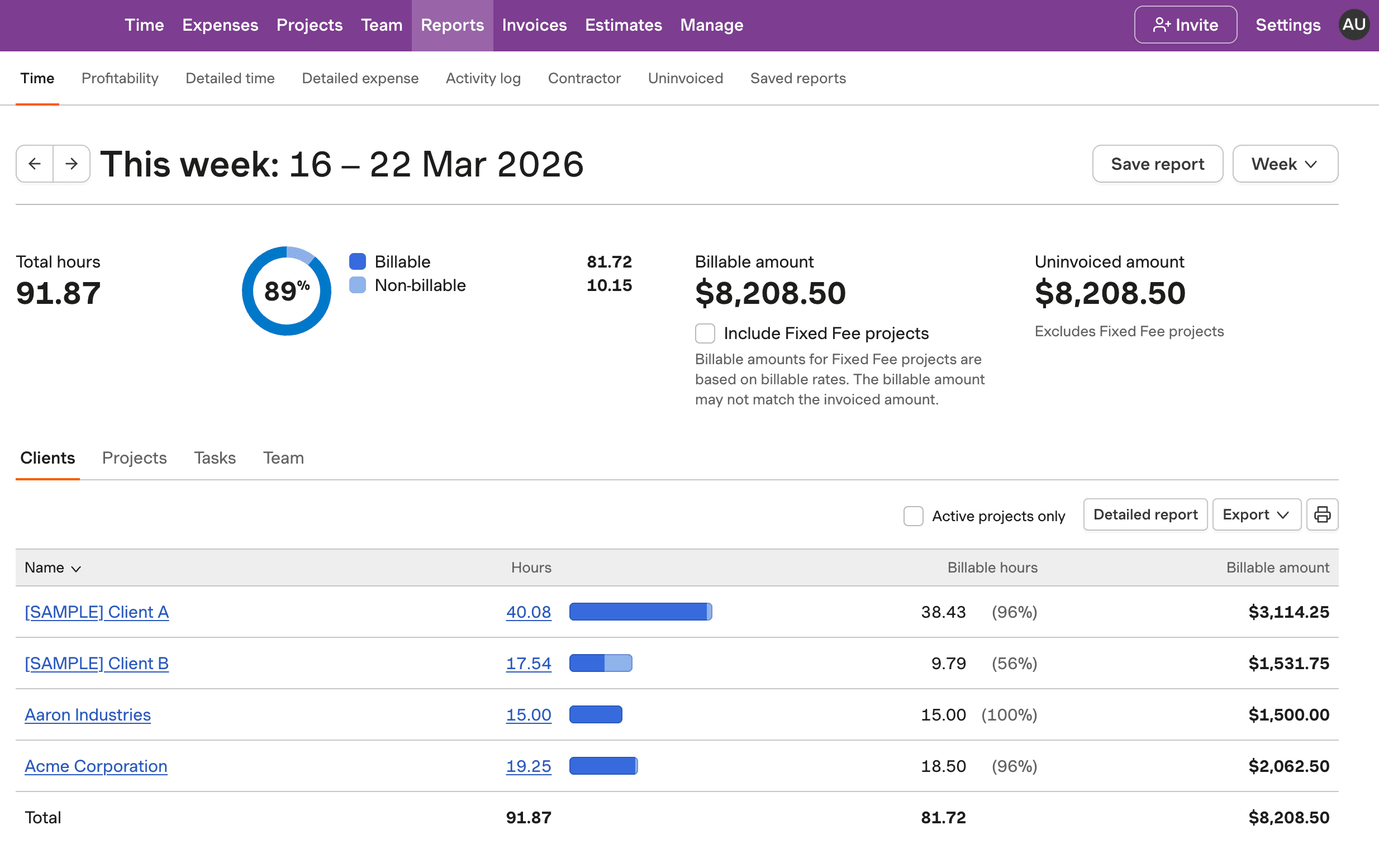
Calculate Billable vs Non Billable Hours with Harvest

See how Harvest helps you track and differentiate billable vs non-billable hours for better profitability.

Screenshot of Harvest calculating billable vs non-billable hours.

Calculate Billable vs Non Billable Hours FAQs

  • Billable hours are the time spent on client-specific tasks that can be invoiced, such as project work and client meetings. Non-billable hours, however, are spent on necessary internal activities that can't be directly charged to clients, like administrative work and training.

  • The billable utilization rate is calculated by dividing billable hours by total available hours, then multiplying by 100. For example, if 28 out of 40 weekly hours are billable, the utilization rate is 70%.

  • Tracking both types of hours is crucial for accurate client invoicing, improving profitability, and identifying inefficiencies. It helps in making data-driven decisions about pricing and resource allocation.

  • Harvest offers tools to log time, categorize hours as billable or non-billable, and generate detailed reports. This enhances billing accuracy and helps maximize revenue by keeping track of every billable hour.

  • Utilization benchmarks vary by industry: professional services often aim for 75-85%, law firms around 65-75%, and IT services at a 70% billable ratio. Reviewing your industry's standards can help set realistic targets.

  • Excessive non-billable hours reduce revenue potential and can lead to underpricing services. Managing these hours effectively is key to maintaining healthy profit margins.

  • Yes, Harvest can track both types of tasks by setting project types. This allows businesses to categorize and report time accurately, ensuring transparency and efficiency.