
Harvest
Time Tracking
Sign up free

Billable Hours vs Flat Fee

Navigating the debate of billable hours vs flat fees, Harvest offers flexible billing options tailored to your legal practice's needs, ensuring client satisfaction and administrative efficiency.

Try Harvest Free

What should you charge per hour?

Most freelancers and consultants dramatically undercharge. This calculator accounts for what most people miss: non-billable time, taxes, and overhead.

$
Accounting for vacation, holidays, sick days
60%
Most freelancers can bill 50-70% of their time. The rest goes to admin, marketing, proposals, and learning.
$
Software, insurance, equipment, accounting, taxes beyond income tax, etc.
Your break-even rate $0
Recommended rate (+20% buffer) $0
Billable hours per week 0h
Equivalent daily rate $0

Start tracking your billable hours

Walk through the entire flow below. Start a timer, check your reports, and create a real invoice — all in three clicks.

Go ahead — start tracking!

One click and you're timing. Try it right here: start a timer, add an entry, edit the details. This is exactly how it feels in Harvest.

  • One-click timer from browser, desktop & mobile
  • Works inside Jira, Asana, Trello, GitHub & 50+ tools
  • Duration or start/end — your call
  • Day, week & calendar views to stay on top of it all
  • Friendly reminders so no hour gets left behind
Acme Corp
Website Redesign
Homepage layout revisions
1:24:09
Content Strategy
Blog calendar planning
1:30:00
SEO Audit
Technical audit report
0:45:00
Brand Guidelines
Color system documentation
2:15:00
Logo Concepts
Initial sketches round 1
1:00:00

Understanding Billable Hours vs. Flat Fees

The legal industry often grapples with the decision between billable hours and flat fee billing, each offering distinct advantages. Billable hours have long been the foundation of law firm economics, with most firms handling over 75% of their work this way. However, the trend towards flat fees is increasing due to client demand for predictability. In fact, nearly 71% of clients prefer flat fees for complete cases, providing a stable budget and reducing anxiety over escalating costs.

While billable hours offer flexibility for complex, unpredictable cases, they can lead to inefficiencies as longer cases generate more revenue. On the other hand, flat fees incentivize efficiency, as the fee remains constant regardless of time spent. This model is particularly effective for routine legal matters with a well-defined scope, such as contract reviews or LLC formations. By offering both models, firms can tailor their approach to the specifics of each case and client preference.
The Pros and Cons of Billable Hours

Billable hours remain popular due to their flexibility and direct alignment with revenue. Lawyers can adjust their efforts based on case complexity, ensuring resources are allocated appropriately. However, this model often results in client dissatisfaction due to cost uncertainty. Clients can experience "sticker shock" when presented with unexpectedly high bills, despite the transparency provided by detailed hourly records.

The pressure to meet high billable hour targets—often 1,800 to 2,200 annually—can lead to burnout among attorneys, impacting firm culture and productivity. Additionally, with average realization rates around 88% and collection rates at 91%, firms leave about 21% of potential revenue uncollected. Harvest addresses these issues by providing precise time tracking tools that enhance billing accuracy and reduce disputes.

Embracing Flat Fees in Legal Practices

Flat fee billing is gaining traction as it offers clients cost certainty and firms a chance to streamline operations. This model is preferred for routine legal tasks where the scope is clear, such as drafting simple wills or handling uncontested divorces. By analyzing historical data and market rates, firms can set competitive and profitable flat fees, avoiding the risk of underpricing or scope creep.

However, challenges arise when estimating scope for flat fee arrangements, particularly in unpredictable matters. Harvest's fixed fee projects, which include hypothetical hourly billing analysis, help firms navigate these challenges by providing detailed insights and cost estimates. This approach not only enhances client trust but also aligns with modern demands for transparency and value-based pricing.

Hybrid Billing Models: The Best of Both Worlds

The future of legal billing may lie in hybrid models, combining the strengths of both billable hours and flat fees. This approach allows firms to employ flat fees for predictable tasks and hourly billing for complex, unpredictable cases, optimizing client service and profitability. With the rise of technology and AI, firms are increasingly exploring value-based pricing, as up to 74% of billable work can be automated, reducing drafting time by 70%.

Harvest supports hybrid billing by allowing legal services to offer both hourly and fixed fee options, adapting to various client needs and case complexities. This flexibility enhances client satisfaction and retention by aligning billing practices with clients' budgetary expectations, providing a competitive edge in a shifting legal landscape.

Choosing the Right Billing Model for Your Firm

Selecting an appropriate billing model involves assessing case complexity, client preferences, and firm capabilities. For instance, high-stakes litigation may warrant hourly billing, while straightforward transactions might be better served with flat fees. Regional variations also play a role, as hourly rates can significantly differ, from $462 per hour in Washington, D.C., to $195 in West Virginia.

Harvest offers the tools to manage these diverse billing needs, streamlining processes with detailed reports and project management features. Whether opting for value-based pricing or maintaining traditional hourly rates, Harvest ensures firms can meet ethical guidelines, achieve efficiency, and enhance client satisfaction.

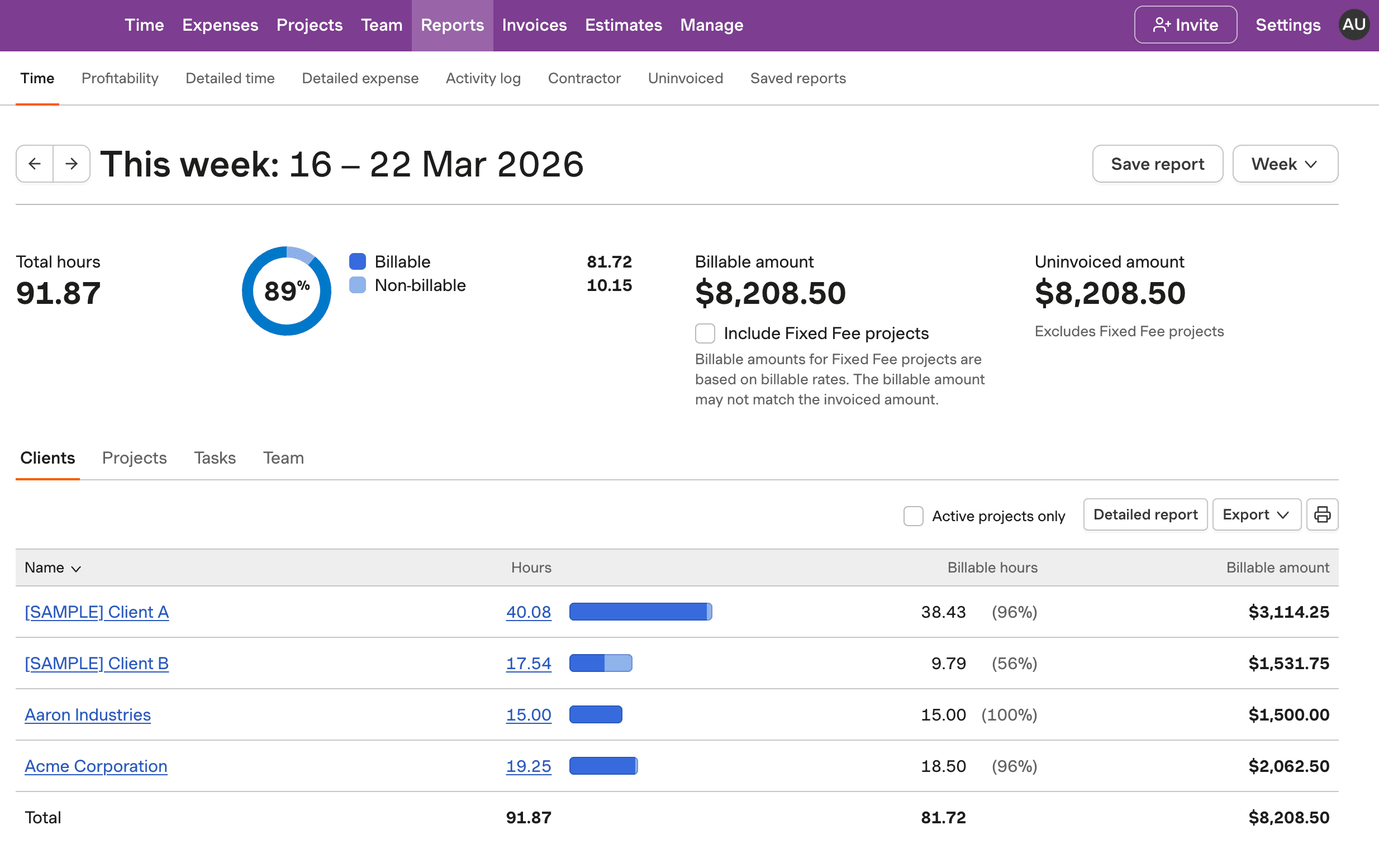
Billable Hours vs Flat Fee with Harvest

See how Harvest supports flexible billing options, including billable hours and flat fees, to meet diverse legal practice needs.

Harvest screenshot showing billable hours vs flat fee comparison.

Billable Hours vs Flat Fee FAQs

  • Billable hours charge clients based on the time spent on their case, providing flexibility for complex tasks. Flat fees offer a set price for a complete service, preferred for predictable tasks, reducing client anxiety over costs.

  • Clients favor flat fees for the predictability and transparency they offer. About 71% of clients prefer flat fees as they provide budget certainty and minimize the risk of unexpected expenses.

  • Harvest supports flat fee billing by allowing law firms to set fixed prices for predictable tasks. This feature helps offer budget certainty to clients, enhancing satisfaction and trust.

  • Hourly billing offers flexibility for cases where the scope and complexity can change. It allows firms to adjust efforts based on case demands, ensuring resources align with client needs.

  • Yes, Harvest supports hybrid billing models, combining fixed fees and hourly rates. This flexibility allows law firms to tailor billing practices to diverse client needs and case complexities.

  • Technology, especially AI, is revolutionizing billing by automating up to 74% of billable work, pushing firms towards value-based pricing models and away from traditional hourly billing.

  • Harvest enhances administrative efficiency with detailed time tracking, invoicing, and reporting features, streamlining billing processes for legal practices.