
Harvest
Time Tracking
Sign up free

Calculate Effective Billing Rate

Harvest helps you calculate your effective billing rate accurately, addressing common financial management challenges in professional services.

Try Harvest Free

What should you charge per hour?

Most freelancers and consultants dramatically undercharge. This calculator accounts for what most people miss: non-billable time, taxes, and overhead.

$
Accounting for vacation, holidays, sick days
60%
Most freelancers can bill 50-70% of their time. The rest goes to admin, marketing, proposals, and learning.
$
Software, insurance, equipment, accounting, taxes beyond income tax, etc.
Your break-even rate $0
Recommended rate (+20% buffer) $0
Billable hours per week 0h
Equivalent daily rate $0

Start tracking your billable hours

Walk through the entire flow below. Start a timer, check your reports, and create a real invoice — all in three clicks.

Go ahead — start tracking!

One click and you're timing. Try it right here: start a timer, add an entry, edit the details. This is exactly how it feels in Harvest.

  • One-click timer from browser, desktop & mobile
  • Works inside Jira, Asana, Trello, GitHub & 50+ tools
  • Duration or start/end — your call
  • Day, week & calendar views to stay on top of it all
  • Friendly reminders so no hour gets left behind
Acme Corp
Website Redesign
Homepage layout revisions
1:24:09
Content Strategy
Blog calendar planning
1:30:00
SEO Audit
Technical audit report
0:45:00
Brand Guidelines
Color system documentation
2:15:00
Logo Concepts
Initial sketches round 1
1:00:00

Understanding and Calculating Effective Billing Rate

The effective billing rate (EBR) is a vital financial metric used in professional services to evaluate billing efficiency and resource utilization. It is calculated by dividing the total revenue generated from billable hours by the total number of billable hours. This metric allows businesses to assess how effectively they convert time into revenue, which is crucial for optimizing pricing strategies and improving profitability.

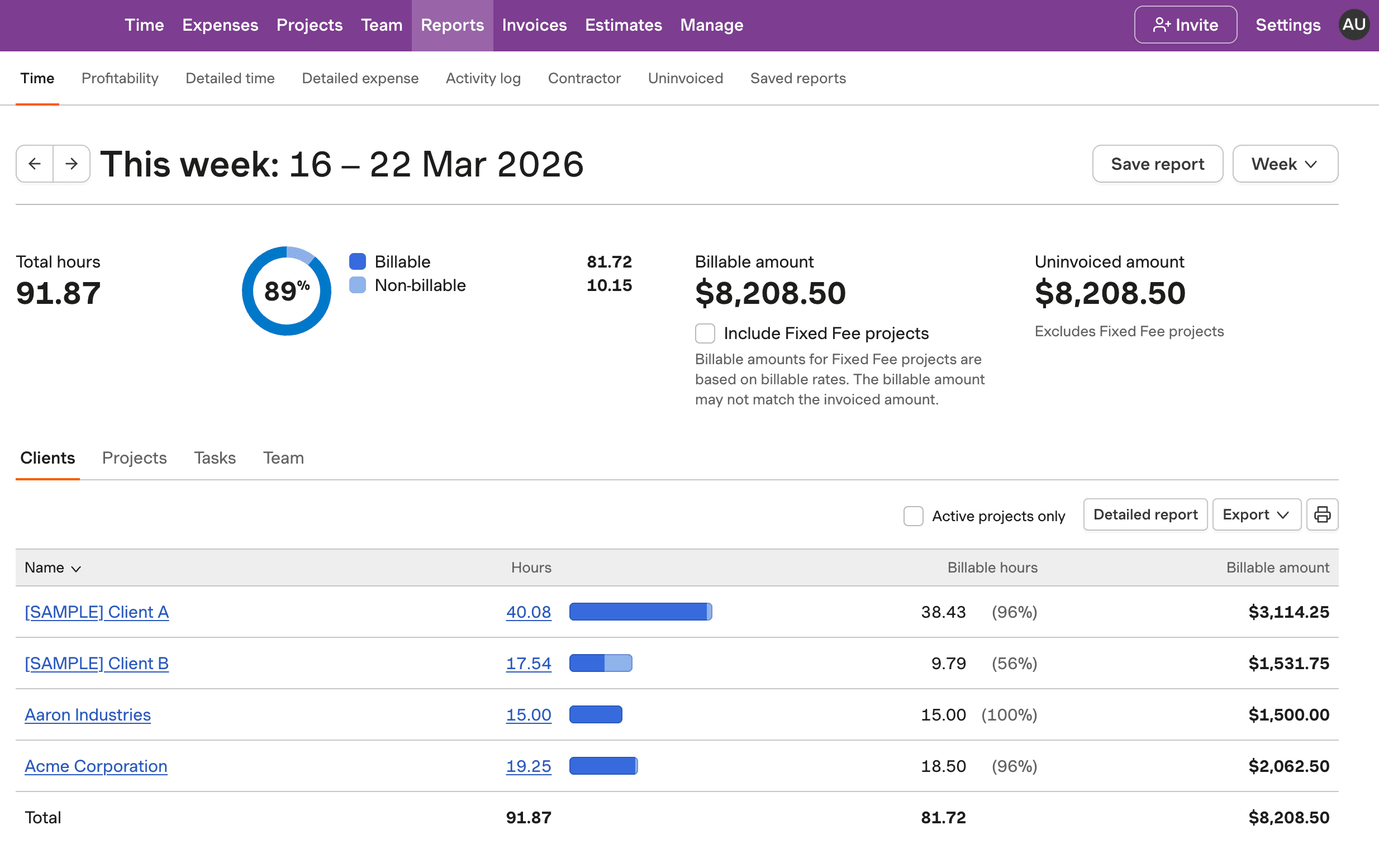
In practical terms, understanding your EBR involves analyzing both billable and non-billable hours to ensure accurate financial reporting. For instance, if a consultant generates $10,000 from 100 billable hours, their EBR is $100 per hour. However, if they worked 150 total hours, including non-billable time, the actual efficiency of their billing efforts might be lower, making it crucial to manage non-billable activities effectively. Harvest offers tools to track billable versus non-billable hours, ensuring precise EBR calculations and enhanced project management.
Factors Influencing Your Effective Billing Rate

Several factors influence the effective billing rate, including the nature of services, client demands, and internal cost structures. Understanding these elements is essential for setting competitive rates while maintaining profitability. For example, industries like consulting often experience variations in EBR due to fluctuating demand and project complexity, necessitating a flexible approach to rate setting.

Harvest aids in managing these complexities by allowing users to set flexible billing strategies, accommodating various project types and client-specific rates. This adaptability enables businesses to adjust their pricing models in response to market conditions or client requirements, ensuring that the EBR remains aligned with financial goals. By leveraging Harvest's detailed reporting capabilities, businesses can also identify trends in billable hours and adjust their strategies accordingly, enhancing overall efficiency and profitability.

Enhancing Profitability Through EBR Management

Improving profitability often hinges on optimizing the effective billing rate. Companies can achieve this by enhancing their use of billable hours and minimizing non-billable time. For instance, reducing non-billable activities by just 5% can lead to a significant increase in revenue, potentially improving EBR by up to 10%.

Harvest provides comprehensive project analysis tools that help businesses evaluate project profitability through effective billing rate calculations. By offering insights into time tracking and project costs, Harvest enables businesses to identify areas for improvement, ensuring that they capitalize on every billable hour. Additionally, Harvest's integration with platforms like Asana and Trello streamlines workflow management, further supporting efforts to maximize the effective billing rate.

Strategies for Calculating and Adjusting Your Billing Rate

Calculating a precise billing rate requires a thorough understanding of both internal and external factors affecting your business. Initially, calculate the minimum viable rate to cover all operational costs, then consider external market rates to ensure competitiveness. Adjusting billing rates based on project type, client needs, and employee roles can significantly impact profitability.

Harvest supports these strategies by enabling businesses to set tailored billing rates per project and employee. This feature ensures that each project's unique characteristics are reflected in the pricing model, optimizing both revenue and client satisfaction. By leveraging Harvest's detailed reports, businesses can continuously assess and adjust their billing strategies, keeping their EBR in line with industry standards and organizational goals.

Calculate Effective Billing Rate with Harvest

See how Harvest helps you calculate effective billing rates for better financial management. Track billable hours and set optimal rates.

Harvest's tool for calculating effective billing rate with precise tracking.

Calculate Effective Billing Rate FAQs

  • An effective billing rate (EBR) is the average rate at which a company bills its services per billable hour. It is calculated by dividing total revenue from billable hours by the total billable hours worked.

  • To calculate your effective billing rate, divide your total revenue from billable hours by the total number of billable hours. This will give you the average rate per hour that you effectively earn.

  • Improving your effective billing rate involves maximizing billable hours and minimizing non-billable activities. Using tools like Harvest to track time accurately can significantly enhance your EBR.

  • Consider the nature of your services, client demands, market rates, and internal costs. Using Harvest, you can set flexible billing strategies that reflect these factors for optimal rates.

  • Billable hours are those you charge clients for, while non-billable hours are spent on activities that are not directly charged. Harvest helps track both, ensuring precise billing rate calculations.

  • Harvest provides tools to track billable and non-billable hours, allowing accurate calculation of the effective billing rate. It also supports flexible billing strategies for different project types.

  • Yes, Harvest allows users to set different billing rates per project and client, ensuring that your pricing model accurately reflects project and client-specific requirements.