
Harvest
Time Tracking
Sign up free

How to Track Utilization Rate

Harvest simplifies tracking and optimizing utilization rates, helping businesses improve profitability by up to 25%.

Try Harvest Free

How much revenue is your team leaving on the table?

Most agencies run at 55-60% utilization. Even a small improvement means significant revenue. See what closing the gap looks like for your team.

Number of people who track billable time
$
Blended rate across roles (junior, senior, lead)
55%
Percentage of total hours that are billable. Industry average is 55-60%.
75%
A realistic target for service businesses is 70-80%.
Monthly revenue gap $0
Revenue at current utilization $0/mo
Revenue at target utilization $0/mo
Extra billable hours needed per person/day 0h
Annual revenue opportunity $0

Start tracking team utilization

Walk through the entire flow below. Start a timer, check your reports, and create a real invoice — all in three clicks.

Go ahead — start tracking!

One click and you're timing. Try it right here: start a timer, add an entry, edit the details. This is exactly how it feels in Harvest.

  • One-click timer from browser, desktop & mobile
  • Works inside Jira, Asana, Trello, GitHub & 50+ tools
  • Duration or start/end — your call
  • Day, week & calendar views to stay on top of it all
  • Friendly reminders so no hour gets left behind
Acme Corp
Website Redesign
Homepage layout revisions
1:24:09
Content Strategy
Blog calendar planning
1:30:00
SEO Audit
Technical audit report
0:45:00
Brand Guidelines
Color system documentation
2:15:00
Logo Concepts
Initial sketches round 1
1:00:00

Understanding Utilization Rate and Its Importance

The utilization rate is a critical metric that indicates the percentage of available time a resource, such as an employee or team, spends on productive tasks. Typically, for employees, this focuses on billable hours, highlighting how efficiently time is utilized to generate revenue. The formula to calculate utilization rate is straightforward: (Total billable hours / Total available hours) x 100. This measure is essential because it directly impacts project profitability and overall business health. Companies tracking this metric can experience a 15-25% improvement in project profitability, as even slight increases in billable utilization can significantly boost revenue.

Understanding and monitoring utilization rates are crucial for effective resource management. A well-managed utilization rate ensures that employees are neither overworked, leading to burnout, nor underutilized, which can result in lost revenue potential. For instance, a utilization rate below 60% is often a red flag for lost revenue opportunities in agencies and consultancies.
Challenges in Tracking Utilization Rates

Tracking utilization rates accurately can pose several challenges. Common issues include distinguishing between billable and non-billable time, managing fluctuating workloads, and accounting for non-productive activities like meetings or training. Non-billable activities are inevitable and necessary, with the average knowledge worker spending around 60% of their time on administrative tasks or "work about work." This necessitates a balanced approach to ensure neither productivity nor employee morale is compromised.

Utilization rates should be monitored regularly, typically on a weekly or monthly basis, to identify trends and make timely adjustments. Advanced tracking tools like Harvest can simplify this process by providing detailed reports on both billable and non-billable hours, aiding in the analysis of team productivity and workload balance.

Optimizing Utilization Rates with Harvest

Harvest offers comprehensive tools to help optimize utilization rates, ensuring teams maintain a healthy balance between billable and non-billable work. With detailed reporting capabilities, Harvest enables businesses to track utilization rates accurately across different job roles, providing insights that can inform strategic decisions. For example, firms in the Architecture & Engineering sector often aim for a utilization rate of 75-85% for billable team members, while project managers might target an average of 88%.

By leveraging Harvest's team utilization reports, businesses can effectively forecast staffing needs and budget allocations. This proactive approach not only enhances productivity but also aligns resources with organizational goals, contributing to improved profitability. Harvest's integration capabilities with platforms like Asana and Trello further streamline the process, ensuring seamless workflow management.

Best Practices for Improving Utilization Rates

To improve utilization rates, companies should adopt structured workflows and regularly analyze performance metrics. Start by defining work categories clearly, distinguishing between billable and non-billable tasks. Understanding the ideal utilization target is key; for most industries, a rate between 70-90% is optimal, though this can vary by role and sector. For instance, technology and software development sectors might aim for a lower range of 60-75%.

Regularly review and adjust workloads based on utilization data. Tools like Harvest provide the necessary insights to make informed decisions about resource allocation and workload balancing. Additionally, fostering an environment where non-billable activities such as training and professional development are valued can prevent employee burnout, ensuring sustainability and long-term success.

Optimize Utilization with Harvest

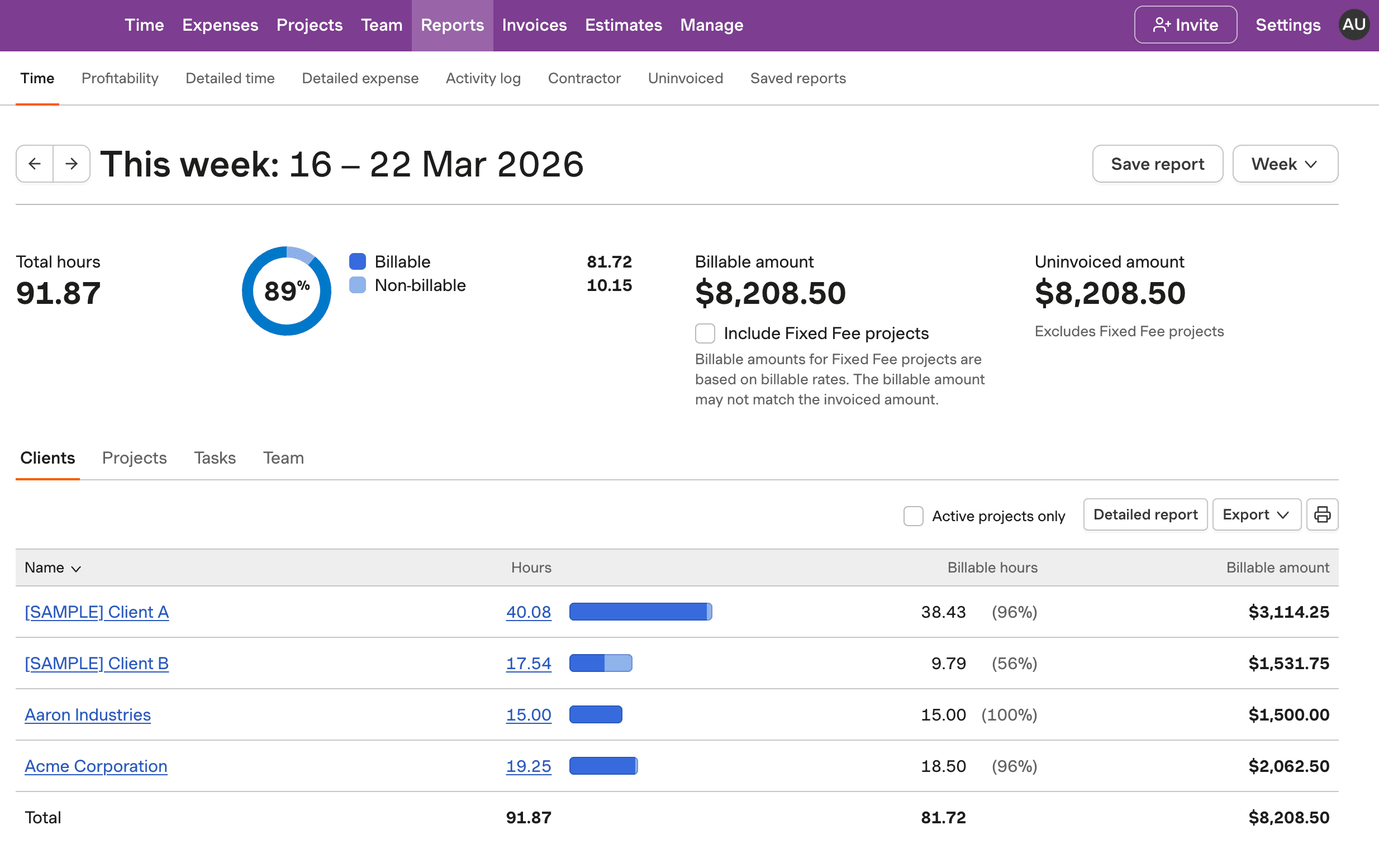
See how Harvest tracks utilization rates, offering insights to enhance productivity and profitability. Try Harvest for detailed analysis.

Screenshot of Harvest tracking utilization rates

How to Track Utilization Rate FAQs

  • The formula for calculating utilization rate is (Actual time worked / Total available time) x 100. For employees, it often focuses on billable hours, using the formula (Total billable hours / Total hours available) x 100.

  • Utilization rates can be effectively tracked using tools like Harvest, which offers detailed reports on billable and non-billable hours. Regular monitoring, typically weekly or monthly, can help identify trends and adjust workloads accordingly.

  • A good utilization rate typically falls between 70% and 90%, depending on the industry and specific roles. Consistently achieving 100% utilization is generally not sustainable, as it can lead to burnout.

  • Tracking utilization rates is crucial for resource management and profitability. Companies that track this metric often see a 15-25% improvement in project profitability, as it helps optimize productivity and resource allocation.

  • Harvest provides detailed reports on team utilization, allowing businesses to analyze and optimize productivity across different roles. Its tracking capabilities help balance billable and non-billable work, preventing burnout and improving profitability.

  • While theoretically possible, a utilization rate above 100% often indicates overwork and potential burnout. It's crucial to maintain a sustainable workload to ensure quality and employee well-being.

  • Utilization rates should be monitored on a weekly or monthly basis to identify trends and make timely adjustments to workloads, pricing, or resource allocation.

  • Tools like Harvest are ideal for tracking utilization rates, offering integrations with platforms like Asana and Trello, and providing detailed reports on billable and non-billable hours.